




Pennsylvania Bill Targets Online Poker Bonuses, Rewards and Player Limits

- Pennsylvania Reps. Tarik Khan and Jamie Flick filed HB 2879 on Oct. 21, 2026. It is a bill, not law.
- As written, it would set fixed loss caps, ban loyalty programs and bar sign-up and deposit incentives on online accounts.
- Other provisions include a two-deposit daily cap, a two-hour ceiling on signed-in time and ACH, wire or check funding only.
- The House has two session days left in 2026, so the bill faces a very short calendar.
Pennsylvania online poker players could lose loyalty rewards and welcome bonuses and face new limits on deposits, losses and playing time under a proposed bill. Reps. Tarik Khan (D) and Jamie Flick (R) introduced HB 2879 on Oct. 21, 2026. The bill would apply to all online gambling accounts in the state, including poker.
HB 2879 was sent to the House Gaming Oversight Committee the same day. Nothing changes for Pennsylvania poker players yet. If passed, the new rules would take effect 60 days after becoming law.
What HB 2879 Would Require on Every Online Account
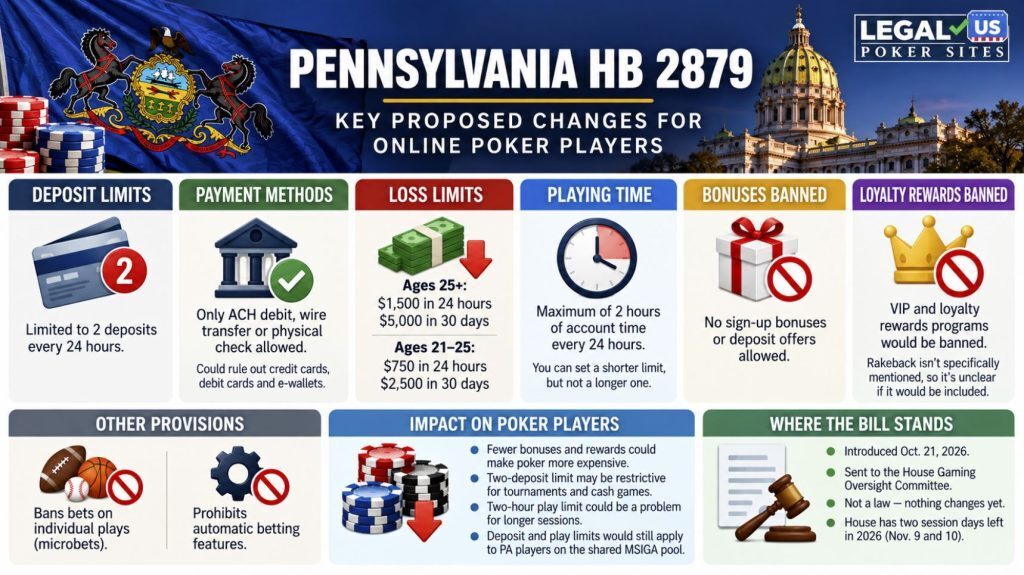
If passed, HB 2879 would:
- Limit players to two deposits every 24 hours
- Require an affordability check for deposits over $5,000 within 180 days
- Allow payments only through ACH debit, wire transfer or physical check
- Set strict loss limits and require players to set their own limits
- Limit players to two hours of account time every 24 hours
- Ban VIP and loyalty rewards programs
- Ban sign-up bonuses and deposit offers
The bill would also ban bets on individual plays during sporting events, known as microbets, and automatic betting features. These changes would mainly affect sports betting and online slots.
Loyalty Rewards, Rakeback and Welcome Bonuses
The bill would ban loyalty programs that reward players for gambling more or making larger deposits. It doesn’t specifically mention rakeback or make an exception for poker.
Rakeback gives players back part of the fees they pay to a poker site. Since players can earn more rakeback by playing more, these rewards could fall under the ban. The Pennsylvania Gaming Control Board (PGCB) or the courts would need to clarify whether rakeback is included.
Losing rakeback could make poker more expensive, especially for regular players who play multiple tables at once. The bill would also ban bonuses for opening an account or making deposits. That could mean the end of welcome bonuses and deposit-match offers at Pennsylvania poker sites.
Deposit Caps, Payment Limits and Fixed Loss Caps
The two-deposit limit could be frustrating for poker players. For example, someone who deposits for a tournament, loses and then adds more money for cash games would have already used both deposits for the day.
Depending on how the rules are applied, the payment restrictions could also rule out credit cards, debit cards and e-wallets.
Players would also face fixed loss limits on top of the daily and monthly limits they must set themselves:
- Players 25 and older: $1,500 in 24 hours or $5,000 in 30 days
- Players ages 21 to 25: $750 in 24 hours or $2,500 in 30 days
The bill includes age 25 in both groups, so it’s unclear which limits would apply to those players.
The bill would also limit players to two hours of signed-in time every 24 hours. Players could choose a shorter limit, but not a longer one. They’d also have to wait 72 hours before increasing their limit. This could be a major issue for poker players, since tournaments can last much longer than two hours.
How HB 2879 Differs From the PGCB’s Proposed Limits Rule
The PGCB is also working on new gambling limits. The proposed rules were published July 11, 2026, and the public comment period ended Aug. 10. A final version hasn’t been submitted yet.
The main difference is that the PGCB’s proposal would require poker sites to offer limits that players can choose for themselves. HB 2879 would make certain limits mandatory for everyone.
What It Could Mean for the Shared MSIGA Poker Pool
Pennsylvania shares its online poker player pool with other states through MSIGA. However, HB 2879’s proposed limits would still apply to Pennsylvania players. Our guide to MSIGA online poker states explains how shared player pools work.
If the bill passes, Pennsylvania players could spend less time at shared poker tables because of the deposit and playing time limits. That could also affect the number of players available for cash games and tournaments.
Online poker already makes up a small part of Pennsylvania’s gambling market. The PGCB’s September 2026 report shows poker brought in $2.27 million, down 1.76% from the previous year, compared to $197.37 million from online slots.
Why HB 2879 Faces a Short Calendar
The Pennsylvania House calendar lists Nov. 9 and 10 as the final session days of 2026. Any bill that doesn’t pass before the legislative session ends on Nov. 30 would need to be introduced again next year. With HB 2879 still in committee, there’s little time left for lawmakers to act.
The bill currently has nine Democratic sponsors and one Republican, Jamie Flick, according to LegiScan.
On the day the bill was introduced, lawmakers also launched a bipartisan Problem Gambling Caucus. Khan and Flick joined the group, while Sen. Joe Picozzi leads the Senate side.
Where the Bill Came From
The bill follows a Pennsylvania gambling study ordered by lawmakers in 2025. The report, published in July 2026, examined ways to reduce gambling harm, including restrictions on microbets and VIP rewards programs.
Khan and Flick first announced their plans in June 2026. The bill points to research showing that just 5.7% of online sports bettors accounted for 80% of betting spending. At one sportsbook, VIP customers made up only about 0.5% of players but generated more than 70% of revenue in 2019–2020.
Khan said the study revealed gambling companies “using predatory practices to keep people betting, even as they’re losing everything.”
Not everyone agrees with the proposed restrictions. Joe Maloney, president of the Sports Betting Alliance, compared VIP rewards to loyalty programs offered by Starbucks and T-Mobile. He also argued that players can easily opt out of these programs.
Meanwhile, around six former FanDuel and DraftKings customers have filed lawsuits in Philadelphia, according to the Philadelphia Inquirer. They accuse the companies of using personalized algorithms and loyalty programs to encourage gambling. Both companies have disputed those claims.
What’s Next for Pennsylvania Online Poker Players?
HB 2879 remains in committee, and Pennsylvania poker players won’t see any changes unless it becomes law. For now, the PGCB’s proposed gambling limits are further along in the process.
If similar restrictions eventually become law, players could face changes to rakeback, welcome bonuses, deposits and playing time.



Comments