




WSOP High Roller Guide: Event Structures and Payouts Explained

WSOP high roller events are the top tier of live tournament poker. Buy-ins are higher, stacks are deeper, fields are smaller, and prize pools can pass $17 million in a single event. If you haven’t played one, the structure sheets and payout tables can look confusing fast.
This guide breaks it down in plain terms: starting stacks, blind levels, re-entry rules, prize pools, and how payouts work from the bubble to first place. By the end, you’ll know exactly what you’re getting into at each level.WSOP high roller events are the top tier of live tournament poker. If you’re looking for a broader breakdown of the series, including the Main Event, see our full WSOP Main Event guide.
What Qualifies as a WSOP High Roller Event?
The WSOP uses the term “high roller” for events with a $25,000 buy-in or higher. Not $5,000, which is a common mistake. That range runs from $25,000 No Limit Hold’em events up to the $250,000 Super High Roller. A $5,000 freeze-out is still a big event, but it’s not labeled as a high roller by the WSOP. The buy-in tells you a lot about field size, player quality, and the likely prize pool. Here is how the tiers break down in practice, based on recent WSOP results:
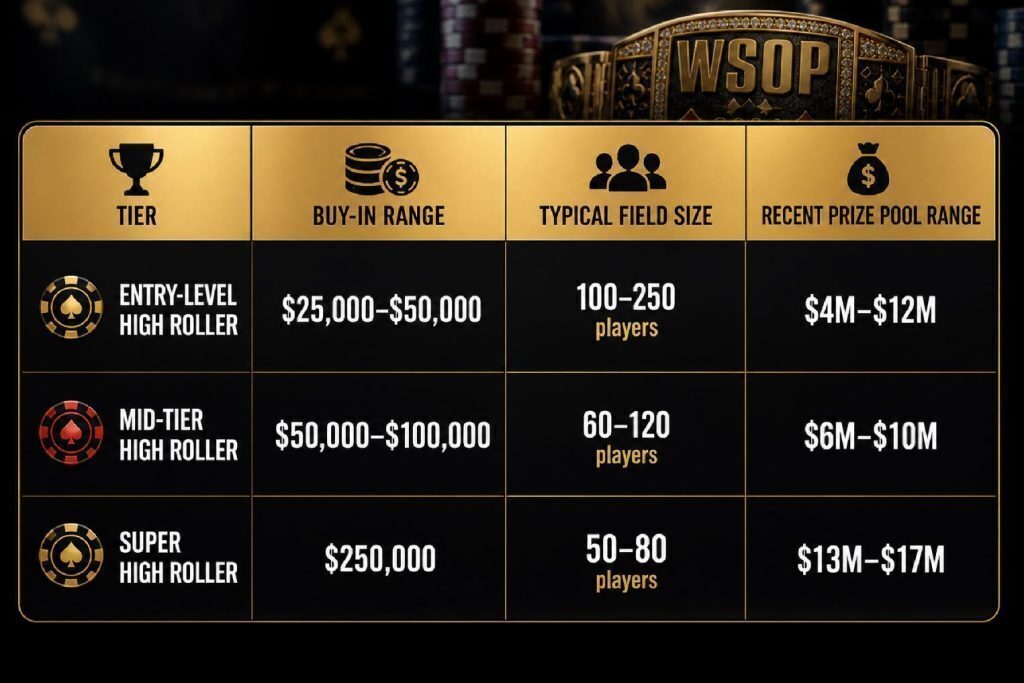
At the entry-level tier, you get a mix of well-funded recreational players and mid-stakes pros. Move up to $100,000 and higher, and the field gets smaller and tougher. The $250,000 Super High Roller is a different level. The field is small, and almost every player is a known high-stakes regular.
Starting Stacks Across WSOP High Roller Events
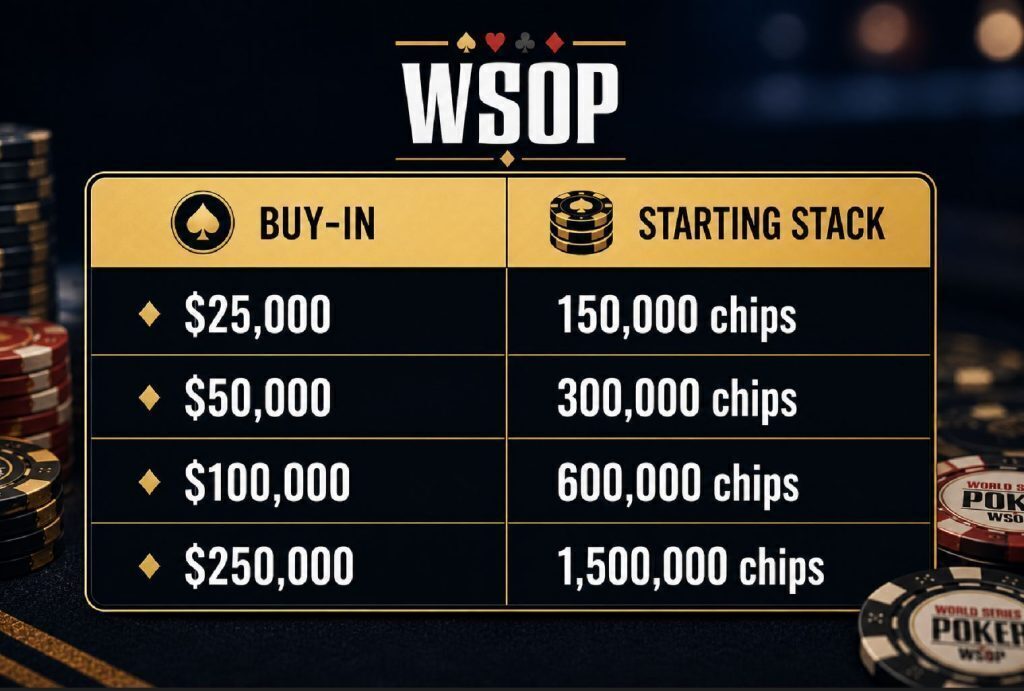
Starting stacks scale with the buy-in in WSOP high roller events. Bigger buy-ins come with deeper stacks.
The stack-to-blind ratio is the key concept here. It shows how many big blinds you start with. In high roller events, that number is intentionally high. In the 2023 $250,000 Super High Roller (Event #40), the opening level was 2,000/4,000 with a 4,000 big blind ante. That gave players 375 big blinds to start.
A deeper ratio means more decisions each hand, more room to play after the flop, and less need to go all-in early. This is by design. It gives top players more time and space to outplay each other over multiple days.
Here are the standard starting stacks across the high roller tiers:
Blind Level Structures and Antes in WSOP High Rollers
Blind levels in WSOP high roller events move slower than in standard tournaments, and the ante format is different.
The big blind ante is standard. Instead of every player posting an ante, the big blind posts one ante equal to the big blind. At 400,000/800,000, the ante is 800,000 from the big blind.
Level length depends on the event:
- $25,000 and $50,000 NLH: 40-minute levels on Day 1, then 60 minutes
- $100,000 and $250,000 NLH: 60-minute levels throughout
- High roller PLO: 40-minute levels throughout
Total Tournament Duration: How Long Do High Rollers Run?
Most WSOP high roller events run three to four days. $25,000 events usually go four days. $50,000 and $100,000 events often wrap in three to four. The $250,000 Super High Roller runs three straight days.
Longer levels mean fewer levels per day, but more hands in each one. Over three days in a $100,000 event, you can play as many or more hands than in four days of a $1,500. Re-entry also plays a role. Late registration stays open longer, which can stretch Day 1 and leave the field size less clear going into Day 2.
Re-Entry Rules and How They Shape the Field
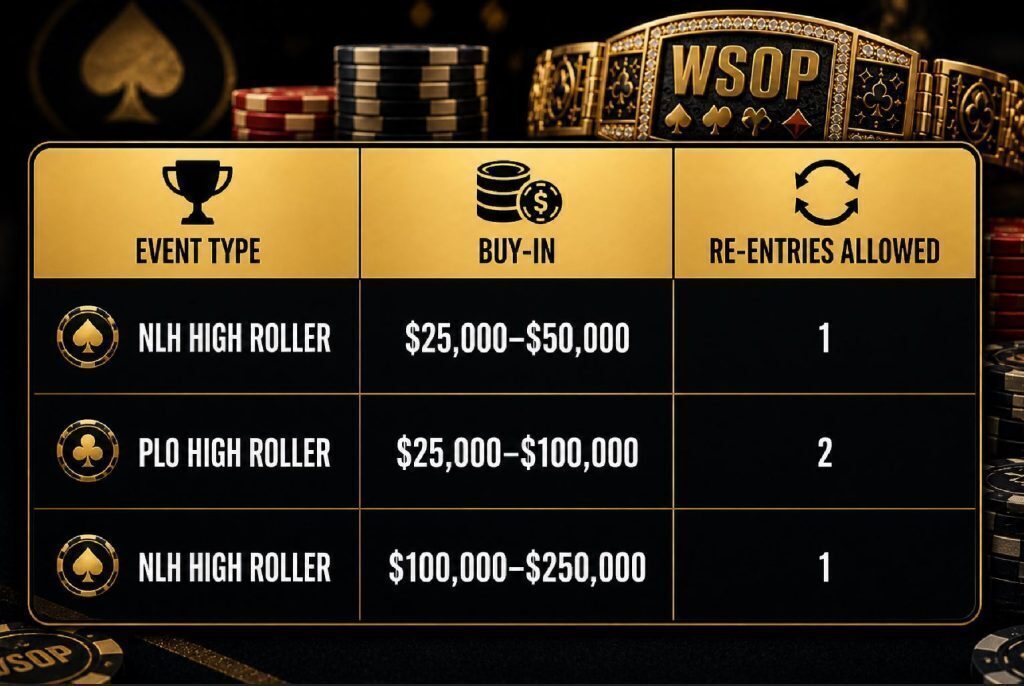
Re-entry rules matter because they affect both cost and prize pool size. The caps are consistent by format, as shown below.
There are no unlimited rebuys in WSOP bracelet events. Every entry is a full buy-in for a fresh stack, and each re-entry adds directly to the prize pool. That is why PLO high rollers can produce larger prize pools than their field size suggests.
Prize Pools and How Payouts Are Calculated
The prize pool formula is simple. Total entries multiplied by the buy-in equals the gross prize pool. At the high roller level, the WSOP includes the fee in the buy-in, so the math stays clean.
A smaller field with a higher buy-in can outpace a larger field at a lower price point. The $250,000 Super High Roller often builds a prize pool in the $15 million to $18 million range, even with fewer than 100 entries. Payouts usually go to about 12% to 15% of the field. In a $250,000 event, that often means fewer than 10 players cash.
Payouts and ITM Structure
ITM, or “in the money,” means finishing in a paid spot. WSOP high rollers usually have small fields, so only a few players cash. A $25,000 event with 60 to 80 entries may only pay eight to 12 spots. At the 2023 WSOP $250,000 Super High Roller, nine of 69 players finished in the money. Even min-cashes are significant. In many $50,000 events, the lowest payout is often more than $80,000.
High roller payouts are heavily top-weighted, with first place commonly taking 24% to 31% of the total prize pool. In 2024, Santhosh Suvarna won $5.4 million from an $18.6 million pool. In 2025, Seth Davies earned $4.7 million from a $15.5 million pool.
Large payout jumps also make final table deals common. Players often use ICM (Independent Chip Model), a formula that estimates each stack’s value based on the remaining prize pool, to divide the remaining prize money before the tournament officially ends (also known as a chop).
The 2026 WSOP High Roller Schedule
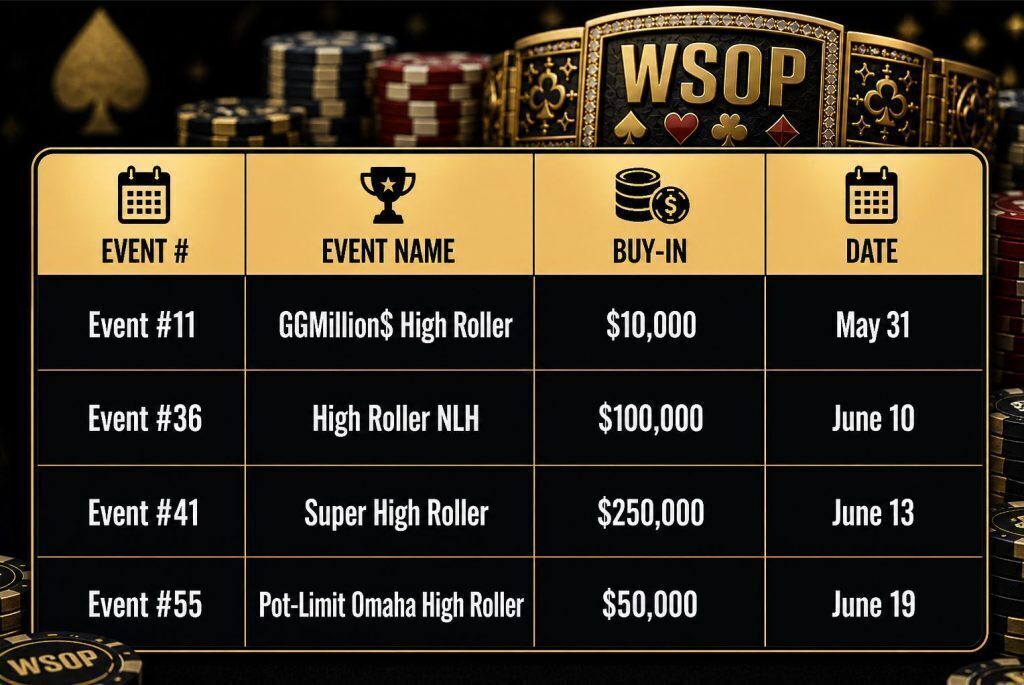
The 2026 WSOP runs from May 26 through mid-July in Las Vegas. High roller events are spread across the schedule in both No Limit Hold’em and Pot Limit Omaha. High roller events are spread across the schedule. You can view the full lineup on our WSOP hub.
Who Plays WSOP High Rollers? Field Composition and What to Expect
WSOP high rollers are much tougher than standard bracelet events, and the difficulty increases fast as buy-ins go up. At the $25,000 to $50,000 level, fields still include some recreational and satellite players, but most entries are experienced pros or backed players. Soft tables are rare.
Once buy-ins reach $100,000 and above, the fields become smaller and far more competitive. Regulars like Alex Foxen, Adrian Mateos, Santhosh Suvarna, Jesse Lonis, and Daniel Negreanu are common.
The $250,000 Super High Roller is considered one of the toughest tournaments in poker. Elite players like Artur Martirosian, Seth Davies, and Alex Foxen appear regularly, and the overall skill level is significantly higher than most WSOP events.
Your Roadmap to WSOP High Roller Poker
WSOP high roller events are built to reward skill. You get deeper stacks, longer levels, and smaller fields. That gives you more room to play and less reliance on early all-ins.
If you are thinking about playing, the most important thing is knowing what you are getting into. The structure is consistent, and once you understand it, you can pick your spots with confidence.If you are new to the format, start with the basics first. Learn how the game works, then come back to this guide when you are ready to take a shot.




Comments