




WSOP Odds: Your Complete Guide to Betting on the Main Event
WSOP odds mean two different things, depending on whether you’re betting or playing. For bettors, they’re the sportsbook lines on who wins the Main Event. For players, they reflect your real chances of getting through a field of 10,000+ entrants.
This guide explains how to read WSOP betting lines, where to find them, and what your actual odds look like once you’re in the field.
What actually drives WSOP odds:
- Field size — More entrants means lower baseline probability for everyone
- Skill edge — Strong players increase their chances, but can’t overcome variance at scale
- Structure — Deep stacks early, pressure later; edges take time to realize
- Public perception — Lines reflect reputation and betting action, not just true probability
- Variance — Even perfect play doesn’t protect you
2026 WSOP Main Event Betting Cheat Sheet
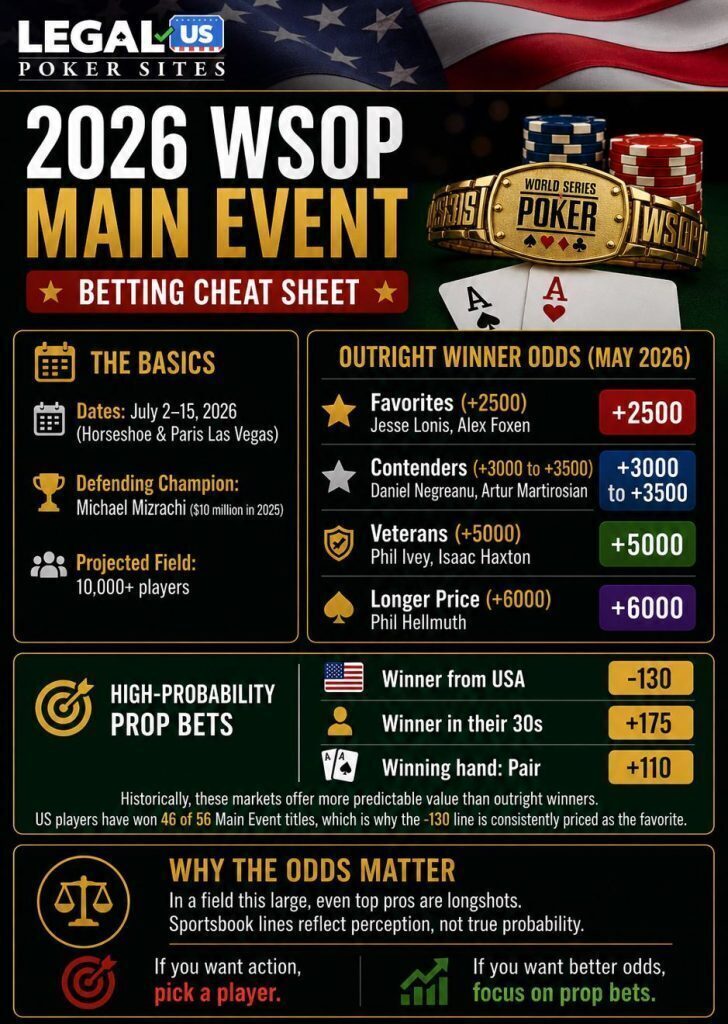
WSOP Main Event Betting Odds: 2026 Early Market Projection
The odds below reflect the early market heading into the 2026 WSOP Main Event. Treat them as a reference point, not a prediction model. Sportsbooks don’t price this event on pure probability. They factor in current form, GPI rankings, and betting action. That gap is where most players get it wrong. The 2026 series is also expected to see higher satellite volume through online qualifiers, which is why the field is projected to push back toward the 10,000-player mark.
If you’re reading these lines, keep it simple. American odds with a “+” show your profit on a $100 bet. +3000 returns $3,000. +5000 returns $5,000. In a field of around 10,000 players, those numbers are realistic. Even the best players are longshots. That’s the structure of the Main Event.
| Player | Odds |
|---|---|
| Jesse Lonis | +2500 |
| Alex Foxen | +2500 |
| Daniel Negreanu | +3000 |
| Artur Martirosian | +3500 |
| Phil Ivey | +5000 |
| Isaac Haxton | +5000 |
| Phil Hellmuth | +6000 |
Here’s a quick breakdown of each player in the market:
- Jesse Lonis — The hottest player in the game right now. A dominant 2026 start with major high-roller results has pushed him into the top tier. He’s no longer a sleeper. He’s a target.
- Alex Foxen — One of the most consistent tournament players in the world. His ability to navigate large fields without major mistakes keeps him priced near the top every year.
- Daniel Negreanu — Still one of the biggest names in poker, but this price isn’t just reputation. Recent results and continued adjustments to his game keep him competitive in modern fields.
- Artur Martirosian — A pure technical player with elite fundamentals. If the final table is stacked with pros, he’s one of the most likely players to convert.
- Phil Ivey — The number looks short for the field size, but that’s the “Ivey effect.” Public money keeps his odds lower than pure math would suggest.
- Isaac Haxton — One of the most technically sound players in the game. Deep stacks and long structures play directly into his strengths.
- Phil Hellmuth — The results are undeniable, but massive modern fields create more volatility for his style. The number reflects that shift.
The 2026 Main Event is expected to push toward another 10,000-player field. Even the top names are longshots, no matter how strong their current form is.
Where to Find WSOP Betting Odds
WSOP Main Event odds are usually listed in the entertainment or novelty sections of sportsbooks. Offshore platforms like Bovada, Ignition Casino, and SportsBetting.ag may offer these markets, but availability depends on timing.
Open the sportsbook menu, go to the entertainment or specials tab, and look for WSOP markets. Odds are posted before the tournament starts and update as the field shrinks. Early prices will not match what you see later in the event.
At the final table, the market resets. With nine players left, odds usually tighten into a +100 to +2000 range. That reflects the shift from a massive field to a short-handed race to the finish.
WSOP Main Event Prop Bets Worth Knowing
Picking an outright winner is difficult in a field this size. That’s why prop markets exist. They give you ways to bet the Main Event without relying on a single player. Historically, these markets offer more predictable value than outright winners. US players have won 46 of 56 Main Event titles, which is why the -130 line is consistently priced as the favorite.
| Market | Betting Favorite | Odds |
|---|---|---|
| Will the Winner Be From the USA? | Yes | -130 |
| Age of Winner | 30s | +175 |
| Winning Hand | Pair | +110 |
What Are Your Real Odds of Winning the WSOP Main Event?
When you move from betting odds to your real chances of winning, there isn’t one exact number. Your odds depend on field size, skill, and luck. Luck is the part you can’t control.
Start with the baseline. In a 10,000-player field, everyone would have a 1 in 10,000 chance if skill didn’t matter. That’s 0.01%. Skill shifts that range. Recreational players may be closer to 1 in 100,000, while strong pros might be around 1 in 6,000. Either way, you’re still a longshot.
What makes the Main Event different is the field. It includes many casual players, qualifiers, and one-time entries. That makes it one of the softest $10,000 tournaments and creates opportunity for skilled players.
The best example is Chris Moneymaker in 2003. He qualified online for $40, turned $86 into a Main Event run, and beat Sam Farha heads up for $2.5 million. That result changed poker and brought in a wave of new players.
Most winners today are professionals, but the structure still allows for surprise runs. The field is large enough that even strong players rely on variance to make deep runs.
How Odds Change at Each Stage of the Tournament
The WSOP Main Event runs in early to mid July at Horseshoe and Paris Las Vegas. It uses a freezeout format with four starting flights. As players get knocked out, your odds change quickly, so your approach should change too.
Early stages
Stacks are deep and blinds are low, so there is time to play. The field is at its softest, but it takes time for skill to show. Luck plays a big role here, and your odds are still close to the full field size.
Middle stages
Blinds increase and decisions matter more. Weaker players start to drop out, so the field gets tougher. Managing your stack becomes important. If you reach the money, usually the top 15 percent, you have already beaten most of the field.
Final table
With nine players left, everything changes. Each player now has at least a 1 in 9 chance to win. Odds tighten, usually from about +100 for the chip leader to +2000 for the short stack. At this stage, stack size, position, and decision making matters more than anything else.
What WSOP Odds Really Mean
WSOP odds look simple, but they only make sense when you understand the scale behind them. In a 10,000-player field, even the best players are longshots, and sportsbook lines reflect perception as much as reality. Reputation, recent results, and betting action all shape the number you see, but none of that changes how hard it is to win.
For bettors, that means choosing where to find value, not just picking names. For players, it’s a reminder that skill helps, but variance decides outcomes over this size of field. The Main Event stays unique because of that balance. It’s difficult, unpredictable, and still open enough that anyone with a seat has a path.
FAQ
Odds vary by sportsbook. In early 2026 markets, Jesse Lonis and Alex Foxen are around +2500, with Daniel Negreanu at +3000 and Artur Martirosian near +3500. Phil Ivey and Isaac Haxton are around +5000, with Phil Hellmuth closer to +6000. In a field this large, even the favorites are longshots.
If the tournament were purely random, your odds would be about 1 in 10,000. That’s your baseline WSOP Main Event probability. In reality, skill changes that range. Recreational players may be closer to 1 in 100,000, while strong pros might be around 1 in 6,000. Either way, you are still a longshot.
WSOP Main Event betting is typically available under the entertainment or novelty betting sections of offshore sportsbooks. Availability varies by site and timing, so not every platform will offer these markets at all stages of the tournament.
Prop bets let you engage with the Main Event beyond just picking an outright winner. The main markets available through offshore sportsbooks include:
Outright winner — Pick the player who wins the tournament
Nationality of winner — Will the winner be from the USA? (Yes at -130)
Age bracket of winner — The 30s bracket is currently favored at +175
Winning hand type — Pair is the favorite at +110
These markets offer more predictable outcomes than the outright winner bet, particularly the nationality market given that 46 of 56 historical Main Event winners have been American.
Yes. Chris Moneymaker’s 2003 win is the best-known example of an amateur winning the Main Event. Jamie Gold also won in 2006. Most winners today are professionals, but amateurs still make deep runs. The size of the field keeps the tournament open every year.