 Sandra Gaweda
Key Details Oklahoma’s ban on sweepstakes casinos took effect on November 1, 2026, under SB 1589, according to Sweepsy’s state
Sandra Gaweda Key Details A hacker allegedly used malware to see the hole cards of high-stakes poker players on Americas Cardroom (ACR),
Sandra Gaweda Texas Card House Houston has added an extra security guard after at least four poker rooms in the Houston area
Best US-Facing Online Poker Sites
U.S. online poker laws can be confusing, but most players still have online poker options. These are our top picks for US-facing real money poker sites available outside the state-regulated market:
Our top-ranked poker sites are legitimate, safe, secure, reliable, and regularly reviewed by our team through ongoing evaluations of software, promotions, banking options, player traffic, and the overall playing experience. They offer a range of trusted banking options, and players can make deposits with confidence using various methods tailored to U.S. customers. To gain a better understanding of the state of USA online poker, we have compiled all of the relevant information pertaining to online and live poker laws, the status of the US online poker market as a whole, some happenings around the world that may affect American players, and the potential for the game’s future. Read some of our latest and in-depth online poker reviews and find a site for you.
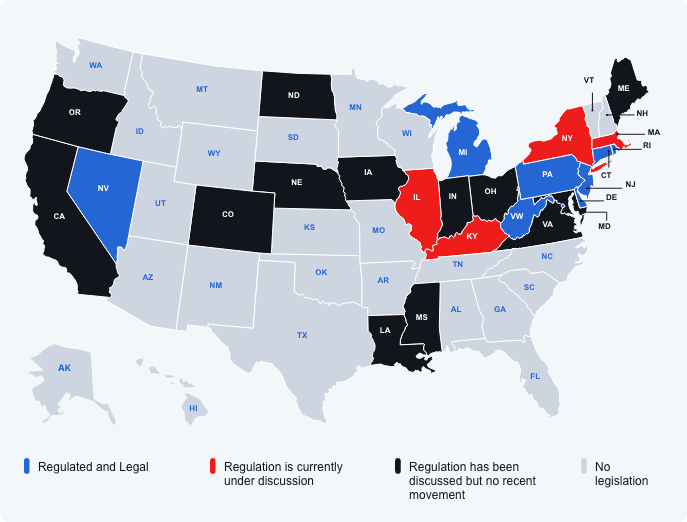
Poker and Gambling Laws by State
What Does the Future Hold for US Online Poker Players?
The most popular US poker sites may never again see the level of popularity they did during the poker boom in the early and mid-2000s. The combination of a global online poker market, Chris Moneymaker winning the World Series of Poker Main Event after qualifying through an online satellite, and the game’s growing popularity created the perfect storm. As a result, the growth of the top online poker rooms from 2003 to 2008 was unprecedented.
From the moment the UIGEA passed in the United States in 2006, the future of the Texas Hold ’em game became uncertain. PartyPoker immediately left the US market, and 888poker left soon after. The years that followed saw other operators grow warier of the risks involved. The significant operators that did not go – PokerStars, Full Tilt Poker, Absolute Poker, and UltimateBet – were the focus of the Black Friday indictments in 2011.
Poker staking, where one person financially backs another player in exchange for a share of potential winnings, is common in both cash games and tournaments. However, players should consider any applicable state laws, tournament rules, and tax obligations before entering a staking arrangement.
European Countries Regulating Online Poker
At the same time, countries worldwide segregated their markets, ousting international operators in favor of the few that paid licensing fees and taxes to operate legally in those countries. France, Italy, Spain, and Portugal were the most prominent countries to regulate and legalize poker online and gaming in this manner.
In contrast, other countries like Germany and Slovenia continue to struggle with the intricacies and complications of instituting licensing regimes. The United Kingdom regulated its market but allowed licensees to maintain dot-com business simultaneously. Countries in South America, Asia, Europe, and the Americas are in various stages of a similar process.
The Past, Present and Future of Online Poker in the US
The US internet poker market has been trending positively for more than a decade. However, a 2018 opinion from the Department of Justice’s Office of Legal Counsel reversed its 2011 interpretation of the Wire Act, raising concerns about interstate online gambling. In January 2021, the First Circuit Court of Appeals ruled that the Wire Act applies only to interstate communications involving sports betting. The Department of Justice did not appeal the ruling to the Supreme Court, removing a major source of uncertainty for interstate online poker.
As of November 2026, nine states have legalized online poker: Nevada, Delaware, New Jersey, Pennsylvania, West Virginia, Michigan, Connecticut, and Rhode Island and Maine. However, only six of these states currently have active regulated online poker sites. Connecticut, Rhode Island, and Maine have yet to launch regulated poker rooms.
Maine became the ninth state to legalize online poker in January 2026, following Rhode Island’s legalization in 2023. However, Maine has not yet launched a regulated online poker market. Other states, including New York, Illinois, and Indiana, have considered online poker legislation, but further expansion remains uncertain.
More Online Poker Resources
 David Lappin
Key Takeaways The Card Players Two men from Aix have been sitting across a card table from one another for
 Daniel Katz
When an online poker site shuts down, the process of getting your money out isn’t always straightforward. Some operators give
 Jordan Conroy
Poker staking isn’t often talked about, but it’s one of the pillars of the game’s ecosystem. Staking is common in
Legal US Poker Sites FAQs
Below are some of the most frequently asked questions about legal poker sites in the US.
Where is online poker legal in the US and how does it work?
US poker sites exist, but they operate on a state-by-state basis rather than nationwide. As of November 2026, nine states have legalized online poker: Nevada, Delaware, New Jersey, Pennsylvania, West Virginia, Connecticut, Michigan, Rhode Island, and Maine. However, Maine has not yet launched regulated online poker sites. Players must be physically located within one of these states to access state-licensed poker sites. Outside these regulated states, US players often turn to offshore poker sites that accept US customers, though these operate in a different legal framework than state-regulated platforms.
What makes an online poker site “legal” in the United States?
A legal US poker site is one that holds a valid gaming license from a state regulatory authority and operates within that state’s legal framework. These sites use geolocation technology to verify players are physically within state borders, comply with age verification requirements, and follow strict financial and consumer protection standards. The term “legal” refers to the operator’s licensing status rather than player legality—playing online poker does not explicitly violate federal law.
Is it illegal to use a VPN to play online poker from a restricted US state?
Using a VPN to circumvent geolocation restrictions and play online poker from a state where it is prohibited or not regulated carries both legal and practical risks. While federal law does not specifically address VPN use for online poker, some states like Washington have strict laws that could potentially apply to any form of online gambling. Beyond legal concerns, using a VPN violates the terms of service of both state-regulated and offshore poker sites. Sites employ sophisticated detection methods to identify VPN use, and violations can result in account closure, forfeited funds, and withheld winnings. Players should only access online poker sites from locations where they are legally permitted to play.
Will online poker become legal in more US states or nationwide?
The expansion of legal online poker in the United States is likely to continue on a state-by-state basis rather than through federal legalization. Several states have considered or are actively discussing online poker legislation, driven by potential tax revenue and the success of existing regulated markets. However, nationwide legalization faces significant political and regulatory hurdles, as gambling regulation has traditionally been a state-level authority.