



Poker Staking: Why Poker Players Sell Pieces of Themselves
Poker staking isn’t often talked about, but it’s one of the pillars of the game’s ecosystem. Staking is common in both live and online poker, particularly among tournament players looking to manage their financial risk.
But do you really understand what it is or how it works? We’ll explore what staking is, the common types of deals, and the risks that come with poker backing.
What Is Poker Staking?
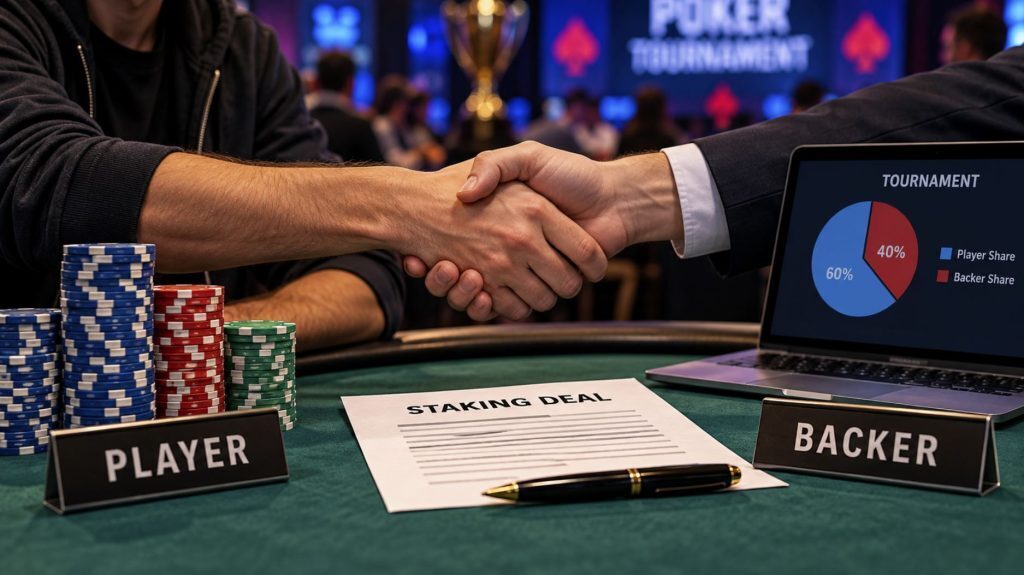
Poker staking is a deal where a “backer” pays for some or all of a player’s involvement in a poker game in return for a share of the winnings. The terms of a staking arrangement, such as how much the backer pays and their potential payouts, can vary greatly from deal to deal. Staking is common in both online and live poker, including cash games, tournaments, and sit-and-go tournaments (SNGs).
It’s important to establish that staking arrangements are not a loan; if the player loses money, the backer is not entitled to their money back – both players share in the risks and rewards.
Why Do Players Sell Pieces of Themselves?
One of the biggest reasons players sell action is to access bigger games while practicing good bankroll management. If you’re rolled to play in $50 tournaments, but feel ready to make the jump to the next level, getting backed to play $100 or $150 events gives you the chance to test your mettle and increase your potential earnings before moving up on your own dime.
Another reason players receive backing is to mitigate variance. This is particularly common among MTT players, as the variance of these games is particularly high. By selling action, pros can reduce their financial exposure to variance and limit the impact of downswings. However, doing this comes at a cost of some of your profits, so it’s important to think about whether it’s right for you before entering any agreement.
How Does a Poker Staking Deal Work?
While there are many different staking deals available, with varying terms depending on the aim of the arrangement, they can be split into two primary categories: one-time deals and long-term backing.
Single-Tournament Staking
This type of agreement only covers one game or event. The player sells a percentage of their buy-in for a share of the winnings. For example, you could sell 25% of your action in a $100 tournament. A backer would pay you $25 in return for 25% of the winnings. If you win $300, the backer gets 25% ($75) of those winnings.
Long-Term Backing Deals
Long-term backing deals are agreements that take place over an agreed period of time, such as one year. In this arrangement, the backer funds the player across multiple events and tracks the results. Profits are split according to the terms of the agreement, which may allow payouts throughout the arrangement. These types of deals potentially offer bigger rewards, but they can also lead to significant losses if the player underperforms.
Key Poker Staking Terms You Need to Know
Poker staking introduces new terms that you may not be familiar with, even if you’re an experienced poker player:
What Is Makeup in Poker Staking?
Poker staking makeup is the accumulated deficit a player carries forward after losses during a long-term backing arrangement. For example, if a player loses $5,000 in tournament buy-ins at the start of an agreement, that player is considered to be $5,000 in makeup. Players typically have to clear their makeup with future winnings before any profits are split. This protects the poker backer from earlier losses. For example, if the player wins $10,000 in the next tournament, $5,000 goes toward clearing the makeup. The remaining $5,000 is profit that can be split between the player and backer.
What Is Markup in Poker Staking?
Poker markup is a premium that some players charge when selling action. For example, a player selling 10% of their action in a $10,000 event would normally charge $1,000. At 1.3x markup, the backer would pay $1,300 instead. This premium reflects the player’s perceived skill edge against the field. A player with a stronger edge may have a higher expected return over time. This can make their action more valuable to potential backers. Not every player charges markup on their action, and the premium can vary between players and events.
What Does “Percentage of Action” Mean?
The “percentage of action” is the amount of a player’s winnings that a backer earns as part of the agreement. Players often sell “pieces” of tournament action rather than the whole amount. This allows them to keep some skin in the game. For example, a player may sell 30% of their action. The backer then receives 30% of any winnings from the event.
What’s the Standard Deal in Poker Staking?
There’s no such thing as a standard deal in poker staking – each arrangement is unique between the player and backer. For example, many players believe long-term deals involve a 50/50 profit split once makeup is cleared. However, this isn’t always the case. Some backers may take more than 50% if they also offer coaching. Players with a significant edge may negotiate a larger share of the profits.
Factors such as the buy-in size, player edge, field size, and prize structures are all considered when constructing a staking agreement. It’s important to work out all the terms of a deal before money changes hands.
The Risks of Poker Staking — For Both Sides
Poker staking comes with significant risks for both the player and backer, so it’s important to understand them before entering an agreement. The biggest risk for either side is the potential to lose money. Poker is a brutal game, and it’s possible to go on long losing stretches in high-variance games like MTTs, even if you have an edge. Long-term agreements can lead to players being in significant makeup, which, depending on the structure of the agreement, can lead to large losses for the player or backer.
It’s also important to be aware of the potential for fraud in staking arrangements. For example, a player could “oversell” their action by selling more than 100% of their available stake. This could lead to payout disputes or fraud. Only enter agreements with players you can trust and make sure diligent records are being kept. Getting the terms of a deal in writing is recommended as it helps clarify how winnings and losses are split at the end of the arrangement.
Where Do Poker Staking Deals Happen?
Poker staking used to be exclusive to private arrangements – backers would be introduced to strong players, and agreements would be made between the two of them. Now, players can connect with potential backers through social media and online poker communities. There are even dedicated poker backing sites that let you advertise action or buy pieces of other players.
Online poker sites are also looking to incorporate backing arrangements into their platform. GGPoker has a built-in staking feature that lets you buy and sell action across online events, making poker backing more accessible than ever.





Comments