




AI Poker Cheating: The Wildest Ways Players Are Cheating

Cheating in poker has existed for as long as the game itself; where there’s money to be made, people will do anything to win. While the rise of AI has threatened the integrity of a variety of industries, many players consider it to be a game-changer in poker cheating. AI’s accessibility increases the feasibility of cheating in a way that was previously unattainable for a layperson. To get you clued up on the latest online poker risks, we’ve explored how people are using AI to cheat at online poker.
Why AI Cheating at Poker Is Different From Anything We’ve Seen Before
While traditional forms of cheating in poker, such as marked cards and collusion, were effective, they were also fallible. This made them unappealing to all but the most dedicated cheaters. They usually took multiple hours to set up and execute for a small edge. AI poker cheating changes the game with its speed, scope, and accessibility. AI tools can also process large amounts of information without the fatigue or emotional decision-making that affects human players. Some forms of AI-assisted cheating are harder to detect because there may be no physical evidence or obvious tells.
While every online poker site prohibits cheating, the rise of poker cheating tools like RTA and online poker bots creates new ways for players to circumvent the rules. Arguably the scariest factor of AI cheating is its social acceptability. Many people don’t consider using AI as “real cheating” in other areas, such as academia.
The Wildest AI Cheating Methods Being Used at the Poker Table
The flexibility of AI allows players to use it to cheat in multiple ways. While some methods are confirmed to have been used by cheating rings, others are speculative. These are ways in which cheaters could use AI to their advantage.
Real-Time Solver Assistance (RTA)
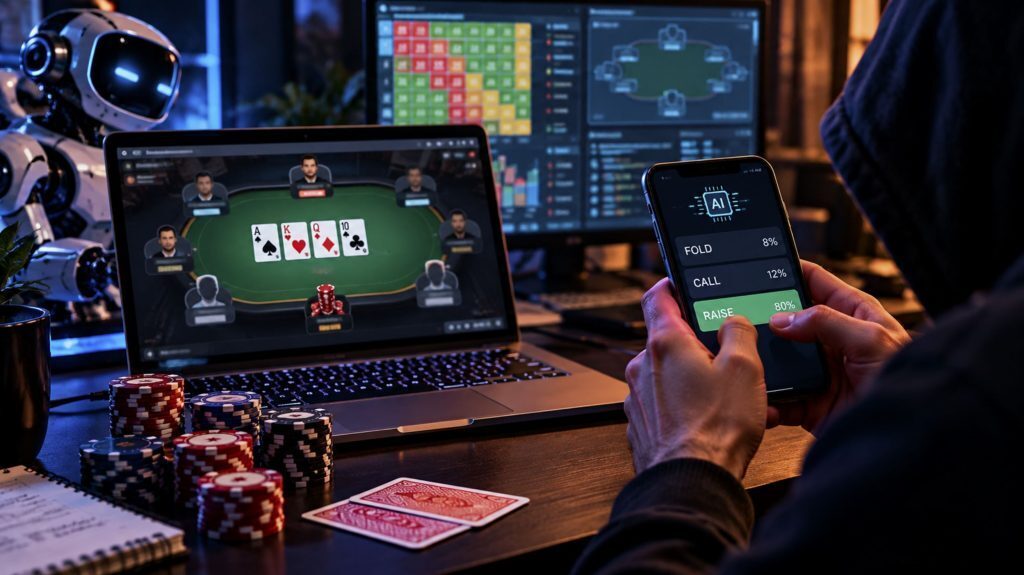
Real-time assistance, or RTA poker cheating, is arguably the biggest threat to online games. This method of cheating involves a player inputting the variables of their hand into a solver. The solver then provides “real-time” insights into GTO strategies. Game Theory Optimal, or “GTO,” strategies aim to make your play difficult to exploit. They account for the board, your opponent’s range, their stack size, and other factors.
Earlier poker solvers could take considerable time to calculate solutions. However, precomputed strategies and lookup tools already made some forms of real-time assistance possible. Advancements in AI and cloud computing have made some poker solver tools even faster. These tools can now provide recommendations in seconds. These recommendations can influence decisions such as folding, calling, raising, or choosing a bet size during an active hand. This is why major poker platforms prohibit unauthorized real-time assistance.
Poker Bots Running Entire Accounts
There have been many recorded instances of online poker cheating via “poker bots” that make 100% of the decisions. Old programs used a basic set of instructions, but over time, they’ve become more advanced. More sophisticated AI-powered systems use variables such as stack sizes and hand ranges to make better decisions at the table.
The key advantages of AI poker bots are their consistency. They can play for hours on end without tilting or getting tired, allowing them to continually execute a profitable strategy. The potential profit of these bots has led to the creation of “bot rings.” These operations can run multiple automated accounts across different tables, increasing the scale of potential cheating. One notable example emerged in 2024, when a poker community researcher alleged that a bot operation on the Winning Poker Network (WPN) had generated nearly $10 million in winnings.
AI-Powered Collusion Networks
Poker collusion is a form of cheating where multiple players sit at the same table and share information about their cards. This gives them an unfair informational advantage.
This form of cheating is effective, but it relies on players knowing what to do with the information. Using artificial intelligence can make collusion one of the most effective online poker cheating methods, as AI is able to quickly digest the information and provide advice based on the known hole cards. In tournament poker, coordinated play can be particularly damaging, as colluding players may influence eliminations. This can give them an unfair advantage over opponents competing for the same prize pool.
AI-assisted collusion can be difficult to detect, particularly when players communicate outside the poker platform. However, suspicious betting patterns and coordinated play can still provide evidence for security teams to investigate.
Ghosting and AI Assistance During Play
Poker has a rule of “one player per hand.” Ghosting in poker breaks that rule by introducing a third party to offer advice or take control of a player’s actions. It’s a popular form of poker cheating in online tournaments; a weaker player who makes a deep run in a big event will be “ghosted” by a stronger player to improve their potential return.
AI poker assistance has the potential to take the place of traditional ghosting, with LLMs giving players real-time advice as they play. This form of cheating can be difficult to detect, as the player is still the one pressing the buttons. Unlike fully automated poker bots, AI-assisted ghosting still involves a human making the final decisions and controlling the account.
Using AI to Exploit Player Tracking Data
Heads-up displays, or HUDs, track the stats of players at your table. They often use hand-history data to identify opponents’ tendencies and playing patterns. Combining HUDs with AI poker analysis can cross into cheating when these tools provide prohibited real-time advice or use data that a poker site does not permit. Rules surrounding HUDs, hand histories, and player profiling vary between platforms. In this way, poker HUD cheating is similar to RTA.
It’s important to clarify that off-table analysis of your player pool and their tendencies is not considered cheating. Poker player profiling is a skill that many of the best players learn. Their hard work gives them an edge over their competitors.
How Do Poker Sites Actually Catch AI Cheaters?
Online poker sites are in an arms race against cheaters to protect their games; as fast as they improve their online poker security, players find ways to evade them. To explain how poker sites detect cheating, we’ve explored the most popular methods:
- Player Behaviour – Sites will monitor a player’s actions, such as their decision times, session lengths, multi-tabling patterns, and bet sizing, to look for suspicious behaviour. However, no system is perfect, and some developers programme their software to mimic human play by varying these factors, making it harder for sites to identify bots.
- Software Detection – Some online poker sites use software detection tools to identify prohibited programs, such as unauthorized solvers or other RTA tools. Depending on the platform, detected violations may result in warnings, account restrictions, or further investigation.
- Tournament Reviews – Poker platforms conduct reviews of their major tournaments. If a player is suspected to have broken the terms of service, any winnings earned from cheating can be redistributed to the affected players.
- AI Detection – Some sites leverage machine learning to improve their poker bot detection. PokerStars, for example, uses proprietary machine-learning systems to analyse playing patterns and identify accounts for further investigation.
Despite these measures, detecting AI-assisted cheating remains an ongoing challenge. Sophisticated tools can be designed to imitate human behaviour, making it difficult for security teams to identify every violation.
What Does AI Cheating Mean for You as a Player?
Although the risk of encountering cheaters varies between games and platforms, AI-assisted cheating is something players should consider when choosing where to play. Higher-stakes cash games and major tournaments can attract cheaters because of the potential financial rewards. However, lower-stakes games are not immune, particularly when automated accounts can play large volumes of hands.
We recommend that you only play at online poker sites with a valid gaming license from a recognised authority. Licensed poker sites are held to higher standards of game integrity, offer more effective poker cheating protection, and are more proactive at identifying cheaters.
To help you have a fun and safe online poker experience, we’ve provided some tips for you to consider when choosing where to play:
- Check for anti-cheat measures, such as software detection and tournament reviews, before you start playing.
- Read reviews from industry experts to find out more about a site’s player protection resources.
- Get the opinions of long-time players who have in-depth experience with the site and its security features.
- Watch for unusual playing patterns, such as extremely long sessions or consistently similar decision times, and report suspicious activity through the site’s security or support channels.
Staying Ahead of AI Poker Cheating
As AI poker cheating methods become more sophisticated, protecting the integrity of online poker will remain an ongoing challenge. While poker sites continue to improve their detection systems, players also have a role to play by choosing reputable platforms, understanding the risks, and reporting suspicious activity. AI may be changing how people cheat at poker, but staying informed is one of the best ways to protect yourself at the tables.
FAQ
The legality of using AI to cheat at online poker depends on the jurisdiction and circumstances. While certain forms of cheating may violate gambling or fraud laws, using prohibited AI tools can also breach a poker site’s terms of service, potentially resulting in account bans or confiscated winnings.
Online poker sites use a variety of tools to detect AI bots, including third-party software detection, statistical analysis of player behaviour, and tournament reviews.
Yes, AI cheating can affect low-stakes poker games. Some cheating rings target low-stakes games due to the relative lack of attention from the platform compared to higher-stakes games, while other groups use low-stakes games as a testing ground for their software.
If you suspect someone at your table is cheating using AI, we recommend that you use your site’s in-game report function to flag it with the security team. You should share the username of the player, what they did to make you suspicious, and specific hand examples.
Using AI to cheat at live poker can be more difficult than doing so online, as many poker rooms restrict the use of electronic devices during play. While methods such as ghosting or receiving RTA via earpieces are possible, live poker generally presents more practical obstacles to AI-assisted cheating than online poker.





Comments