




Is Online Poker Rigged? Myths vs. Real Statistics

The legitimacy of online poker is one of the most hotly discussed topics on any poker forum or website. There are dozens of myths and anecdotes from people who swear that a site is rigged, so we’re here to provide you with a straight answer based on evidence rather than speculation.
In this article, we’ll cover how regulated platforms operate, how RNG systems are certified, and what the statistical data actually shows.
The Short Answer – Online Poker is Not Rigged
As the title says, licensed and regulated online poker sites are not rigged. No regulated operator has ever been proven to run a manipulated random number generator, and the financial and legal consequences of doing so would be catastrophic for any licensed business.
In truth, any concerns over the legitimacy of a game likely come from a misunderstanding of how brutal variance can be. Real-money online poker can feel deeply unfair during a downswing, and when bad beats stack up in a single session, it’s natural to look for an explanation beyond simple bad luck.
The nuance in this question comes from one critical distinction: regulated online poker sites versus unregulated platforms. These are not the same thing, and conflating them is the root cause of most “online poker is rigged” narratives.
How Online Poker Actually Deals Cards — The RNG Explained
One of the reasons why online poker is susceptible to claims of “rigging” in the way that live poker isn’t, is that you cannot see how the cards are shuffled and dealt. When you play at a casino, you can watch the dealer shuffle the cards and deal them out, giving you complete transparency, whereas online poker shuffles are determined by an RNG.
What is an RNG?
A random number generator (RNG) is a software algorithm that produces unpredictable numerical sequences at extremely high speed. In online poker, the shuffle is determined by the RNG, meaning that there’s no human involved in the process. Most major platforms either shuffle the entire deck at once before a hand begins or draw a random card on demand each time the game client requests it.
Algorithmic Randomness vs True Randomness
One of the problems with RNGs is that a computer algorithm can never be truly random. After all, an algorithm is a specific set of instructions, so if you use an algorithm to output a number, that number can never be truly random. In theory, if you have the algorithm, you can reverse engineer it to calculate the expected outcomes.
This creates a problem for poker sites, as any possibility of this happening would completely eliminate a player’s trust in the integrity of their games.
To counteract this, sites use a variety of methods to create “true randomness,” which does not rely on algorithms. For example, Pokerstars uses a physics-based randomisation method, where a photon is fired at a semi-reflective mirror, and the angle of reflection is measured to determine the number. They pair this with player inputs, such as mouse movements, to create a truly “shuffle.”
Certified RNGs
Certified RNG systems used by major operators like Pokerstars are independently verified to ensure that outcomes cannot be predicted or influenced by anyone — including the poker site itself. Once a certified RNG is implemented, the operator does not control how cards are dealt on a hand-by-hand basis. The system runs autonomously, and the results are routinely checked to make sure that they’re truly random.
The idea that RNG systems are secretly altered to favor certain players or inflate rake simply isn’t supported at regulated sites. Doing so would require tampering with certified software in a way that auditors would detect, risking the operator’s license, its reputation, and its entire business. The incentive structure runs entirely in the opposite direction.
Who Audits the RNG and Why That Matters
Independent RNG audits are a legal requirement for any licensed poker site. These audits are designed to verify that an RNG is being run correctly and that the outcomes are fair. eCOGRA (eCommerce Online Gaming Regulation and Assurance) is one of the most recognized independent auditing bodies in the industry, and is responsible for auditing many of the RNGs used by top poker sites. Any site that displays an RNG certification is subject to regular audits, as eCOGRA and similar organizations conduct ongoing testing to verify that fair online poker software continues to perform within certified parameters. Sites that carry this certification have passed rigorous, independent fairness testing, which means that you can be sure of the site’s game integrity.
Regulated vs. Unregulated Poker Sites
The licensing status of an online poker site matters more than almost any other factor when assessing game integrity. Licensed poker sites operating real money games under regulators like the Malta Gaming Authority (MGA), the UK Gambling Commission (UKGC), or US state gaming authorities are held to strict fairness standards, with regular audits, player fund protections, and legal accountability. No regulated operator under these frameworks has ever been proven to run a manipulated RNG.
In the United States specifically, real-money online poker is currently operational in six jurisdictions: New Jersey, Nevada, Delaware, Michigan, Pennsylvania, and West Virginia. Connecticut has legalized online poker, but does not yet have live operators. Platforms in the operational states are under direct oversight from state gaming commissions, which include mandatory RNG certification, segregated player funds, and ongoing compliance reviews.
Unregulated poker sites face limited accountability, and player recourse in the event of a dispute is minimal. While this doesn’t automatically mean every offshore site is cheating, it does mean you have far fewer protections if something goes wrong.
| Regulated Sites | Unregulated Sites |
| Under the authority of gambling authorities | No mandatory oversight |
| Certified RNG audited by third parties like eCOGRA | No required fairness testing |
| Player funds protected by regulatory requirements | No guaranteed fund protection |
| Legal recourse available through gaming commissions | Limited or no player recourse |
| Transparent terms and complaint processes | Terms may be unclear or unenforceable |
Why Online Poker Feels Rigged — The Psychology and Math Behind Bad Beats
The feeling that online poker is rigged is extremely common, as the frequency of bad beats can feel impossible in a way that live poker rarely does. The reason for this is the speed of online poker compared to live poker.
When playing online poker, you can see between 70 to 150 hands per hour, whereas most live games barely reach 30 hands an hour. This means that you’re potentially seeing more than five times as many hands per hour when playing online. More hands mean that statistically rare events, like two-outers, runner-runner draws, etc., occur more frequently within a single session. The game isn’t more unfair; it’s just faster, and faster means more of everything, including the painful outcomes.
Think of it this way; if you flipped one coin every 30 seconds, it could take you hours to get a sequence of 8 heads in a row, but if you flipped 5 coins every 30 seconds, you’re likely to see 8 heads in a row, or even 9 or 10 in a row, quicker and more frequently.
The Problem With Variance
Poker variance refers to the natural, expected swings in results that occur even when you’re making correct decisions. While many players think they understand how it works, they can’t comprehend how variable variance is! There’s an old saying that goes, “at some point, you’ll run worse than you ever thought possible for longer than you ever thought possible,” and it’s natural when this run occurs, that people chalk it up to something other than variance.
To help demonstrate just how brutal variance can be, we used a poker variance calculator to visualise the possible outcomes for a player winning at 4bb/100 over a 100,000-hand sample.
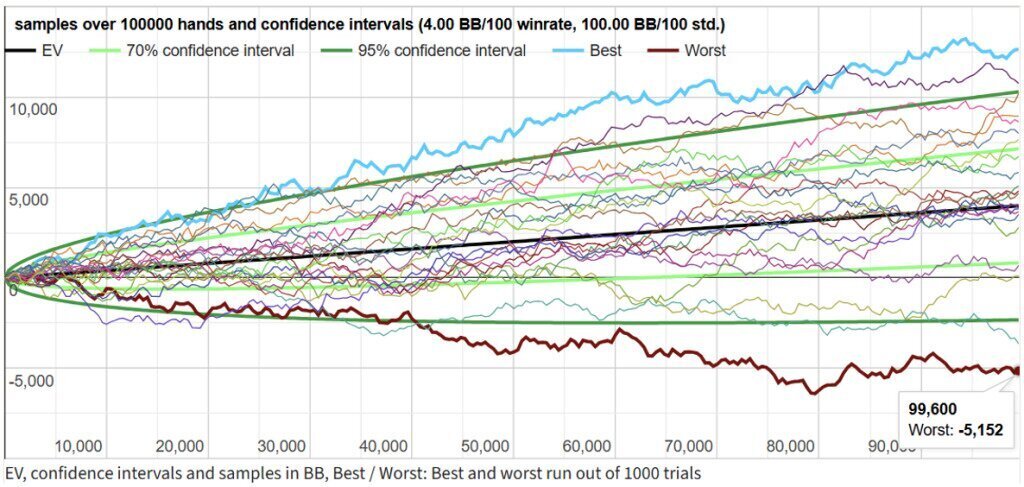
To put this in perspective, a 100,000-hand sample is considered by many to be the benchmark at which you can determine your true win rate in a game. Even with a win rate of 4bb/100 – a win rate that would be considered “crushing” in most online games, you have a 10% chance of losing money over that stretch. The worst-possible outcome had a player losing 50 buyins while being a 4bb winner!
It’s easy to see how someone going through such a run would blame the site; “Surely I can’t run this bad, it has to be manipulated!”, but the truth is, you can.
Confirmation bias plays a significant role here too; players tend to remember the brutal river card that cracked their aces far more vividly than the six times their aces held up in the same session. That’s a well-documented psychological pattern, not a poker-specific phenomenon, and it’s a major driver of the “this site is rigged” feeling that hits after a tough night.
Why Sample Sizes Matter
Session-level results, no matter how painful, simply don’t contain enough data to draw meaningful conclusions about the fairness of a game. A few hundred, or even a few thousand hands, is not a statistically meaningful sample in poker. Meaningful conclusions about whether a site’s dealing is fair require hundreds of thousands of hands, ideally millions, before any pattern becomes statistically significant.
Tools like PokerTracker and Hold’em Manager allow you to save and analyze your full poker hand history, tracking outcomes like your win rate with pocket aces across larger samples. While variance will still have a big impact on your sample, the chances are that your results are tracking close to the mathematical baseline.
Real Threats That Do Exist — Bots, Collusion, and Superusers
Regulated online poker sites are not rigged, but that doesn’t mean cheating never happens. Some players still try to gain an unfair advantage. The good news is that regulated sites have systems in place to detect and stop these activities.
- Online Poker Bots: Bots are computer programs that play poker automatically without a human controlling them. They can play around the clock without getting tired or making emotional decisions. Regulated poker sites use tracking tools and player reports to identify and ban bot accounts.
- Poker Collusion: Collusion happens when two or more players work together at the same table to gain an advantage over other players. For example, they may share information about their cards. Regulated sites monitor games for suspicious activity and investigate reports of possible collusion.
- Superuser Scandals: In the past, some poker sites had insiders who gained access to players’ hidden cards. These people, known as “superusers,” used that information to cheat. The most famous cases involved Absolute Poker and UltimateBet. These incidents were not caused by rigged software but by dishonest individuals abusing their access. Modern regulated poker sites have much stricter security measures, audits, and oversight to help prevent this type of cheating.
How to Verify You’re Playing on a Fair, Legitimate Site
To help you make sure that you’re playing on a fair and legitimate poker site, our experts have come up with a guide that you can follow during your search:
- Check the Gaming License – Look for licensing from your region, such as the MGA, UKGC, or a US state gaming commission (New Jersey’s Division of Gaming Enforcement, Michigan Gaming Control Board, etc.). Licensed poker sites are held to higher standards of player safety and game integrity, so you can be sure that you’re playing in a secure environment.
- Look for Third-Party Certification – Reputable poker sites display their certification prominently, often in the footer. The presence of a license from an independent auditor, such as eCOGRA, is verifiable proof that the RNG meets the required fairness standards.
- Use Expert Reviews – In-depth poker site reviews, like the ones you’ll find here at LegalUSPokerSites, is a great way to learn about the security features that each site offers. After evaluating the resources used by the site to keep you safe and the opinions of our experts, you’ll have everything you need to make your decision.
The Bottom Line
Regulated online poker sites are not rigged. They use independently tested random number generators (RNGs) and are regularly audited by gaming regulators. What many players mistake for rigging is simply variance. Online poker deals more hands per hour than live poker, so bad beats happen more often.
The biggest risk is playing on unlicensed sites. To stay safe, stick to regulated poker rooms that are licensed and independently tested.
FAQ
At regulated poker sites, staff cannot see your hole cards during normal operations. Access is tightly controlled and only used for security investigations. Past scandals showed what can happen when controls fail, but modern regulations and audits make this much harder today.
It can feel like you’re losing more online because you’re playing far more hands. Online poker deals around 70 to 150 hands per hour, while live poker typically deals only 25 to 30. More hands mean you’ll see more bad beats, coolers, and unusual situations. Even if you’re losing at the same rate in both games, online losses can feel bigger simply because they happen more often in a shorter period of time.
Here are a few signs that an online poker site is trustworthy:
- A valid gaming license from a recognized regulator.
- Independent RNG testing and certification.
- Legal authorization to operate in your state.
- Positive reviews from reputable industry experts.
No regulated poker site has ever been proven to rig its RNG. The cheating cases that have occurred involved players or insiders, such as bots, collusion, or unauthorized access to player information. While these are serious issues, they are different from a poker site manipulating game results. That’s why it’s important to play on regulated sites with proper oversight and security measures.
There is no evidence that poker sites create “action flops” or rig hands to increase rake. Licensed sites use certified RNGs that are regularly tested for fairness. The risks of getting caught, including losing a gaming license and damaging their reputation, far outweigh any potential benefit. For regulated operators, keeping games fair is the smarter business decision.




Comments