


Brandon Wilson Wins Super High Roller Bowl XI for $1.125M
By Sandra Gaweda | October 13, 2026 | 4 min read Brandon Wilson is the Super High Roller Bowl XI


Pennsylvania Bill Would Ban Sweepstakes Poker With Fines Up to $500,000 Per Violation
By Sandra Gaweda | October 13, 2026 | 4 min read
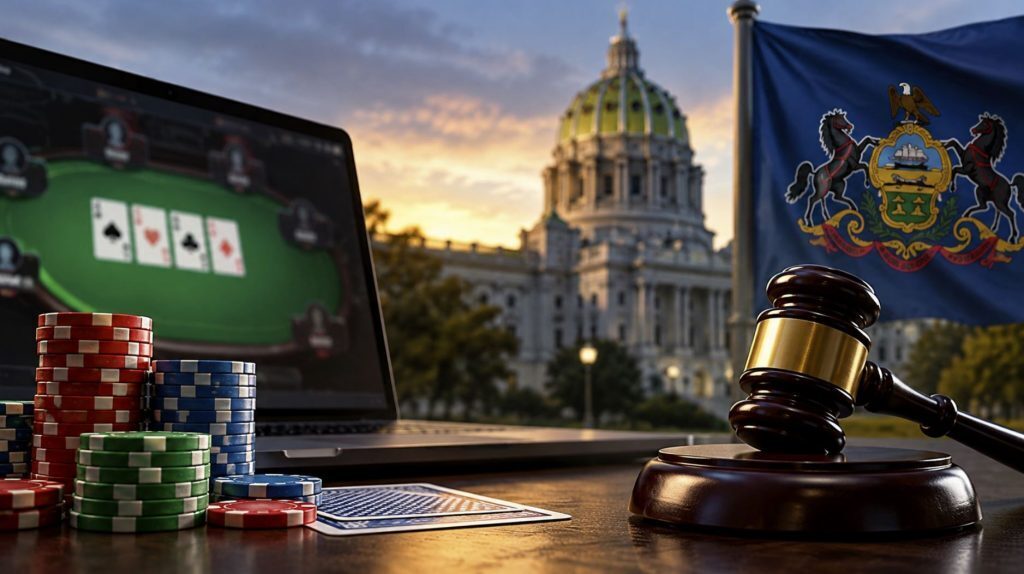
Pennsylvania lawmakers have a bill on the table that would outlaw sweepstakes poker in the state. House Bill 2801, sponsored by Rep. Russ Diamond, would make it unlawful to operate, conduct or promote online sweepstakes games, and its definition explicitly lists poker. Operators that break the ban would face fines of $50,000 to $500,000 per violation. For now, it’s only a proposal. The bill went to the House Gaming Oversight Committee on September 24, no votes or hearings have taken place, and the session ends November 30. The ban targets dual-currency sweepstakes games. True play-money games that award no cash prizes are excluded.
Diamond, a Republican from the 102nd District, serves as minority chairman of the House Gaming Oversight Committee. His bill adds a new Section 27 titled “Sweepstakes games prohibited.”
The official bill text gets straight to the point. It reads: “It shall be unlawful for a person or entity to operate, conduct or promote online sweepstakes games within this Commonwealth.”
The language reaches past operators. The bill also prohibits efforts to “support or assist in the administration, operation, conduct or promotion” of these games. That wording could pull in vendors and service providers.
The bill defines an online sweepstakes game by its dual-currency model. Players use one currency, such as Gold Coins, for free play and a second, such as Sweeps Coins, that can be redeemed for prizes. Our report on August’s sweepstakes shutdowns explains how that setup works.
The bill’s definition covers slots, keno, bingo, sports wagering and table games including blackjack, roulette, craps and poker. For poker players, dual-currency sites offering sweepstakes poker with redeemable prizes could fall under the proposed ban.
True play-money games get a carve-out. The bill’s definition excludes games that don’t award cash prizes or cash equivalents. If you play free poker for chips with no redemption value, this bill leaves you alone.
Fines would run $50,000 to $500,000 per violation. Violators would also lose any state gaming license and be barred from receiving one. For a company eyeing Pennsylvania’s regulated market, that second penalty could hurt more than the fine.
The Pennsylvania Gaming Control Board (PGCB) would have authority to investigate, hold hearings, issue subpoenas and send cease-and-desist orders. The attorney general could also investigate and issue subpoenas and cease-and-desist orders.
Regulators already have sweeps operators on their radar. Pennsylvania has not enacted a specific sweepstakes ban, but regulators have already challenged some operators under existing gambling laws. The PGCB has sent cease-and-desist letters to sweeps operators. Outside Pennsylvania, sweepstakes poker has already drawn legal action: Florida’s attorney general sued VGW, the owner of Global Poker.
HB 2801 has four co-sponsors: Republican Reps. Jacob Banta, Brad Roae and Dan Moul, plus Democratic Rep. Jeanne McNeill.
The bill hasn’t moved since its referral. The official bill page lists no votes or committee meetings, and PlayUSA reports no hearing or vote is scheduled. The legislative term ends November 30, leaving limited time for the bill to advance.
The sweepstakes section is a small slice of HB 2801, which primarily focuses on regulating and taxing skill-game machines.
Diamond’s memo, cited by RG.org, would allow up to five skill game machines in clubs, liquor-licensed bars and restaurants, and qualified truck stops. Those machines would pay a 20% tax on gross terminal revenue.
Pennsylvania players already have legal real-money poker. Online poker has been legal since HB 271 passed in 2017, and licensed sites include PokerStars PA, BetMGM Poker, WSOP.com and BetRivers Poker. Our Pennsylvania online poker guide covers the rules, including that you must be 21 or older and physically in the state.
The state also signed MSIGA on April 17, 2025, the multistate agreement for shared online poker.
Here’s how the three types of poker sites differ for Pennsylvania players:
If the bill becomes law, licensed sites would be the clear legal path for Pennsylvania players who want to play poker for cash prizes.
HB 2801 remains a committee proposal with no hearings or votes, and the legislative term ends November 30. Pennsylvania has not enacted a specific sweepstakes ban, though the PGCB has already challenged some operators under existing gambling laws.
If you play sweepstakes poker in Pennsylvania, keep an eye on this bill. If you want a fully regulated game, the state’s licensed sites already take real-money action from players 21 and older located in Pennsylvania. We’ll update this story if HB 2801 gets a hearing or a vote.
By Sandra Gaweda | October 13, 2026 | 4 min read Brandon Wilson is the Super High Roller Bowl XI

By Sandra Gaweda | October 10, 2026 | 4 min read Sean Perry’s Super High Roller Bowl XI lasted one
By Sandra Gaweda | October 8, 2026 | 4 min read Hustler Casino Live (HCL) has pulled high-stakes regular Britney




Comments