



Poker Slang: How the Language of the Game Has Changed
Poker slang and terminology are so commonplace that experienced players often forget how unfamiliar they can sound to newcomers. Sit down at the poker table as a layperson, and you’ll be bombarded with terms like “flop,” “check-raise,” and “showdown” that’ll make zero sense unless you’re familiar with the game. We’ll take you through a brief history of poker slang, how it’s evolved, and what it means for the game today.
Why Poker Has Its Own Language
While poker is considered mainstream in 2026, early games often took place in less public settings. These included riverboats, saloons, and backrooms.
Like any subculture, poker players developed their own language, or “poker slang.” This made communication easier and helped create a shared identity. Players can recognise others within the poker community through their use of these terms, while also identifying those less familiar with the game.
The Classic Era: Slang from the Live Card Room
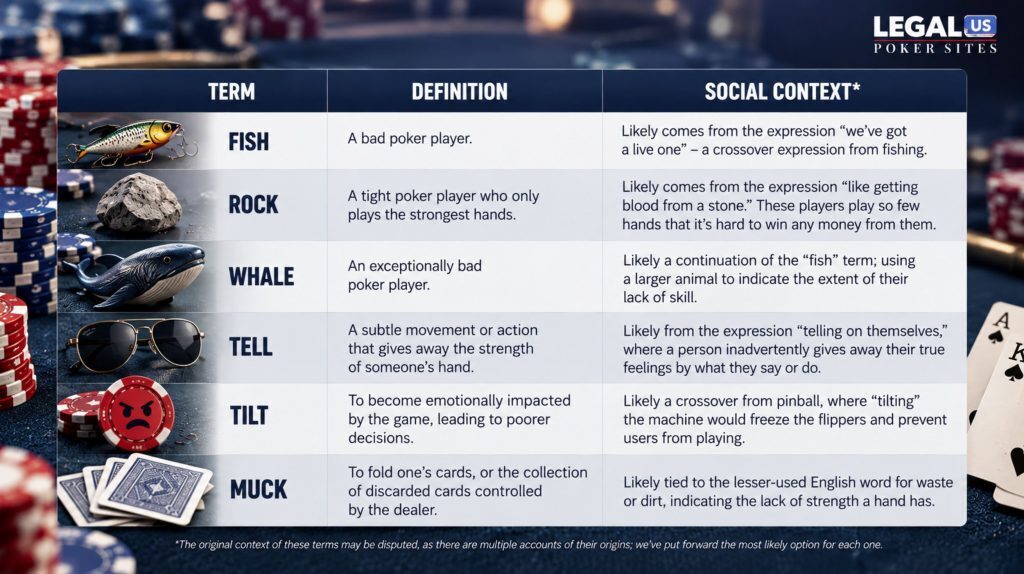
Classic poker terms that we’re familiar with today evolved across years of live play, simplifying common expressions into a single word or two. Many of the popular poker slang terms used today come from the earliest live poker games, including:
Hand Nicknames and Where They Came From
Poker hand nicknames are also part of poker’s cultural identity. Many are actually longer than simply naming the hand itself. Some of these nicknames are still regularly used by players to this day, including:
- Pocket Rockets (AA) – The nickname comes from the shape of the “A,” which resembles a rocket. It also references the hand’s preflop strength.
- Cowboys (KK) – This nickname is a throwback to poker’s “Wild West” origins. It also references the “Texas” part of Texas Hold’em.
- Big Slick (AK) – Early live players nicknamed the hand “Big Slick” because of its unpredictable nature. It can either win or lose a fortune.
- Snowmen (88) – The number 8 (with some imagination) looks like a snowman, so two together are snowmen.
- Nickels (55) – A five-cent coin is commonly known as a nickel. That’s why a pair of fives is called “nickels”.
- Dead Man’s Hand (Aces and 8s) – Wild Bill Hickok was reportedly holding two pair (aces and eights) when he was shot and killed during a poker game.
The Poker Boom and the Birth of New Slang (2003–2010)
The poker boom of the early 2000s, fuelled in part by ESPN’s WSOP broadcasts, brought a huge influx of new players. This accelerated the development of poker language. Expert commentary helped newcomers understand unfamiliar poker terms like “bad beat,” “showdown,” and “cooler.” It also helped standardize terminology across the player base.
After Moneymaker’s win via an online satellite, more players were introduced to poker on their PCs rather than at casinos. Forums like 2+2 also grew in popularity and helped shape online poker slang. Players shared new terminology through forums, chat boxes, and instant messaging. Terms like “3-bet” and “4-bet” became more widely used, replacing clunkier terms like “re-raise,” “re-re-raise,” and “come over the top.”
The Solver Era: How Modern Poker Changed the Language Again
The introduction of new technology changed the way we think and speak about the game. Poker solvers give us access to “GTO” (Game Theory Optimal) poker strategies and solutions that help us play more accurately. These programs can require significant time and money to use effectively. This has created a divide in poker terminology. Serious grinders who study GTO often use different terms than recreational players.
For example, some modern poker terms commonly used by studied players include:
- Expected Value – The term expected value is used to express the profitability of a certain decision.
- 2E/3E – These terms refer to geometric bet sizing. This involves betting the same percentage of the pot across multiple streets, usually with the aim of going all-in.
- Range Betting – The act of betting with 100% of your range in any given situation.
- Range Advantage – A situation where one player’s range has an advantage over another’s.
- Blocker – Blockers describe using known information about your hand to make inferences about your opponents’ hands and make strategic adjustments.
Slang That Crossed Over: Poker Words in Everyday American English
The popularity of the game, as well as its appearances in film and media, means that many people use poker slang in everyday language, such as:
- Poker Face – Give nothing away about how you’re feeling.
- Ante Up – Pay your share.
- Bluff – Taking an action that makes someone think you’re stronger or weaker than you are.
- Wild Card – An erratic or unpredictable person.
- Raise the Stakes – Upping the risk while upping the potential rewards.
- Keeping Your Cards Close to Your Chest – Not letting anyone see what you’re doing or thinking.
Many of the poker idioms are derived from poker terms that come from early poker games, up until the time of the poker boom. This is because early poker expressions can be used by people who know of the game, whereas post-poker-boom terms require a greater level of knowledge of the game than the average layperson would have.
What Poker Slang Tells Us About the Game Today
Poker slang in 2026 is an amalgamation of words and terms popularised throughout the last 100+ years of poker games. While some words fade away and die through lack of use, some of the oldest poker language remains as popular as ever.
The rise of online poker has created a sub-sub-culture of players who take the game more seriously, leading to a divergence in the language they use. Due to the growing support for online US poker, and as more states legalize online poker, this “advanced” terminology may become more common among American players.
As the game continues to evolve, poker culture and its language will grow with it – we’re excited to see where it goes next!
FAQ
Based on our findings, “all in” is the most universally recognised poker term. Many people use the term to signal full commitment to a person or situation.
Poker slang terms have multiple origins, ranging from early backroom games to modern online players. The lexicon of a modern poker player is comprised of a mix of these old and new sayings.
There are multiple poker terms and phrases that have transitioned beyond the felt and have made their way into everyday parlance, including:
- Ante Up – To pay your share.
- Raise the Stakes – Increase the possible risk and reward of a situation.
- Show Your Hand – To give up important information (often unwillingly).
- Wild Card – An erratic or unpredictable person.
In poker slang, GTO, or Game Theory Optimal, refers to a mathematically balanced and unexploitable strategy; the term is used by both new and experienced players, although many people misuse the term.
Poker players use a lot of slang as it’s an easy way to efficiently communicate the action of the game and identify players who are part of the sub-culture.





Comments