




When Poker Becomes a Lottery
Key Takeaways
- GGPoker’s Ocean KOs add random jackpot multipliers to Progressive Knockout tournaments, with bounty multipliers reaching as high as 400x.
- The format increases variance by making the value of each knockout dependent on a random draw as well as a player’s performance.
- Similar Jackpot PKO formats are already available at Winamax and ACR, suggesting the format could become more widespread across online poker.
- Some professional players have raised concerns about bankroll requirements, long-term profitability and potential collusion as Jackpot PKOs become more popular.
The Million Lottery
In 1694, the English government had a problem familiar to governments throughout history: it needed money, and it needed it quickly. The solution was, on the face of it, ingenious. Rather than simply taxing the population, it created a lottery. The Million Lottery sold 100,000 tickets at £10 apiece, raising the then enormous sum of £1 million for the state. Each ticket came with an annual payment of £1 for 16 years, while a handful of lucky people would receive much larger prizes. It was gambling dressed as investment.
The genius of the scheme was precisely that ambiguity. You weren’t simply throwing £10 into the abyss in the hope of becoming rich. You were buying something that appeared to have intrinsic value, while simultaneously purchasing a tiny piece of a dream. The respectable financial proposition and the intoxicating possibility of a windfall sat side by side, each making the other easier to swallow. The lottery didn’t need to convince people that gambling was sensible. It merely had to make the gambling look sensible enough.
Before long, lotteries became a national obsession and, according to contemporary accounts, London coffee houses were abuzz with discussions of tickets and prizes. The remarkable thing is that the state had discovered something that would become a recurring feature of gambling for centuries afterwards: the most powerful lottery is not necessarily the one that looks the most like gambling. It is the one that gives gambling a respectable disguise.
Ocean KOs
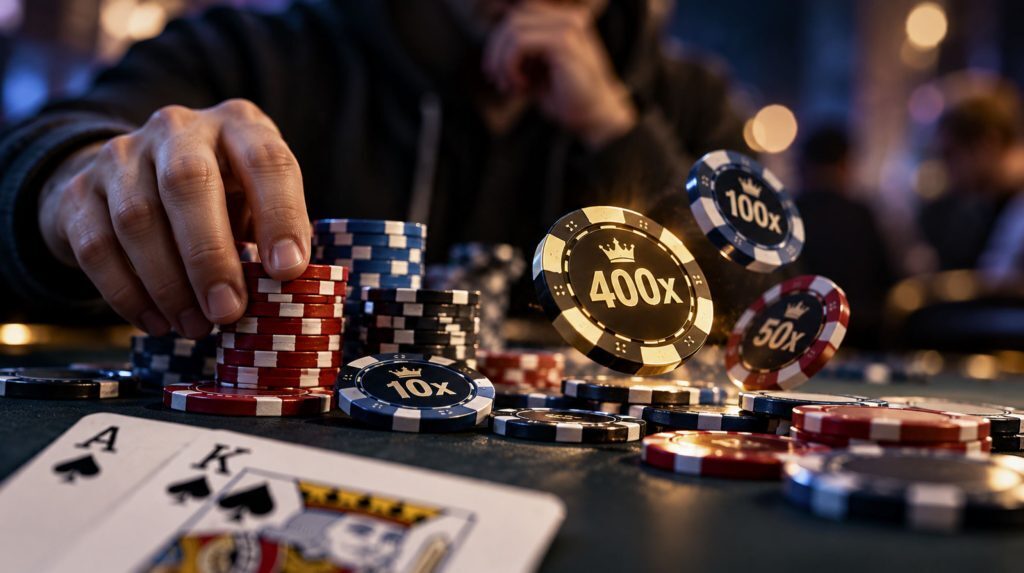
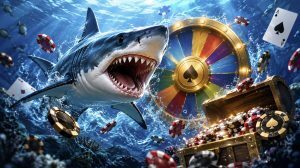
Crash cut to the present day and GGPoker are unveiling ‘Ocean KOs’, a new jackpot format which takes the Progressive Knockout concept and introduces a random multiplier to the bounty awarded when a player is eliminated. The vast majority of the knockouts return less than the headline bounty, while a tiny number (1 in 50,000) produce extraordinary payouts, with multipliers reaching as high as 400x. In other words, the bounty pool is effectively being redistributed across the entire Ocean KO tournament ecosystem, with the occasional player hitting the jackpot.
GGPoker did not invent this format. Winamax premiered ‘Space KOs’ in December 2024, combining the progressive mechanics of a PKO tournament with the jackpot psychology of ‘Spins’ (‘Expresso’ or ‘Spin & Go’). One noteworthy jackpot came in September of this year when a €100 Space KO with an €80,000 guarantee distributed more than €1 million, including an €838,000 bounty from a single knockout.
The appeal of Ocean KO is the escalating importance of picking up bounties in regular PKOs combined with the tantalising prospect of a more exciting bounty proposition. It is an attempt to import the jackpot economy of lottery-style poker into the MTT environment. In a conventional PKO, the value of a knockout is reasonably predictable. In Ocean KO, the same knockout can be worth a small or large amount, and that changes the economic nature of the game.
John Molesworth and the Psychology of Luck
This is where the historical analogy becomes useful. Seventeenth and eighteenth-century Britain had an extraordinary appetite for lotteries and lottery-linked financial products, with the distinction between investment and gambling often considerably blurrier than we might imagine today. Lottery tickets could be traded and financial instruments could contain lottery characteristics, creating a world in which a perfectly respectable financial transaction could also contain an enormous speculative tail.
Almost a century after the creation of the Million Lottery, the renowned and notorious lottery agent John Molesworth claimed that his tickets possessed a special advantage. Of course, the maths did not support his assertion. There was no magical category of ticket capable of bending probability in the buyer’s favour. Rather, Molesworth’s insight was a psychological one. He wasn’t selling mathematics. He was selling the possibility that mathematics might not apply to you.
At its core, a lottery ticket is an extraordinarily small object carrying an extraordinarily large imagined future. Most of the time, nothing happens. However, the buyer is not really paying for the almost inevitable outcome. They are paying for the possibility of the exceptional one. Molesworth understood that there are plenty of people who just want a reason to feel lucky and, if they do, fantasy will ultimately do all the heavy lifting.
Rational Calculation and Fantasy
Ocean KOs take the same tension between rational calculation and fantasy and put it on the poker table. Every decision you make that results in a successful knockout actually comes with a second decision that you do not make, a random draw made by the silicon overlords. Most of the time, you receive less than the expected value, while the money retained from those outcomes helps finance the handful of spectacular scores.
For the recreational player it is a simple proposition: the format offers them the dream of turning a €100 knockout into tens of thousands of euros, while ensuring that most of the time they are collecting less than they might expect from a conventional PKO. It might be thrilling but thrill and value are not the same thing. The operator will advertise the possibility of extraordinary bounties while the overwhelming majority of players experience something much closer to the other side of the distribution.
That is why the ‘Spins’ comparison matters. A good player can be a winner in Spins, but the practical problem is that, even at a table with only three seats, a winning player’s edge needs an enormous sample to be realised. That favours players with big bankrolls or backing and the ability to generate huge volume. Ocean KO imports the same problem into tournaments and amplifies it. Your poker decisions still determine whether you win the hand, but now a second lottery determines how much that victory is worth.
Poker Player Predictions
A prizepool larger than the one into which you bought is alluring. Recreational players who are of a more gamble-embracing mindset will be attracted to these. Ocean KOs will not be, strictly speaking, unbeatable. The problem is that they make the cost of being a professional poker player higher while simultaneously making the evidence that you are a good poker player harder to read. If two players make the same number of correct decisions over 10,000 tournaments, but one happens to collect several enormous bounties and the other does not, their results can tell us surprisingly little about the difference in their underlying ability.
That has very real consequences for the ecosystem. A player needs a larger bankroll to withstand the swings and a much larger sample to assess whether they are winning. Poker pro and stable-owner Patrick Leonard boldly insisted this week that “no MTT player in the world will be able to bankroll themselves in these. The variance is absolutely wild. Winamax, GG, and ACR all have them now and will be the end of the ‘self rolled’ pro.” Consider how Spins all but killed Sit & Gos, historically the most reliable way for a good tournament player to build up a bankroll. This is a multiplication of that.
There are also the game security and integrity implications. On the one hand, bounty formats add a complicating factor which makes poker hands insoluble. That’s a good thing and the poker sites understand that. However, there is another side to that coin when the bounties are potentially stratospheric. High-stakes pro Chris Brewer raised the issue of potential cheating in Jackpot PKOs, explaining that “colluding to get the big bounties within friend groups/stables is going to be a huge issue”. That will require additional policing.
The Risks
Rational calculation might tell you that the odds are dreadful, but imagination has a wonderful ability to turn a microscopic probability into a vivid possibility. That is what Molesworth understood and it is the psychological engine that has powered lotteries for centuries. The numbers can be brutally cold but the dream is anything but. The thing is though, that is not ‘the poker dream’. In fact, it is entirely at odds with it.
One of the USPs of poker is that skill can, eventually, separate itself from luck. The poker dream is not just about being better than your opponents. It’s about overcoming the rake, the reg fees and the variance over the long term. Jackpot PKOs might be fun but they undoubtedly make that harder to realise. Sure, the best players in the pool will still have an edge, but if the practical ability to reify that edge increasingly depends on capital, backing and volume, then far more will succumb to the heightened risk of ruin.
In his excellent article about this new format, poker player and writer Blaise Bourgeois concluded with a prognostication: “My prediction: Ocean KOs / Jackpot PKOs aren’t just here to stay; they are fully going to take over online poker much the way PKOs and Mystery Bounties have.” Rumour has it that beyond Winamax, ACR and GGPoker, other operators have similar products in development so the seascape of poker may be changing very soon.
The ocean might be the best place to fish, but if only the biggest boats can stay out long enough to make money, we should at least ask whether we are still building a poker ecosystem, or simply a more sophisticated lottery.

Comments