







Are Home Poker Games Legal in the US?
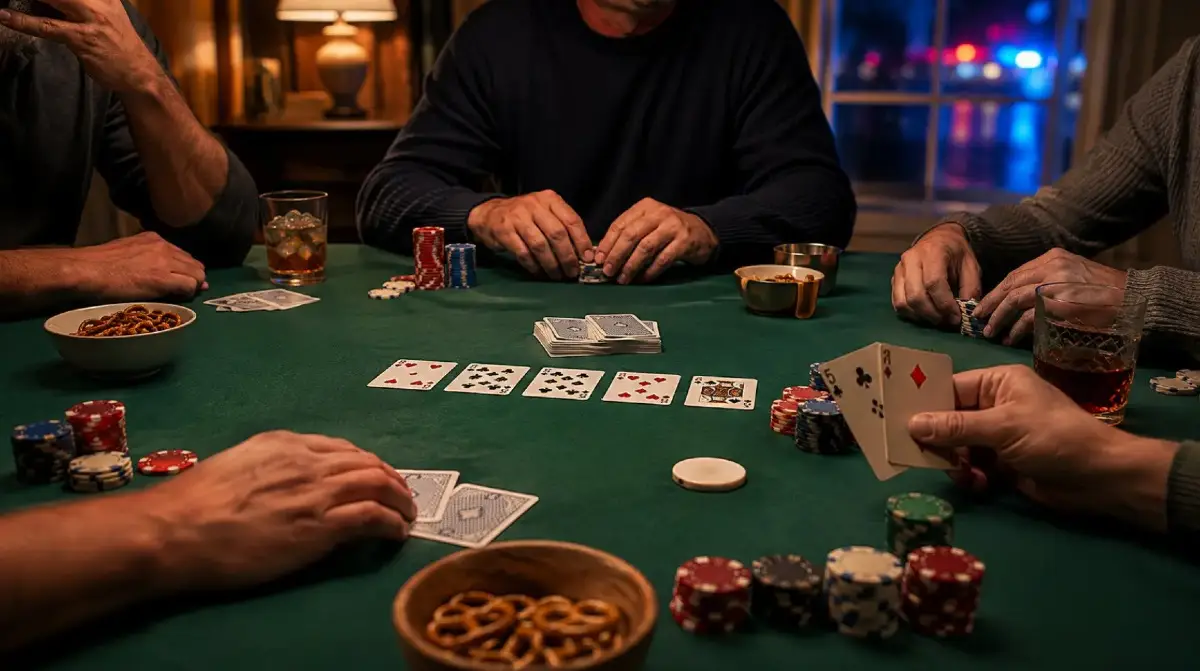
Are home poker games legal in the United States? The answer depends on where you live, whether the host takes a rake and, in some states, how much money is wagered. That matters when Friday night arrives, the beers are on ice and the poker chips are arranged in neat little stacks around the kitchen table.
So, you spent the week memorizing the odds of hitting a flush so you can get an edge on Daryl from Sales who’s clueless about the game but just gets lucky. But did you ever stop to consider the odds of a SWAT team turning up on your doorstep? Is this quintessentially American pastime even legal where you live?
Let’s find out.
OK, so the odds of the cops turning up in riot gear to break up your home game are almost non-existent, whichever state you live in. But that’s not to say it has never happened, more of which later.
When Are Home Poker Games Legal?
The good news is that 29 of 50 states (see table) explicitly allow social home games, provided individuals do not organize them for profit.
Wait, aren’t all home games organized for profit? Isn’t that the point of poker?
Well, yes, but it’s the act of taking a rake or a “vig” on a tournament buy-in that’s the no-no. To be fully legit, you must ensure that no one profits other than players who win within the confines of the game.
Confusion Reigns
Because each state makes its own gambling laws, America is a confusing patchwork of state statutes that is often hard to navigate. For example, you can play Texas Hold’em in Texas in the privacy of your own home, but playing Omaha in Omaha, Nebraska is not strictly legal.
Hawaii, where all forms of gambling are illegal — even lotteries and raffles — does make an exception for home games. But in Illinois, where almost all forms of regulated gambling are legal, home games, technically, are not.
“A person commits gambling when he plays a game of chance or skill for money or other things of value,” according to Article 28 Section 1 of the Illinois’ Penal Code.
Home Poker Game Stake Limits
In some states, it’s the stakes that matter. In North Dakota, for example, by the letter of the law, the game becomes illegal once anyone bets more than $25 in an “individual hand, game, or event.” Florida also limits legal home games under its penny-ante law. The winnings of any player in a single round, hand, or game cannot exceed $10.
Meanwhile, in Iowa, the amount won or lost by any of the players cannot exceed $50 in any 24-hour period. Legislators wrote many of these laws decades ago without accounting for inflation, so the permitted stakes lose real-world value each year. Maybe decades ago, the games in Iowa were pretty juicy!
Iowa is also very specific about what defines a “social” game, as is Wyoming. There must be a “bona fide social relationship between the parties apart from the gathering to gamble.”
Some states, such as Texas, put the emphasis on the private nature of the games. It is a defense from prosecution if “the actor engaged in gambling [is] in a private place,” whether that be your home or a private country club.
Arkansas Bans Nameless Variants
But what about states whose laws don’t explicitly make home games legal?
Very few states explicitly ban the act of participating in a poker game. Most simply don’t mention poker, or they fail to exempt non-commercial home games from their general gambling laws.
However, Arkansas mentions poker very specifically, and even bans variants that haven’t been invented yet. The Arkansas Code 5-66-112 prohibits anyone from “betting any money or any valuable thing on any game of brag, bluff, poker, seven-up, three-up, twenty-one, vingt-et-un, thirteen cards, the odd trick, forty-five, whist, or at any other game of cards known by any name now known to the law or with any other or new name or without any name.”
But the penalty for breaking this law is relatively inconsequential – a fine of between $10 and $20. In Vermont, it’s even less, a maximum of $5. Maybe you should just think of it as a rake. Just don’t take one yourself.
Once again, these laws are not adjusted for inflation, so they were harsher once upon a time. But the fact that lawmakers in Arkansas and Vermont haven’t updated them suggests that punishing social poker players is not a priority.
Crimes and Misdemeanors
But what about the states that do not specifically prohibit or authorize poker home games? It’s a gray area, but keep in mind that most states illegalize gambling unless the legislature or a public referendum has specifically legalized and the state has licensed it. This means private games should be assumed to be illegal even if the law is not strictly enforced.
In most states, participating in illegal gambling is a misdemeanor that could land you with a small fine or short jail sentence at most. The exception is Oklahoma, where organizing a home game is, technically at least, a FELONY, which means it carries a maximum sentence of ten years in the state penitentiary.
“Every person who opens… or who conducts… or carries on either poker… or who either as owner or employee, whether for hire or not, deals for those engaged in any such game, shall be guilty of a felony,” states Oklahoma Statutes 21 § 941.
However, felony gambling charges are rare in Oklahoma, and back in 2009, authorities told The Oklahoman newspaper they had little interest in enforcing the law on small poker games.
Is Poker Legally Considered a Game of Skill?
Many states make exceptions in their gambling laws for games of skill. Great, well that’s that settled then. Poker’s a game of skill, right?
It’s not as watertight a defense as you might think. Not many states agree with you, and some have actually written it into their gambling laws that poker is not a skill game.
Poker is a game of skill and chance. The question is which predominates. Courts in several states have considered whether skill or chance predominates in poker, although the answer does not always determine whether wagering on the game is legal.
But that may not be enough to get you off the hook. In 2008, a South Carolina municipal judge accepted expert testimony that Texas Hold’em was predominantly a game of skill but still convicted five defendants arrested during a home poker game. In 2012, the South Carolina Supreme Court confirmed in Town of Mount Pleasant v. Chimento that wagering on Texas Hold’em falls under the state’s gaming prohibition regardless of whether skill predominates over chance. Talk about getting rivered!
Shades of Gray
If home games are not explicitly legal in your state, the question is, is the law enforced and with how much zeal.
Do states fail to explicitly exempt home games from their gambling laws because they tolerate them to the degree that they consider such a statute unnecessary? Or do state authorities adhere to the letter of the law?
When faced with this possible gray area, proceed with caution. Google is your friend. Scour local media for reports of police raids. If you find none, you can probably proceed under the assumption that while home games may be nominally illegal, they do not enforce the laws. But be discreet. And definitely don’t take a rake.
The bottom line is authorities usually have better things to do than bust a friendly game with a few hundred dollars on the table.
But that doesn’t mean someone won’t target private home games, or that they couldn’t target yours.
Blood, SWAT, and Tears
During the mid-2000s poker boom, authorities in several states faced criticism for using SWAT teams to raid poker games. Most targeted games involved someone taking a rake, although the response was still heavy-handed. That wasn’t always the case, however.
Police raided an unraked game in San Mateo, California, in 2008 while wearing full riot gear. No one had taken a rake, but authorities claimed the $5 that players had contributed to buy refreshments qualified as illegal gambling.
In 2007, a Dallas SWAT team raided a Veterans of Foreign Wars Outpost hosting charity games because they were not conducting the game in a “private place” in accordance with Texas law.
In 2010, in Idaho, law enforcement raided a small-stakes game organized by senior citizens. The bust sparked a public outcry, and as a result, all such raids now require the approval of the public prosecutor’s office.
Robbery More Common
Today, there are very few recent examples of these kinds of raids on small non-commercial poker games, which suggests authorities across America have chilled out a bit over the past 15 years, at least when it comes to poker.
The truth is, home game robberies are far more common than police raids, which is another very good reason to be discreet about your home game and only invite people you know.
Ultimately, if someone is going to come bursting through your door, guns drawn, you’d prefer it to be the cops.
Home Poker Game Laws by State
The table below shows whether each state explicitly permits social home poker games. Additional restrictions may apply, including rules covering rake, stakes, locations and the relationship between players.
| State | Home Games Explicitly Legal? |
|---|---|
| Alabama | Yes |
| Alaska | Yes |
| Arizona | Yes |
| Arkansas | No |
| California | Yes |
| Colorado | Yes |
| Connecticut | Yes |
| Delaware | No |
| Florida | Yes |
| Georgia | No |
| Hawaii | Yes |
| Idaho | No |
| Illinois | No |
| Iowa | Yes |
| Kansas | No |
| Kentucky | Yes |
| Louisiana | Yes |
| Maine | Yes |
| Maryland | Yes |
| Massachusetts | Yes |
| Michigan | Yes |
| Minnesota | Yes |
| Mississippi | No |
| Missouri | Yes |
| Montana | Yes |
| Nebraska | No |
| Nevada | Yes |
| New Hampshire | Yes |
| New Jersey | Yes |
| New Mexico | No |
| New York | Yes |
| North Carolina | No |
| North Dakota | Yes |
| Ohio | Yes |
| Oklahoma | No |
| Oregon | Yes |
| Pennsylvania | No |
| Rhode Island | No |
| South Carolina | No |
| South Dakota | No |
| Tennessee | No |
| Texas | Yes |
| Utah | No |
| Vermont | No |
| Virginia | Yes |
| Washington | Yes |
| Washington DC | No |
| West Virginia | No |
| Wisconsin | No |
| Wyoming | Yes |
State and local gambling laws can change, and additional municipal rules may apply. This page provides general information and should not be considered legal advice.
FAQ
Home poker game laws vary by state. Many states permit private social games as long as the host does not take a rake or otherwise profit from operating the game. Other states prohibit poker games played for money or do not provide a clear exemption for social gambling.
Generally, no. In states that permit social poker games, the host usually cannot take a percentage of the pot, charge an entry fee or receive another financial benefit from operating the game.
Some do. Florida, Iowa and North Dakota are among the states that impose specific limits on the amount players may wager, win or lose in an otherwise permitted social game.
Tournament-style games may be permitted when they meet the same requirements as other social poker games. The host generally cannot profit from the buy-in, and state-specific stake or prize limits may apply.




Comments