


Best Rakeback Deals for Tournament Players
Tournament rake can quietly eat into a player’s profits, especially for those who grind tournaments regularly. Rakeback programs help offset

Mystery Bounty Tournaments: How They Work & Strategy Guide

Mystery bounty tournaments are the hot new thing in poker thanks to their potential for life-changing payouts. These tournaments have hidden bounties that are only revealed when you claim them, adding an extra layer of strategy to your decision-making. Many players don’t properly account for the impact of these bounties, meaning that there’s plenty of value to be found in these tournaments if you know how to play them. This article covers how the format works, strategy changes for different stages, mental factors that affect play, and where to find these tournaments online.
Mystery bounty tournaments split the prize pool into two parts: the regular payout structure and a separate bounty pool. All of the possible bounties are listed on the tournament information page, and when you knock a player out, you’ll receive one of these prizes at random. This is significantly different to traditional bounty tournaments, as you don’t know the size of the bounty you’ll receive until you’ve knocked a player out.
In most traditional mystery bounty tournaments, bounties become active once players reach the money. However, some variations activate bounties earlier, including formats where they are available from the first hand.
This unknown factor changes the math compared to regular bounty tournaments, where you can calculate exactly if calling an all-in makes sense based on the fixed knockout value. In mystery bounties, you make decisions based on average bounty value rather than exact numbers, so it’s important to keep the list of remaining bounties available at all times.
Many of the best US poker sites offer mystery bounty tournaments, so it’s important to compare your options to find the best-value tournaments. The buy-ins and maximum bounty sizes vary by event, so we recommend checking the tournament lobby for specific details on buy-ins, bounty structures, and prize pools before you play.
Bovada’s “Mystery Knockout” tournaments put exactly 50% of each buy-in into the bounty pool, creating a balanced structure between regular payouts and knockout value. Bounties activate only in Phase 2 (once in the money), which means early play follows standard tournament strategy. The 50/50 split makes the math cleaner than sites with irregular allocations.
BetOnline’s $55 Mystery Bounty Jackpot tournaments feature a progressive jackpot bounty starting around $70,000 (potentially life-changing money from a single elimination). The site offers low-cost satellites to access these events, making the format accessible. The fixed $55 buy-in limits options compared to sites offering multiple stake levels throughout their schedule.
ACR schedules Mystery Bounty events regularly, with bounties activating once you reach the money (top 12% of the field). Each elimination awards a “mystery chest” prize, and one chest holds roughly 10% of the total prize pool. The format creates intense action in the later stages, though you’ll need to survive a regular tournament structure first before getting any bounty value.
SportsBetting.ag offers the same Mystery Bounty Jackpot tournaments with the $70K progressive bounty as BetOnline. The site stands out with ultra-cheap satellite qualifiers (some just $0.25) and a consolation freeroll entry if you bust a satellite. This accessibility makes it appealing for recreational players, though serious grinders may want more buy-in variety.
Black Chip mirrors ACR’s Mystery Bounty structure but targets a different player base. Bounties only become active on Day 2 after the money bubble, meaning Day 1 plays like a regular tournament. The potential for a single mystery prize to beat the first-place payout adds drama, though this same variance means many eliminations give minimal bounties.
Ignition runs the same Mystery Knockout format as Bovada (they share software), with 50% of buy-ins funding the bounty pool. The two-phase structure keeps Phase 1 bounty-free, then switches to mystery knockout mode once players reach the money. This setup works well for players who want regular tournament poker early with lottery-style excitement later.
Mystery bounty tournaments can vary based on their buy-in structure and level structure. It’s important to understand the differences between each type of tournament, as your strategy will change based on its structure.
Single-day tournaments often feature faster blind structures, while multi-day events generally allow more time for play. However, blind levels vary considerably between online and live tournaments. Multi-day events are common in live poker, although online operators also offer multi-day tournaments and events with multiple starting flights. The timing of bounty activation depends on the tournament’s specific rules, so it’s important to check when knockout prizes become available.
The faster pace of single-day events means that you have less time to accumulate chips, forcing you to take more high-variance spots to build a stack and claim bounties. Multi-day events, by comparison, give you much more playing time, allowing you to pass up thin spots to preserve your tournament life.
The best poker tournaments allocate different percentages of the buy-in to the bounty pool, typically ranging from 25% to 50%. The bounty allocation is one of the most important things to check before you register, as it will have a significant impact on your strategy. Generally, a larger bounty allocation increases the value of knockout opportunities relative to regular payouts, although the best decision still depends on stack sizes, payout considerations, and the remaining bounties.
Some poker sites offer a special variant of the Mystery Bounty format where 100% of your buy-in goes to the bounty pool (minus the tournament fee). These “Total Mystery Bounty” events have no regular prize pool, and bounties are live from the first hand. There are also “Mostly Mystery Bounty” events, which have a 75/25 split between the bounty and standard prize pools.
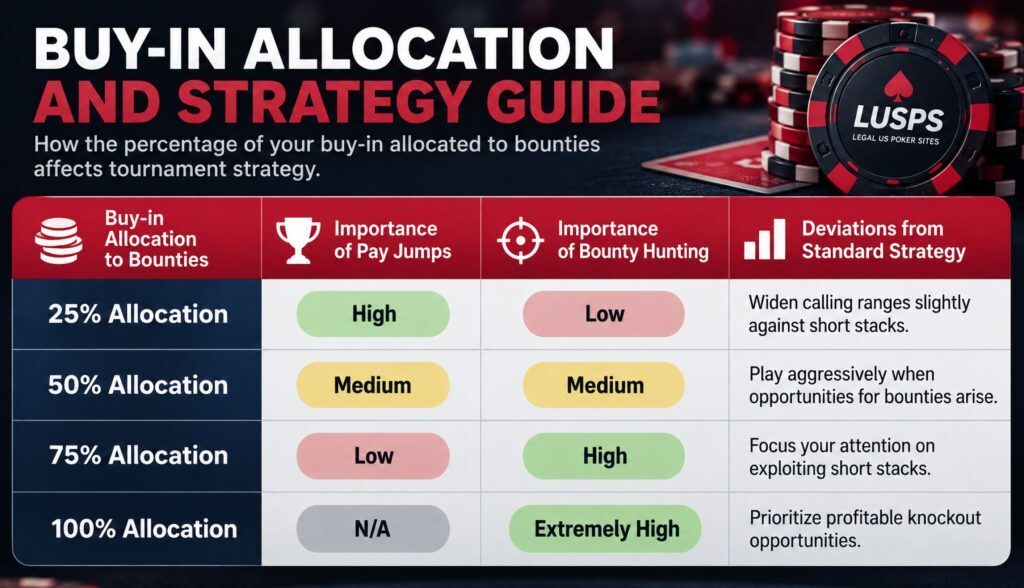
Mystery bounty tournaments require you to shift your approach based on the stack sizes of your table-mates and the average bounty size. Many players don’t adjust their strategy to account for the bounties, which gives you the opportunity to exploit them. To help you master mystery bounty tournaments, our experts have provided some key strategy tips you can use in your next event. Once the bounty phase begins, you’ll need to adjust your calling ranges to account for the extra value each knockout brings.
While bounties aren’t available at the start of the tournament, you should use the early levels to put yourself in the best possible position for when they do come into play. Building a solid stack before bounties activate gives you the chips needed to take advantage of elimination opportunities later, but if you play too aggressively, you can become a target for other players.
We recommend that you play solid poker in the first few levels, accumulating chips through well-timed bluffs and value bets. Some players advocate for extreme aggression in the early stages, and while that does give you a chance at running up a big stack, you’re equally likely to go into the bounty-portion of the event short-stacked, making you a target for other players.
Many players don’t understand how to adjust their ranges based on the value of a tournament bounty, which leads to significant mistakes in-game. One way to estimate bounty value is to convert the expected bounty payout into a chip equivalent, accounting for the portion of the buy-in allocated to the regular prize pool.
For example, when facing an all-in against a player you can eliminate, the potential mystery bounty adds value to winning the hand. The size of that additional value depends on the average remaining bounty, the tournament’s prize-pool allocation, and the effective stacks. A larger expected bounty can justify calling with a wider range than you would in a standard tournament, provided the call remains profitable.
Once the bounties come into play, it’s important to track the average bounty value as closely as possible and use it to adjust your calling ranges. Sticking to your standard tournament calling ranges will result in -EV plays, as you’ll miss out on the bounty prize pool.
For example, you’re in the BB with four starting stacks (40bb), the player in the SB shoves for one starting stack (10bb), and the average mystery bounty value is around 20% of your tournament buy-in. The additional bounty value can justify calling with a wider range than in a standard tournament, depending on your opponent’s shoving range, effective stacks, and payout considerations.
If you play conservatively and don’t adjust your range to account for the added EV of the bounties, you’ll make multiple overfolding mistakes that will hurt your bankroll in the long run.
Depending on the size of the bounty prize pool, you should be looking for spots where short-stacked players are likely to commit their chips and adjusting your strategy to take advantage of the potential bounty. This is more the case in events where the majority of the prize pool is awarded via bounties, as you’re incentivised to claim as many bounties as possible.
For example, if you see a short-stacked player in the big blind, you should widen your raising range to give yourself a better chance at the knockout. The added value of the bounties means that you’re allowed to raise and call off wider than usual, which makes it a mistake to play conservatively.
You can also lay the trap for short-stacks by playing passively, hoping that they jam to pick up the extra chips. If you’re in early position and see a short-stacked player behind you, a common strategy is to limp in with a strong hand and wait for the action to unfold behind you. While this does run the risk of taking a strong hand multi-way, you can potentially pick up multiple bounties if more than one player decides to chase the short-stack bounty.
Mystery bounty tournaments create specific situations where players make costly errors that don’t exist in regular tournaments. Recognizing these mistakes will help you avoid them and give you an advantage over opponents who fall into these traps.
Mystery bounty tournaments trigger different mental responses than regular poker events; some players play conservatively and wait for strong hands, knowing that they’ll be called light, while others go on the offensive, playing a hyper-aggressive strategy to get as many knockouts as possible. Understanding these mental factors helps you stay disciplined while taking advantage of opponents who let excitement override their judgment.
Some players are drawn in by the thought of pulling the top bounty and adjust their ranges based on the top prize, rather than the average prize value. These players will call off against shoves extremely wide, and will play a hyper-aggressive strategy that’s designed to get all-in as frequently as possible.
When playing against these players, don’t be afraid to get all-in with a more marginal hand than you usually would. Hands like AJs, 99, KQs, etc. are far ahead of the range that they’re likely to call with, giving you a great chance to build a stack. Bluffing against these players isn’t advisable, as they’re calling far too much of their range for you to do so profitably.
Passive players watch players widen their range to chase bounties and think, “I can trap them!” These players don’t understand the EV of playing a wider range in bounty tournaments, and will counterintuitively tighten up to try and “exploit” their opponents.
Bluffing against this group of players is going to be extremely profitable, as they’ll significantly overfold their range, even when bounties are on the line. Look for spots where you have a range advantage over your opponent and leverage that advantage with multi-street aggression.
Knowing how to cope with the money bubble and how the dynamics shift is an important part of poker. In these events, the presence of the bounties means that two bubbles are taking place at once; one for the standard payouts and another for the bounty prize pool.
Players with medium-short stacks are highly incentivized to survive, as making it past the bubble provides them with the opportunity to earn bounties. This leads to players dramatically overfolding – even more than they do in standard tournaments – providing you with a great opportunity to build your stack in preparation for the bounties.
Despite being a relatively new format, mystery bounty tournaments have already created some of poker’s most dramatic and memorable stories. The format’s unpredictability means any elimination could turn into a life-changing score, even if you don’t make a deep run in the event. These real examples show how the format can transform ordinary hands into special moments.
Mystery bounty tournaments have quickly become one of the most popular formats in poker because they add an element of surprise to every elimination. The key to acing these events is knowing when to play your normal game and when to adjust for bounty value, while also staying aware of how the hidden prizes affect your opponents’ decisions. Remember to stay aware of the average bounty value and use this information to adjust your ranges and make +EV decisions.
You can find mystery bounty events at reputable online poker sites that offer regular tournaments with various buy-in levels. Start at stakes you’re comfortable with and see if this exciting blend of strategy and chance is right for your game.
Tournament rake can quietly eat into a player’s profits, especially for those who grind tournaments regularly. Rakeback programs help offset


Your bankroll management for Tournament poker is significantly different from that for cash games. The ups and downs are bigger,

Knowing the best times to play sit & go tournaments can make a difference in your poker winnings, as player







Comments