



Online Poker Household Rules: Can Two People Play From the Same House?
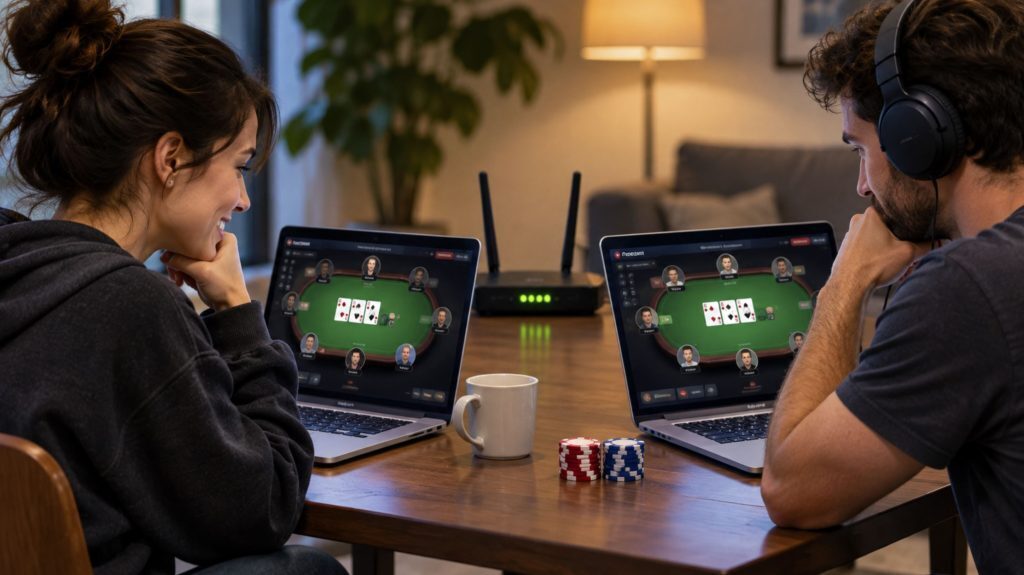
Living with someone who also plays online poker doesn’t automatically mean that you can’t both have accounts. Most licensed poker sites do permit separate players at the same address, but there are real rules around collusion, shared tables, and account use that you need to understand before you start playing. This article covers what those rules look like in practice, why poker sites monitor household accounts, and what you can do to protect yourself from any issues.
Why Sharing a Household Matters in Online Poker
When two people connect to the internet from the same home, they share a single public IP address assigned by their internet service provider. Poker sites check players’ IP addresses to prevent players in the same household, or using known open proxy servers, from playing on the same tables. This is a standard part of how online poker platforms manage security and fair play.
Sharing an IP address does not mean you are doing anything wrong. Poker sites understand that families, couples, and roommates all use the same home network. The concern isn’t the shared connection itself, but whether players use it to gain an unfair advantage at the tables.
Can Two People in the Same House Play Online Poker?
The short answer is yes, in most cases. Most licensed poker sites allow separate accounts for people living at the same address, provided each player registers and plays independently. Conditions do apply, however, and they can vary between operators.
Here are the key points to keep in mind:
- Separate accounts are required. Each player must register their own account using their own personal details, including name, date of birth, and payment information.
- Account sharing is prohibited. All major poker operators prohibit players from sharing a single registered account, regardless of their relationship.
- Shared-table restrictions may apply. Some sites limit whether household members can sit at the same cash game table or enter the same tournament.
- Rules differ between operators. Poker sites have different rules, so always check what your specific platform allows.
Why Poker Sites Monitor Collusion Between Household Accounts
Collusion occurs when two or more players work together to gain an unfair advantage over others at the table. Online poker platforms prohibit this form of cheating. It can take many forms, but the core issue is that players who know each other and can communicate outside the game have opportunities to coordinate in ways that undermine fair competition, such as sharing hole card information.
Household accounts attract additional scrutiny because the players behind them have obvious means to communicate in real time. Online poker rooms keep records of every hand played and use that data to identify patterns that may indicate collusion. Players who frequently sit at the same tables may attract additional scrutiny, particularly if their betting patterns suggest coordinated play. Depending on the site’s policies, players caught colluding may face account suspension or termination, confiscation of winnings, or permanent bans from the platform.
What Is Soft Play in Poker?
Soft play is one of the more subtle forms of collusion and can occur even without any deliberate intent to cheat. It refers to a situation where a player fails to bet or raise in a hand when the situation would warrant doing so, primarily to avoid winning money or chips from a friend. For example, if you’re heads-up against your spouse and you check down a strong hand on the river instead of making a value bet, that’s soft play. It isn’t always intentional or malicious, but it still raises collusion concerns because it unfairly benefits those involved in a way that disadvantages other players at the table.
How Poker Sites Identify Suspicious Activity
Collusion detection combines information about possible links between accounts, such as shared IP address and device fingerprints, with gameplay-pattern monitoring. Colluders who use separate identities, email addresses, and payment methods often slip up at the device level. Security teams also examine login patterns, account registration details, betting behavior, and how frequently two accounts interact at the same tables.
An IP address alone isn’t enough to establish collusion. Sites also examine gameplay patterns for evidence of coordination.
What Poker Site Rules Say About Household Accounts
Account sharing is prohibited on all major licensed poker platforms. This applies regardless of the relationship between players. Separate accounts for household members are generally permitted, subject to each site’s rules.
| Poker Site | Household Account Rules | Shared-Table Restrictions |
| PokerStars | Household members can maintain separate accounts. Identity verification may be required. | Household members cannot play at the same cash game table or Sit & Go tournament. Exceptions apply to scheduled MTTs and heads-up matches. |
| Global Poker | Multiple accounts in one household are permitted. Each player should use their own device and account. | Contact Global Poker support to confirm any restrictions on household members playing at the same table. |
Some operators may restrict accounts to one per person, household, or IP address. Always check the site’s terms and conditions before playing.
Can Household Members Play at the Same Table?
Shared-table restrictions can catch players off guard, particularly when different poker formats have different rules. For example, restrictions on cash game tables and Sit & Go tournaments may differ from those for scheduled Multi-Table Tournaments (MTTs) and heads-up matches. Some sites enforce these restrictions automatically through their software.
While the rules tend to be very similar across the industry, operators can handle these distinctions differently. Because there is no single industry-wide standard, you should confirm the rules directly with your poker site before sitting down at the same game as someone you live with.
How to Protect Your Online Poker Account When Sharing a Household
Taking a few straightforward steps before you start playing can prevent account problems down the line. The following measures cover the most common areas where household players run into issues.
- Register separate accounts with accurate personal information. Each player in the household should create their own account using their real name, address, and date of birth. Providing false details is itself a terms violation.
- Use individual payment methods where required. Check whether your site requires that deposits and withdrawals be linked to payment methods in the account holder’s own name.
- Contact customer support to confirm household policies. Before playing, reach out to your poker site and ask specifically about household accounts and shared IP addresses.Get confirmation in writing if possible, and save the correspondence in case questions arise about your account later.
- Follow any restrictions on shared tables and tournaments. If your site prohibits household members from playing at the same table, respect that rule, even in low-stakes games.
- Avoid transferring funds between household accounts. Unauthorized transfers between accounts can be flagged as suspicious activity, even if no collusion was intended.
What About Play-Money Poker and Private Games?
Not all poker formats carry the same level of account scrutiny, and play-money environments are worth addressing separately. Play-money platforms and private home-game apps sometimes have more relaxed policies around household accounts, since there’s no real financial risk involved. However, if a platform offers any real-money features — even optional purchases or prize pools — the same principles around account integrity and fair play may still apply. Some private game formats are also subject to applicable gambling laws depending on your jurisdiction, so it’s worth being aware of the legal context even in informal settings.
What Household Poker Rules Mean for Players
Sharing an address or IP address doesn’t prevent two people from playing online poker. Most licensed sites accommodate same-household players, provided each person maintains their own account and follows the rules around shared-table play and collusion. The key is understanding that poker sites monitor connected accounts as part of their security processes, and that certain behaviors, even unintentional ones like soft play, can attract scrutiny.
Checking your site’s terms before playing, contacting support with any questions, and keeping your account activity clean are the most reliable ways to avoid problems. Household poker is entirely manageable when you approach it with the right information.





Comments