

Sean Perry Burns $200K as Seth Davies Leads Super High Roller Bowl XI
By Sandra Gaweda | October 10, 2026 | 4 min read Sean Perry’s Super High Roller Bowl XI lasted one


WSOP Bracelet Timeline: Every Design From 1970 to 2026
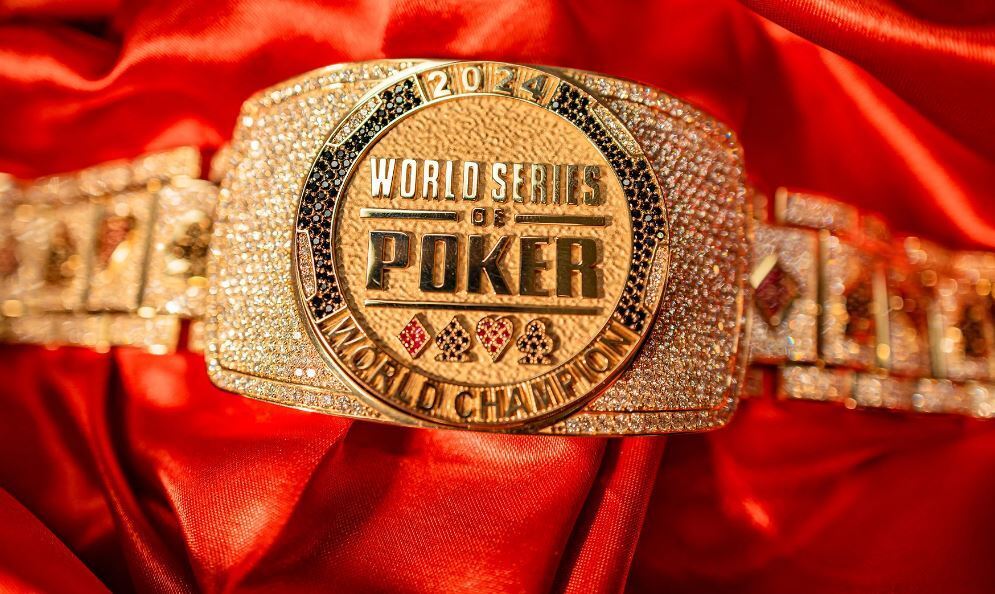
The WSOP bracelet is the most recognized trophy in poker — but it hasn’t always looked the way it does today. From the inaugural silver cup handed to Johnny Moss in 1970 to a nearly half-kilogram Main Event bracelet given to Michael Mizrachi for his Main Event win, this timeline covers every major design era, the craftspeople behind each piece, and more.
For poker players, a WSOP bracelet carries the same weight as a Super Bowl ring does for a football player competing in the World Series of Poker. It’s the crowning achievement of most players’ careers, and a permanent reminder of your accomplishment. No other prize in the game comes close to matching its symbolic value.
Arguably the greatest proponent of the WSOP bracelet is Phil Hellmuth. The all-time leading bracelet winner, Hellmuth places a lot of significance on each of his wins, saying, “To me, the bracelets have always been a really huge deal… This is how they measure greatness.” However, not everyone shares his belief of the bracelet’s importance, seeing them more as an addition to their prize money than a symbolic representation of their win.
Some of the modern bracelet designs vindicate this belief; for example, the 2024 Main Event bracelet, won by Jonathan Tamayo, was appraised at up to $500,000, which is more than the first-place prize for many smaller events across the annual WSOP schedule.
The WSOP bracelet did not exist at the start of the World Series of Poker. It would take 6 years for the iconic bracelet to be introduced, as the WSOP grew from a select few of the country’s greatest players to a worldwide phenomenon.
The World Series went through several designs before finally settling on the gold bracelet:
Record keepers retroactively count all pre-1976 WSOP championships as bracelet wins, which is why Johnny Moss and other early champions appear on all-time bracelet lists.
Benny Binion introduced the WSOP bracelet in 1976, replacing the silver cups and plates used in previous years. The man behind the original design was Mordechai Yerushalmi, a Las Vegas jeweler known as the “King of Bling,” who went on to create pieces for celebrities like Elvis Presley, Evel Knievel, and Mike Tyson.
The early bracelets were simple, as Yerushalmi’s design drew on a gold nugget aesthetic; raw and textured in a way that reflected the era’s craftsmanship. Becky Behnen, Benny Binion’s daughter, described the original bracelet band as looking “like gold nuggets kind of hammered flat.”
They weren’t the high-value pieces we’re used to seeing today; in the 1970s and 1980s, a WSOP bracelet was worth roughly $500. However, this is at a time when gold was around $125 an ounce; assuming 4 ounces of gold per bracelet, those bracelets would be worth more than $18,000 today!
In the early days of the WSOP, players focused on prize money, not the hardware. Even Doyle Brunson didn’t really care for the trophies, saying, “I didn’t even go pick two of them up because they didn’t have any real significance before…I gave the rest of them away to family members.”
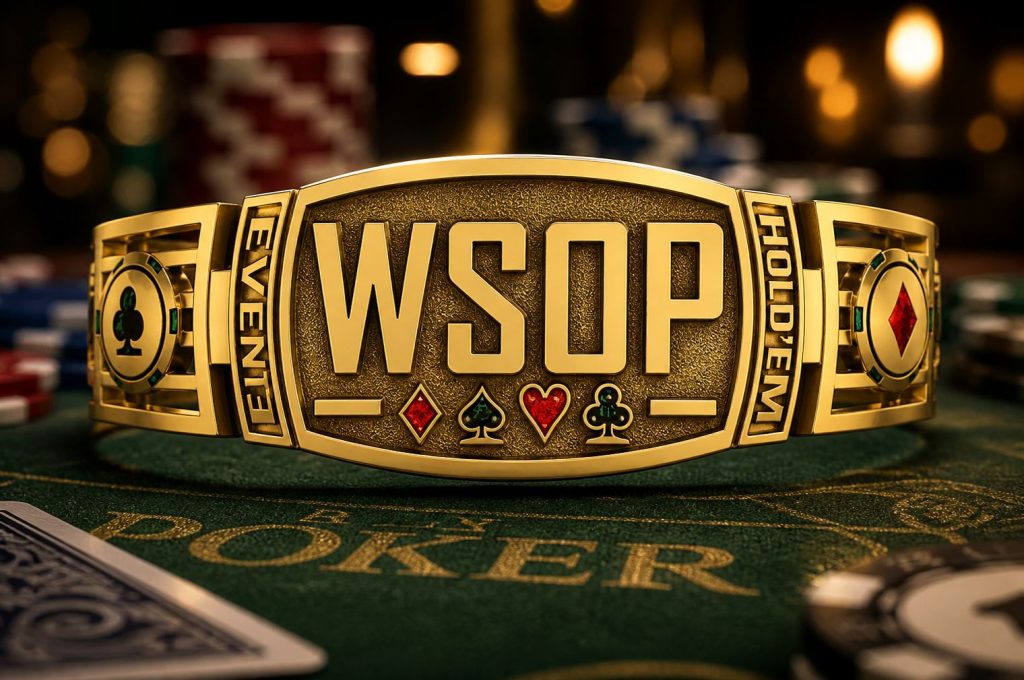
In the early 2000s, Caesars Entertainment (then operating as Harrah’s), acquired the WSOP and set about modernizing every aspect of the brand, including the bracelet design. The Yerushalmi-era gold nugget design had served the Series for nearly 30 years, but Caesars wanted to move in a different direction. For the Main Event specifically, they felt that the tournament deserved a special bracelet that matched the growing commercial scale and prestige of the WSOP.
Gold and Diamond International took over bracelet production in 2005, and the Main Event bracelet won by Joe Hachem that year was significantly more “blinged out,” featuring platinum and diamonds alongside the classic gold, and represented a significant departure from the simple bands of the Yerushalmi era. The WSOP also included Corum watches in winner packages, reinforcing the shift toward luxury-level prizes.
Frederick Goldman stepped in as bracelet producer in 2006, and the Main Event bracelet won by Jamie Gold that year became one of the most detailed and documented designs in WSOP history. The piece combined white and yellow gold with diamonds, rubies, sapphires, and black diamonds; designers used the colored gemstones to represent the four card suits. This detail would become a recurring theme in WSOP bracelet design going forward.
From 2010 onward, WSOP bracelet design continued its trajectory toward high-value luxury pieces. The WSOP now produces more intricately detailed bracelets than anything from the Caesars transition era. Each design uses more diamonds, precious metals, and event-specific branding.
Steve Soffa and Jason Arasheben, two of America’s most popular jewelers, have helped produce WSOP bracelets. These designs reflect the tournament’s status as a global sporting event. Even Jostens produces bracelets and rings for the WSOP and WSOP Circuit. It is best known for making championship rings in the NFL and NBA.
The result is a bracelet that no longer resembles the simple gold band Doyle Brunson gave away to family members in the late 1970s. The WSOP designs modern bracelets for display, collecting, and appraisal.
Most of the effort to modernize the WSOP bracelet design goes into the WSOP Main Event bracelet. “Normal” events work from a standardized design, while special tournaments, like the Main Event, have special bracelets commissioned. Below, we’ve highlighted the key differences between the Main Event bracelet and a standard WSOP bracelet:
| Feature | Main Event Bracelet | Standard Event Bracelet |
| Weight | 445 grams of 10-karat gold | < 100 grams |
| Gems | 2,253 total (1,948 diamonds, 230 black onyx, 75 rubies) | Limited if any |
| Special Feature | Removable card protector faceplate | Standard fixed design |
| Estimated Value | Up to $500,000 | $1,000-$2,000 |
The table below summarizes the confirmed design eras, jewelers, and key details across the full WSOP bracelet timeline.
| Era/Year Range | Jeweler/Maker | Design Characteristics |
| 1970-1975 | N/A (silver cup/plate) | No bracelet awarded |
| 1976-2003 | Mordechai Yerushalmi | Gold nugget-style band |
| 2004-2006 | Gold & Diamond Int. / Frederick Goldman | Shift to diamonds, luxury builds |
| 2007-2009 | Corum | High-end builds + luxury watch tie-ins |
| 2010-2011 | OnTilt Designs / Steve Soffa | Onyx + diamond styling |
| 2012-Present | Jason of Beverly Hills / Jostens | Fully custom, gemstone-heavy, large-scale builds |
From a simple $500 gold band that Doyle Brunson didn’t bother picking up to a custom-built, nearly half-kilogram piece of hardware loaded with gold and precious stones, the WSOP bracelet has evolved considerably since it was first introduced in 1976. The advancements in design have brought the World Series bracelet in line with other notable US sports hardware, such as the Super Bowl ring.
While the design has changed significantly since the early days, what hasn’t changed is the core meaning. Winning a WSOP bracelet is the dream of millions of poker players around the world, and represents the culmination one has always meant the same thing: you were the best player in the room when it mattered most. The design evolved. The prestige only grew.
Bracelets were first awarded in 1976, introduced by Benny Binion to replace the silver cups and plates used in prior years. All pre-1976 WSOP championships are retroactively counted as bracelet wins for record-keeping purposes.
Bracelet value varies significantly depending on the event. Standard WSOP bracelets are valued between $1,000 to $2,000 on average, while special bracelets, like the one awarded to the Main Event winner, can reach as high as $500,000.
Yes, WSOP bracelets are made with real gold. The karat and quantity have varied across eras and events. The 2025 Main Event bracelet, for example, contained 367 grams of 10-karat gold alongside thousands of diamonds and other gemstones. Earlier designs used simpler gold bands before gemstones became a standard part of bracelet production.
Phil Hellmuth holds the all-time record with 17 bracelets, and he’s widely credited with turning bracelet collection into a competitive pursuit within the poker community. Behind him are Phil Ivey with 11 bracelets, and Erik Seidel, Johnny Chan, and Doyle Brunson with 10 each.
Yes, online bracelet events are now a permanent part of the WSOP calendar. The online series will be running from May 30 through July 14 alongside the live events, so check out our 2026 WSOP schedule to plan the events you want to play.
By Sandra Gaweda | October 10, 2026 | 4 min read Sean Perry’s Super High Roller Bowl XI lasted one
By Sandra Gaweda | October 8, 2026 | 4 min read Hustler Casino Live (HCL) has pulled high-stakes regular Britney
By Sandra Gaweda | October 7, 2026 | 4 min read High-stakes poker players who use company money could face



Comments