


Freud, The Uncanny And Poker
Freudian Insights
I read a lot of Freud in college, both the try-hard, rigorous Freud who was deeply respectful of the scientific method and the playful, after-dinner Freud who waxed lyrical on psycho-sexual motivations. I was studying philosophy and, within that broad subject, I drifted towards existentialism and its overlap with many of the great Irish literary figures. As far as I was concerned, Fredrick Nietzsche, Martin Heidegger, Jean-Paul Sartre and Albert Camus were swimming in the same deep waters as George Bernard Shaw, John Millington Synge, James Joyce and Samuel Beckett.
Freud was lumped in with the psychologists but that categorisation never fit for me. His insights, while sharp, were not scientifically provable. Down the years, I have engaged in good faith debate with psychologists but none have ever convinced me that Freud’s work belongs under their umbrella. Instead, he belongs with the literary theorists, and as a giant of that discipline. In fact, I would contend that nobody has made a bigger contribution to how the modern person both processes and narrates their lives.
I have also pondered long and hard about the ways that Freud’s work provides some particularly interesting insights into the poker life. His ideas about the unconscious mind, hidden desires and defense mechanisms can be applied at the tables. So too can his concepts of the id and the ego as the tension between risk-taking and caution mirrors the push and pull between instinctual desires and rational control. In this way, poker is more than just a game; it becomes a stage where hidden motives and emotional regulation play out in real time, aligning closely with Freud’s theories of the human mind.
The Uncanny
In his famous essay Das Unheimliche (The Uncanny) Freud examines a phenomena adjacent to deja-vu, when something alien feels familiar. It could be a coincidence that feels choreographed or stranger who is recognised. He argued that an uncanny experience is the return of something long repressed, thrust from the unconscious to the conscious, a once buried thing now exhumed.
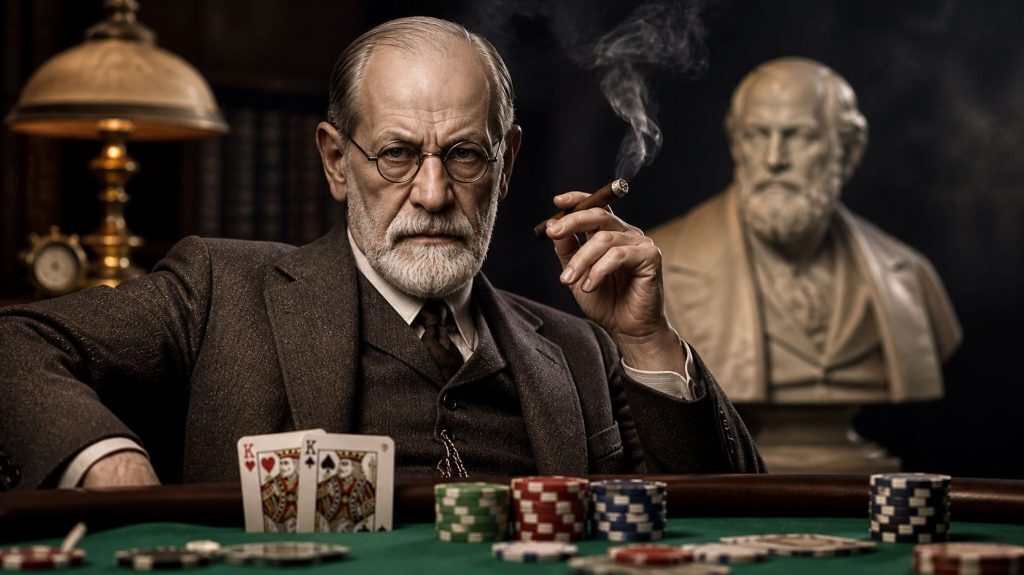
Poker players experience the uncanny. We lose with Kings into Aces on Sunday. It happens again on Tuesday. By Thursday, when we peel back those two red Kings, we feel something that is not merely anxiety. It is recognition. A script that we did not write seems to be playing out again. When this happens, we fight off superstition. We tell our brains, which are hard-wired to find patterns, that none exist. We know that we are living in a unique, random moment yet the rational explanation struggles to dispel the sensation of design.
Mathematically, of course, nothing supernatural is happening. The deck has no memory, poker odds remain unchanged and variance holds no grudges. Yet the human mind recoils from randomness that clusters. It has evolved to find order in noise and when it detects too much order, especially the kind that harms us, it interprets it as agency. The uncanny feeling arises not because fate exists, but because our cognitive wiring struggles to accept that it does not.
The Double and The Automata
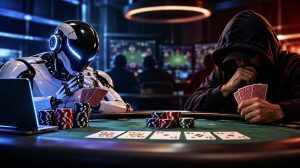
Freud linked the uncanny to the figure of the double, a person who mirrors you, anticipates you and even exposes you. He also wrote about ‘automata’, describing lifelike figures that disturb precisely because they hover between animate and inanimate. A robot that looks almost human unsettles more than one that is obviously mechanical.
In poker, the double often appears in strategic form, when you encounter a player whose game resembles yours. You observe them betting the same textures, choosing the same sizings and probing the same scare cards. Watching them play is like reviewing your own hand history in real time. Poker players like to believe that their game is idiosyncratic, born of private insights and personal flair. The uncanny sensation comes from the realisation that your identity at the table is less singular than you imagined.
That sensation is especially sharp in the case of online poker where we encounter both the double and the automata. A cartoon fox flats your raise in the cutoff. A national flag with the same HUD stats as you squeezes from the small blind. Bet sizes are calibrated to the decimal. The gestures of poker are present but the bodies are absent. It is still poker of course but, without the physical component, it is a silent negotiation of ranges. It is an uncanny valley.
The Physical Tell
Freud suggested that the uncanny often accompanies the revelation of what was meant to stay hidden, when secrets are uncovered and the truth is dragged into the light. That of course can be when cards are exposed at showdown but a more stirring experience of the uncanny comes when you pick up a physical tell.
Picture the scene: You are sitting across from a player whose posture has been steady all night, their breathing even, their mannerisms consistent. Then, in a pivotal pot, something flickers. Perhaps you see a pulse in the neck, a tremor in the hand or a glance that lingers too long at the boardall potential signs that an opponent may be bluffing. The moment feels uncanny. Poker is a performance of control so when the mask slips, even for a fraction of a second, you glimpse the machinery underneath. The repressed anxiety surfaces. The human leaks through the constructed persona.
Acting on that tell feels like exploiting a secret passage in a familiar house. You thought you knew the architecture of your opponent. Suddenly a concealed door swings open. The discovery is both thrilling and unsettling. It reminds you that beneath every studied exterior lies a nervous system susceptible to fear and desire. The uncanny is not in the tell itself but in the revelation that the polished façade was always fragile, and maybe yours is too.
Recognising The Uncanny
Freud did not argue that the uncanny should be banished. He argued that it should be understood. Once we trace the feeling back to repression, repetition and the resurfacing of buried anxieties, then its grip loosens. Rather than lapse into childhood beliefs in omnipotent forces orchestrating events around us, that the site is rigged or the deck is cursed, we should remain vigilant. When variance feels scripted, we should consult the data. If an opponent feels like a malevolent double, we should analyse frequencies. When the online arena feels mechanical and estranged, we should acknowledge the absence of physical cues rather than attribute sinister intent to avatars.
Through understanding, we do not remove emotion but we do contextualise it. The uncanny becomes explicable and consequently less haunting. We are creatures wired for pattern and story but poker remains a structured contest of incomplete information. Uncertainty, suspicion and that unmistakable feeling of the uncanny comes with the territory and there is a quiet maturity in accepting that sensation without surrendering to it.
Our Kings will run into Aces again. A string of bad beats in a row will blow holes in our bankrolls. Pulses will race. Spider senses will tingle. However, to sit at the table, aware of the mind’s tendency to dramatise coincidence and anthropomorphise variance, is to reclaim the game from ghosts of our own making. The uncanny will visit again. It always does. But when it does, we can greet it not as an omen, but as a reminder of how deeply human the game has always been.



Comments