



WSOP Staking Explained: How to Sell Your Action Step by Step
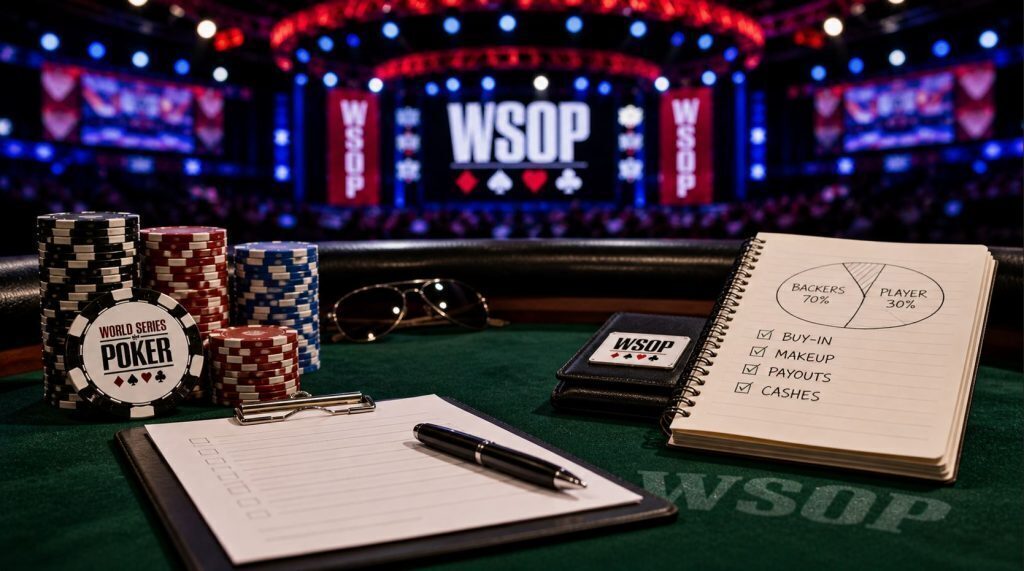
Selling action at the WSOP is part of tournament poker culture, especially once buy-ins start getting expensive. It gives players a way to protect their bankroll and play more events during the series. But staking deals can turn ugly fast if nobody clearly explains the terms or puts the agreement in writing. Most problems start after a big cash, when people realize they were never fully on the same page.
This guide breaks down how WSOP staking actually works, from setting markup and building a package to handling payouts, taxes, and common mistakes players make every summer in Las Vegas.
What Is WSOP Staking?
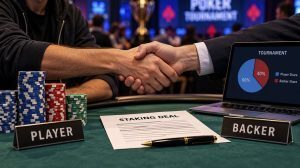
WSOP staking is when a player sells part of their tournament action to backers to help cover the buy-in. In return, the backers receive the same percentage of any winnings. For example, if you sell 30% of your action in a $3,000 WSOP event and cash for $30,000, your backers would split $9,000.
Staking is common at the WSOP because tournament poker has massive swings. Buy-ins can range from a few hundred dollars to $250,000 for high rollers, and even great players can go long stretches without a big score. Selling action helps players avoid putting their entire bankroll on one tournament.
It also helps strong players compete in bigger events and play longer WSOP schedules. The prize pools are huge, but so is the variance, and staking helps spread out the risk.
Why Players Sell Action at the WSOP
Most players who sell WSOP action are usually trying to do one of three things. Here’s what those reasons look like in practice:
- Bankroll management: A $10,000 WSOP Main Event buy-in is a massive investment for most players. Selling action lets you play the event without risking a huge portion of your bankroll on one tournament.
- Variance reduction: Even great poker players can go a long time without winning money in tournaments. Selling action helps spread out the swings instead of one player taking the full hit alone.
Community and engagement: Many players also sell action to friends, fans, and poker communities who want to follow their WSOP run and have a piece of the action themselves.
Key Terms You Need to Know Before You Sell
Before selling WSOP action, you need to understand the basic staking terms. These are the words you’ll see in almost every staking deal:
- Action: The percentage of your tournament winnings you’re selling to backers.
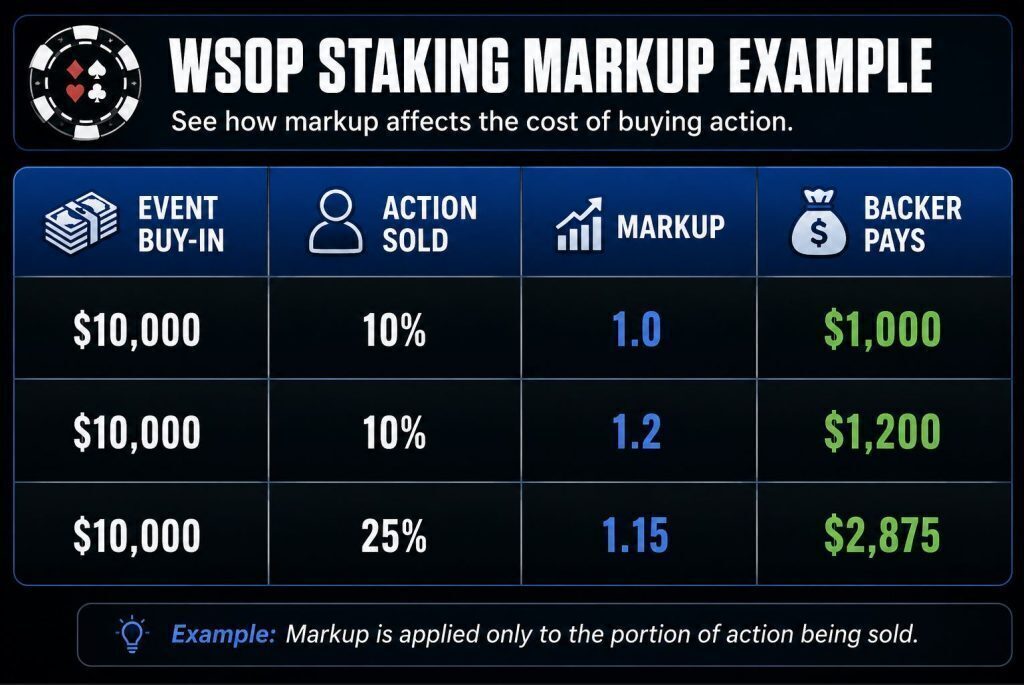
- Markup: An extra fee added on top of the buy-in. For example, if you sell 50% of a $2,000 event at 1.2 markup, the backer pays $1,200 instead of $1,000 for that piece. Markup is meant to reflect a player’s skill level and long-term results.
- Package: A group of WSOP events sold together instead of one single tournament.
- Staker / Backer: The person buying a percentage of the player’s action.
- Horse: The player being backed.
- Makeup: Money owed to a backer from previous losses before future profits are split. This mostly applies in long-term staking deals.
Many players use markup calculators on sites like Upswing Poker to help price their action more accurately before selling a package.
How to Sell Your Action at the WSOP: Step by Step
This is where a lot of staking guides fall short. Understanding what staking means is one thing. Knowing how to actually sell your action at the WSOP is another. Here’s what the process usually looks like from start to payout.
Step 1 — Decide Which Events to Include in Your Package
Many players sell action for multiple WSOP tournaments at once instead of just one event. This is called a package. It gives backers more chances to cash and is usually easier to sell than a single high buy-in tournament.
When building your package, focus on events that actually fit your strengths. Think about the buy-ins, game formats, and field types you play best. Adding random tournaments just to make the package look bigger usually does more harm than good.
Step 2 — Set Your Markup
Markup is the extra amount players charge when selling action. For example, if you sell 10% of a $10,000 WSOP event at 1.2 markup, the buyer pays $1,200 instead of $1,000 for that piece. The extra cost reflects the player’s skill and results.
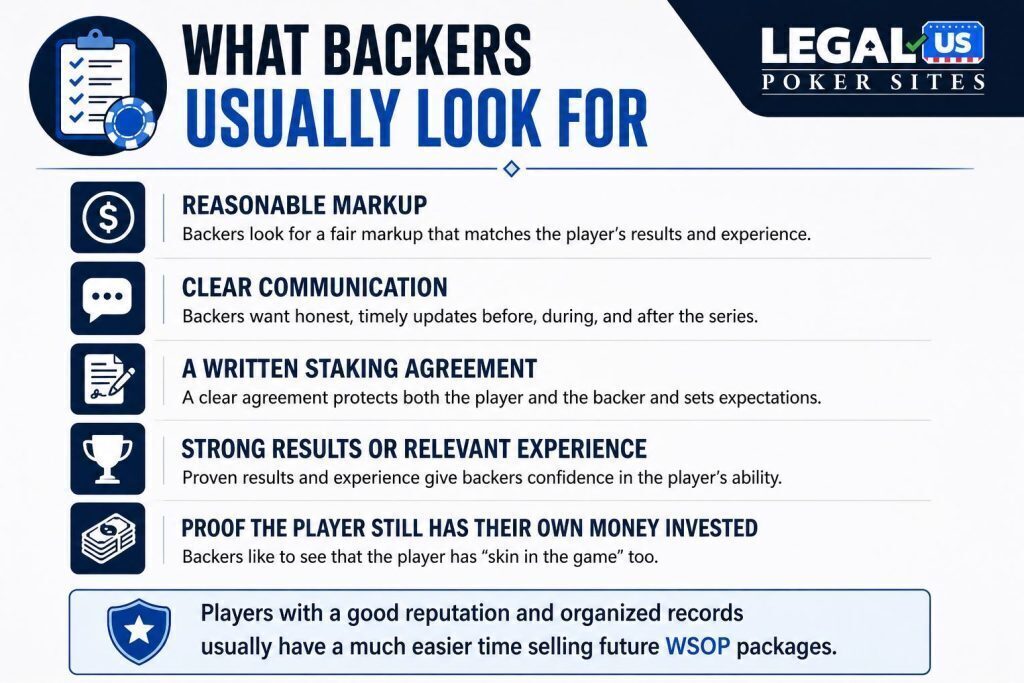
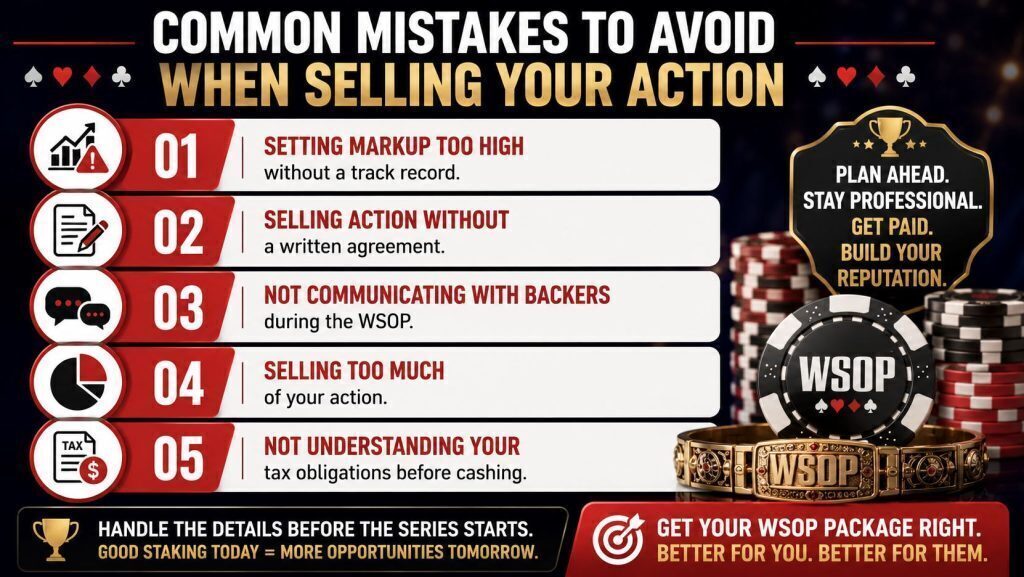
Most players base markup on their track record and the type of field they’re entering. Stronger players with proven results can usually charge higher markup. If your markup is too high, experienced backers may avoid the package. If you don’t have strong results yet, staying close to 1.0 is usually the safer move.
Step 3 — Decide How Much Action to Sell
Most players sell between 10% and 50% of their action and keep the rest for themselves. Backers usually want to see that players still have their own money on the line too. Selling too much action can be a red flag for experienced backers. The goal is to lower your own risk without selling so much action that backers lose confidence in the package.
Step 4 — Put the Agreement in Writing
A verbal agreement isn’t enough when real money is involved. If you make a deep WSOP run without a written staking agreement, things can get messy very quickly. Disputes over percentages, payouts, and taxes are much harder to solve when nothing was written down beforehand.
Your staking agreement should clearly explain:
- How much total action has been sold
- The markup being charged
- Which WSOP events are included in the package
- How and when backers will be paid after a cash
- What happens if you miss an event because of illness, scheduling problems, or other issues
- Whether makeup applies and how it works
Get everything signed before the series starts. Players who skip written agreements are much more likely to run into disputes later.
Step 5 — Choose Where to Sell Your Action
You can sell WSOP action privately or through a staking platform. Private sales usually work best for players with an established network of friends, poker contacts, or followers. The downside is that you have to manage payments, tracking, and payouts yourself. Platforms like StakeKings and PokerStake make the process easier by helping players track action sold, manage payments, and organize payouts.
Step 6 — Keep Backers in the Loop
Once the WSOP starts, keep your backers updated. Many players share chip counts, bust-out updates, re-entries, and deep runs through Discord, Telegram, or social media. Clear communication makes backers much more likely to support you again in future series.
Step 7 — Pay Backers Quickly and Correctly
After a WSOP cash, the payout is usually issued in the player’s name. If backers are not there with the proper paperwork, the player is responsible for sending everyone their share afterward. That is why clear agreements and accurate records matter. You need to know who owns what, calculate payouts correctly, and keep proof of payments.
Some players also hold back part of the winnings for taxes before sending payouts. This is also part of poker reputation. Jonathan Little, Benny Glaser, and Josh Arieh have all sold action over the years, but the expectation stays the same: pay backers quickly, clearly, and without confusion.
Tax Considerations When Selling Action at the WSOP
Staking can create major tax issues if you are not prepared before the WSOP starts. Large WSOP cashes can trigger tax forms like a W-2G. If the full payout is issued in your name, the IRS may treat all of it as your money unless you can prove some belonged to backers.
That is why it’s important to keep records. Tax rules can also be different for professional and recreational players, and gamblers can now only deduct 90% of their losses for tax purposes. If you are selling action for the first time, it is smart to talk to a tax professional before the WSOP starts.
Disclaimer: This section is for informational purposes only and should not be treated as tax advice.
FAQ
Markup should reflect your actual edge, not ego. Most players sell between 1.0 and 1.1. Higher markups only make sense if you have proven results in that exact format and buy-in level. Backers pay for ROI, not confidence.
Taxes got tougher in 2026 under the OBBBA rules. Without a written staking agreement, you could end up paying taxes on money already owed to backers. Forms like 5754 or 1099-MISC help split the tax liability properly.
Yes. A simple written agreement protects everyone involved. It should outline the action sold, markup, events covered, and payout terms. If there’s ever a dispute or IRS issue, screenshots and handshake deals usually won’t cut it.
Use trackable payments like bank transfers, wires, or crypto, and document everything. If you’re not using a staking platform, double-check the payout math before sending funds. Clean records matter, especially for large scores.
Sell Smart, Protect Yourself, and Build for the Long Run
WSOP staking can work well for both sides when everyone is clear from the start. Players get to enter bigger events without risking their whole bankroll, and backers get a small piece of tournaments with huge prize pools. Players who stay organized and pay people on time usually build strong staking reputations. In poker, reputation matters, and backers remember who handled things like a pro.
If you’re planning to sell WSOP action this summer, treat it like a real business deal from day one. Clear terms, honest pricing, accurate records, and good communication will make the entire process smoother for everyone involved.




Comments