legal-united-states-poker-sites
  • Online Poker
    • Poker Tournaments
    • Card Rooms
    • Poker Apps
    • Real Money Online Poker
    • Poker Games
      • Caribbean Stud
      • Mississippi Stud
      • Texas Hold'em
      • 5 Card Stud
      • 7 Card Stud
      • 5 Card Draw
      • 3 Card Poker
      • Omaha
      • Omaha Hi Lo
      • Horse Poker
  • Reviews
    • Americas Cardroom
    • Betonline
    • Black Chip Poker
    • Bovada
    • Ignition
    • Sportsbetting Poker
  • Deposit Methods
    • Bitcoin
    • Prepaid Visa
    • Visa
    • Cash App
    • Mastercard
  • Poker By State
    • Alabama
    • Alaska
    • Arizona
    • Arkansas
    • California
    • Colorado
    • Connecticut
    • Delaware
    • Florida
    • Georgia
    • Indiana
    • Idaho
    • Illinois
    • Iowa
    • Kansas
    • Kentucky
    • Louisiana
    • Maine
    • Massachusetts
    • Maryland
    • Michigan
    • Minnesota
    • Mississippi
    • Missouri
    • Montana
    • Nebraska
    • Nevada
    • New Hampshire
    • New Jersey
    • New Mexico
    • New York
    • North Carolina
    • North Dakota
    • Ohio
    • Oklahoma
    • Oregon
    • Pennsylvania
    • Rhode Island
    • South Carolina
    • South Dakota
    • Tennessee
    • Texas
    • Utah
    • Vermont
    • Virginia
    • Washington
    • West Virginia
    • Wisconsin
    • Wyoming
  • World Series of Poker
    • Schedule
    • Main Event
    • Satellite
  • Poker Strategy
    • Bankroll Management
    • Betting Rules
    • Bluffing
    • Check Raising
    • Hand Rankings
  • Tournaments
Flag Background
Home › Blogs › WSOP Main Event Biggest Bluffs: The 10 Most Memorable Hands Ever Pulled Off
WSOP Main Event Biggest Bluffs: The 10 Most Memorable Hands Ever Pulled Off

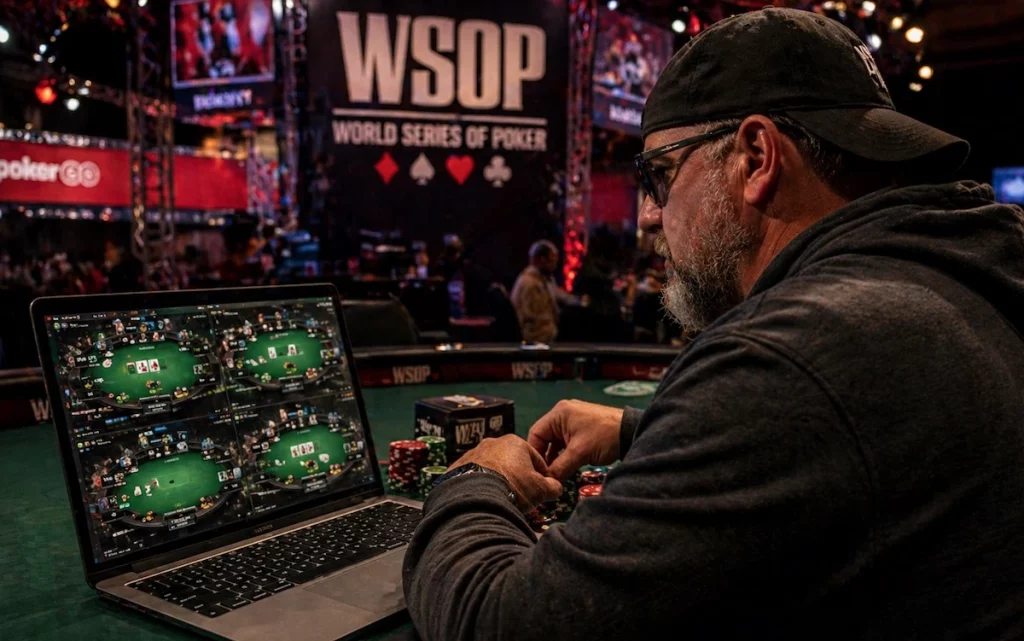
WSOP man

The WSOP Main Event has produced more iconic bluffs than any other tournament in history. From Chris Moneymaker's audacious river shove against Sam Farha in 2003 to kickstart the Poker Boom to Nick Rigby's "Dirty Diaper" antics, these hands are why watching poker is so engaging. This breakdown covers the ten most memorable bluffs in Main Event history, with a street-by-street analysis of each hand so you can understand how they were pulled off.

Why Bluffing at the WSOP Main Event Is Different From Any Other Tournament

Many pros believe that the Main Event is one of the most psychologically demanding tournaments in poker. The 12-hour days, the marathon structure, and the pressure of shooting for poker’s biggest prize take a huge toll on even the most stoic professionals – creating unique opportunities for bluffing.

The $10,000 buy-in helps make the Main Event a special tournament. While there are hundreds of $10K+ events on the calendar these days, none of them come close to attracting the number of amateurs that the Main Event does. That entry fee represents a full year's poker bankroll for many players, which adds to the psychological pressure of each decision.

The amateur-heavy field of the Main Event creates unique table dynamics that are rarely found outside of the WSOP. World-class players can sit across from recreational players who have saved for years to have one shot at the Main Event. That mix produces unpredictable dynamics and hugely exploitable plays that you simply won't find at other high-roller events.

The visibility of the stage matters too. The Main Event is the pinnacle of poker and is watched by millions of fans around the world. With the WSOP’s new deal to bring the Main Event back to ESPN, that visibility is larger than ever. Playing on a TV table can affect a player’s propensity for bluffing, as some players go all-out to prove that they’re capable of sick plays to the watching public, and that awareness adds a layer of psychological complexity that simply doesn't exist anywhere else in poker.

The 10 Biggest Bluffs in WSOP Main Event History

We’ve ranked these bluffs based on their audacity, strategic execution, and lasting cultural impact; the further down the list you go, the more iconic the bluff.

#10 — Andrew Wu Vs. Stephen Chidwick(2023 WSOP Main Event)

In this world of GTO robots, Andrew Wu showed that amateurs can still get one over on the pros.

Street-by-Street:

  • Preflop: Wu raised to 37,000 with J♦10♥ and Chidwick called from the SB with A♦J♣.
  • Flop (A♠5♣4♦): Chidwick makes top pair checks in flow to Wu, who puts out a cbet of 54K. Chidwick calls, and they go to the turn.
  • Turn (J♠): Chidwick now makes top two, and Wu makes second pair. Chidwick checks again, and with his showdown value, Wu checks back.
  • River (K♠): The backdoor flush completes, and Chidwick value bets his two pair, betting 140K. Wu, instead of counting out a call, counts out a huge raise to 500K, putting Chidwick all in. After a two-minute tank, Chidwick folds, giving Wu the pot.

Why It Worked:

This hand is a great example of the weird dynamics that can happen in the WSOP. As an amateur on Day 5 of the Main Event, Wu isn’t perceived to be getting out of line, so when he shoves the river, Chidwick is put in a tough spot. Stephen’s hand is a bluff-catcher, so he has to decide how often he thinks Wu is bluffing in this spot. Given the circumstances of the hand, it seems unlikely that Wu would be bluffing much, if at all, so Chidwick eventually makes the fold.

It’s a classic “he knows that I know that he knows” situation, and this time, Wu came out on top.

#9 — Jamie Gold vs. Prahlad Friedman  (2006 WSOP Main Event)

Table talk was a feature of Jamie Gold’s run to the 2006 WSOP Main Event, and he shows off that skill in this hand against Prahalad Friedman.
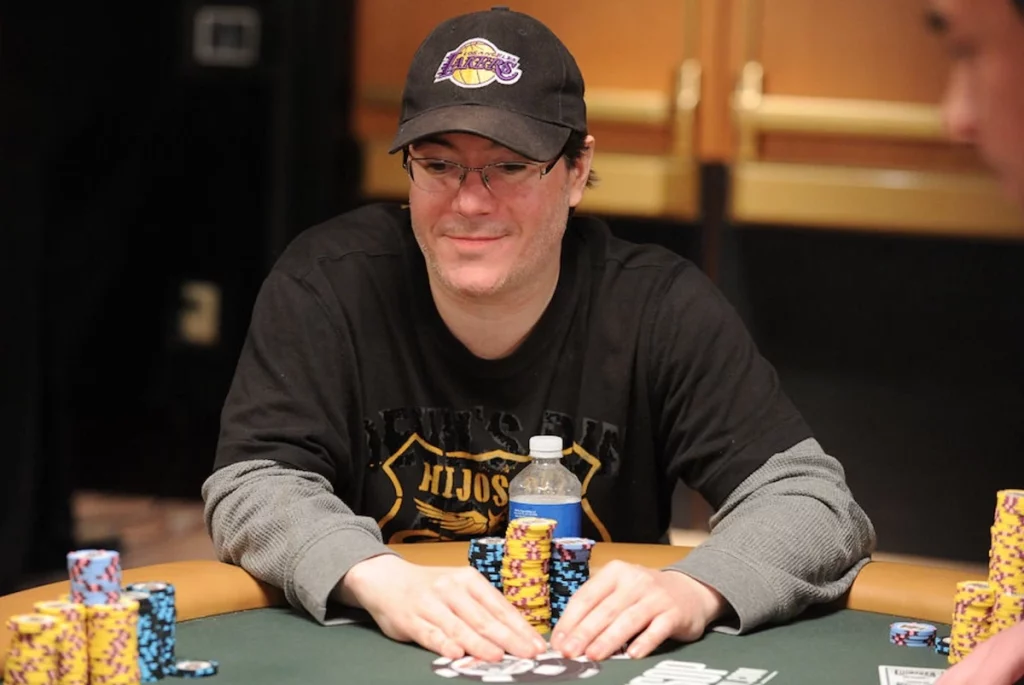
Jamie Gold
Jamie Gold won the 2006 WSOP Main Event for $12m.

Street-by-Street:

  • Preflop: Gold raises with K♦T♦from MP, and Friedman calls from the button with 7♦7♣.
  • Flop (4♦2♣2♠): Gold makes a standard cbet with his two overs and a backdoor flushdraw, betting 300K into around 400k. Prahalad calls with his overpair, and the two see the turn. His opponent bet. Merson called.
  • Turn (A♠): Jamie quickly checks, and Prahalad checks back
  • River: (3♣) The 3 puts four to a straight on the board, and Gold bets 750K into around 1 million, putting Prahlad into a tough position. Prahalad starts talking to Jamie, who says that he “has something” and would show Prahlad if he folded. Friedman then recalls a hand where Gold made a similar play with K-high – exactly what he’s holding in this hand – and Jamie starts being honest, saying “you’ve got me,” and “you’ve got a great read.” Despite almost nailing his exact hand, Prahalad folds the best hand.

Why It Worked:

This hand was all about the table talk between the two players. When Prahalad checks back the turn, Gold knows that he likely has a weak pair, so applies the pressure with a big bet. When Prahalad is first considering his decision, Gold tries to act strong, talking as if he has top pair or better. However, when Prahalad starts figuring him out, he changes tact, almost verbally giving up on the hand before Friedman calls. The mind games ultimately work, and Prahalad goes against his better instincts to fold.

#8 — Adrian Attenborough vs. Matija Dobric  (2022 Main Event)

While playing from the BB is a disadvantage, there are opportunities to use the unique range construction to your advantage and pull off a big bluff like Attenborough does in this hand.

Street-by-Street:

  • Preflop: Dobric raised 2x from the button with K♦2♦and Attenborough called from the big blind with 6♠5♣.
  • Flop (K♣3♣3♠): Drobric flops top pair. Attenborough checks to the aggressor, who puts out a small cbet of 500K into 2.2 million. Attenborough, with his backdoor straight draw, comes over the top and raises big to 2.7 million, which Dobric calls.
  • Turn (7♥): Attenborough picks up a gutshot and continues his aggression, betting 7.3 million into 8.1. Dobric quickly makes the call, and the pair see a river.
  • River (8♣): Attenborough bricks, but the front door flush draw comes in. Adrian shoves 12.2 million into 22.7 million, and after a small tank, Dobric lets go of his top pair.

Why It Worked:

Adrian understands that as the big blind, he has much more 3x in his range than Dobric, giving him more of a license to aggressively check/raise the flop. He also knows that Dobric will be betting this flop extremely often, so he expects this raise to work extremely often. When Dobric calls, his most likely hand is Kx, which he can apply pressure to with bets on the turn and river. The flush completing on the river gave Attenborough even more leverage, as it’s unlikely that Dobric would be calling with a flush draw.

#7 — Van Hoof vs. Larabe (2014 Main Event)

The pay jumps at the Main Event final table are massive, and provide the perfect opportunity for big stacks to leverage their advantage over their opponents, which is exactly what happened in this hand.

Street-by-Street:

  • Preflop: Van Hoof raised to 2.5x with K♣T♥, and Larabae called in the big blind with 9♥8♣.
  • Flop (J♥T♣9♦): An action flop; Van Hoof flops second pair and a gutshot, while Larabe has bottom pair and an open-ender. Larabge checks to Van Hoof, who cbets 40% of the pot. Larabe quickly calls with his pair + draw.
  • Turn (K♥): Van Hoof makes two pair, but there’s four to a straight on the board. Larabe, recognising how scary the board looks, donks for 60% pot, but Van Hoof calls with his two pair.
  • River (7♣): After bluffing the turn, Larabe makes his straight on the river and checks it. Van Hoof could easily check back with his two pair, but decides to make an overbet of 1.4x the pot, turning his hand into a bluff. Larabe insta-folds, and Van Hoof takes it down.

Why It Worked:

The crux of this hand is Larabe’s donk on the turn and check on the river. When he leads out on the straight completing turn, he polarizes his range to essentially a queen or a bluff. However, when he checks the river, Van Hoof recognises that he wouldn’t do this with a queen, and takes the opportunity to make a huge bet and put maximum pressure on his opponent. With the original 9 players still battling it out on the final table, Larabe doesn’t want to cripple his stack by making a bad call, so he quickly folds his straight without much thought.

#6 — Jordan Griff vs. Jonathan Tamayo (2024 WSOP Main Event)

Heads up in the 2024 Main Event, Jonathan Tamayo (below) flexed his poker skills by pulling off a huge bluff against amateur Jordan Griff.
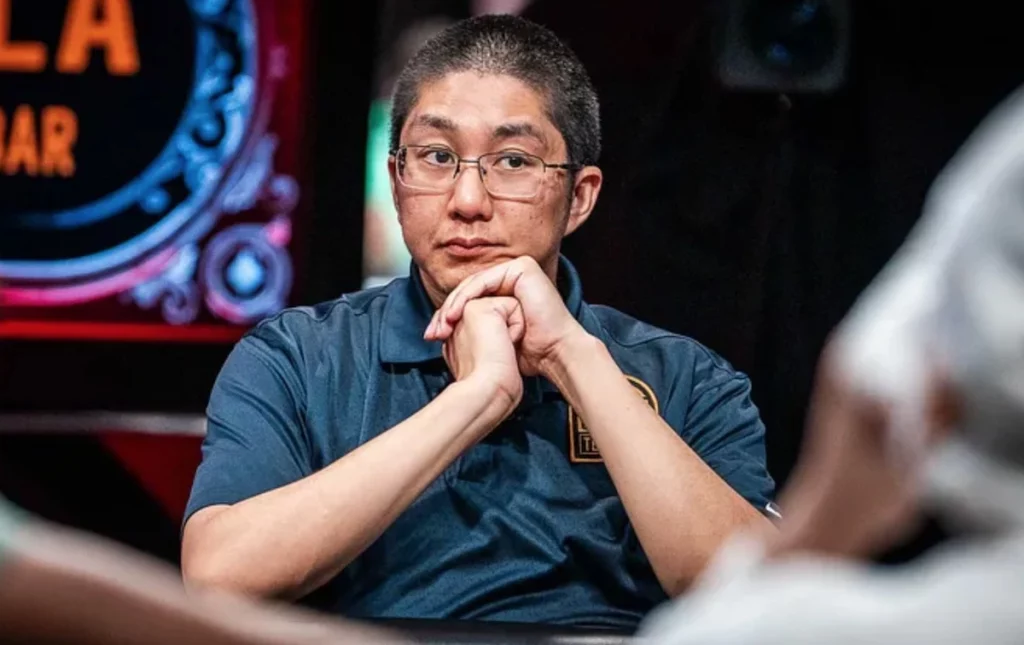
Street-by-Street:

  • Preflop: Tamayo raises from the BTN with 5♠3♣, Griff defends the big blind with K♠T♣.
  • Flop (J♠T♦7♥): Griff checks, Tamayo cbets around half pot, and Griff calls with second pair.
  • Turn (Q♦): Griff picks up an open-ended straight draw to go with his pair, but the action goes check/check..
  • River (K♥): Griff makes two pair but there’s four to a straight on the board. After a quick check, Tamayo bet 62 million into 40 million, forcing Griff to fold.

Why It Worked:

The hand plays out pretty standardly until the river; Tamayo raises and c-bets with a weak holding, and seems to give up on the hand until the river comes. The way that Griff quickly checked likely told Tamayo that he had a showdownable hand like one pair or two pair, and that a standard bet may not take it down. Plus, in heads-up, Griff is likely to 3bet a lot of his Ax preflop, giving Tamayo a clear range advantage on the river.

Tamayo leverages this advantage and makes a massive bet on the river, polarizing his range to a straight or nothing. Given the amount of Ax Tamayo has in his range, it’s hard for Griff to call with a hand like two pair, leading to his decision to fold.

#5 — Karim Rebei vs. Brian Kim (2022 WSOP Main Event)

While Rebei is the player pulling off the bluff, most people remember this hand for the fold made by Brian Kim.

Street-by-Street:

  • Preflop: The hand started with a raise from the HJ before Rebei 3bet from the BTN with A♦5♦. Brian Kim held Q♠Q♣in the SB and put in a cold 4bet, which was met by a 5bet from Rebei. Kim called the 5bet, and the two players went to the flop.
  • Flop (10♠ 9♣6♦): A safe board for Kim, who still has an overpair. He checks to Rebei, who puts out a standard ⅓ cbet with his overcard and backdoor flush draw. After some table talk between the two players, Kim stunningly folds his overpair on the flop!

Why It Worked:

This is one of the best examples of how the pressure of the Main Event can affect a player’s decision-making. The hand takes place on Day 7, with both Kim and Rebei having two of the biggest stacks in the tournament. In any other game, Kim would call the flop and would likely call the shove on the turn, but with the Main Event final table in sight, he took the conservative option and made a nitty fold.

Rebei could likely sense this conservative attitude from Kim and leveraged it into a well-executed bluff.

#4 — Nick Rigby vs. Ronald Jensen (2021 WSOP Main Event)

With 60 players left in the Main Event, you wouldn’t think that anyone would be playing 32o in a 4bet pot, but Nick Rigby (below) showed that even the worst hands can come out on top if you’re brave enough to play them aggressively.
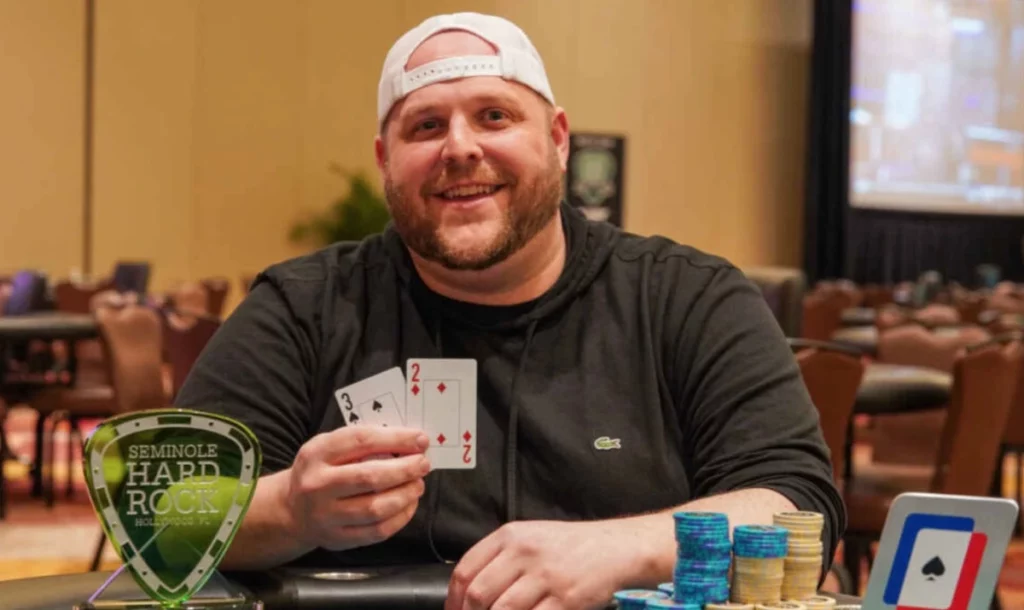
Street-by-Street:

  • Preflop: Jensen opens the hand with K♠K♦by raising to 325K. Rigby takes his favourite hand, 3♥2 d, which he calls the “dirty diaper,” and 3bets to 920K. Jensen responded with a 4bet to 2.1 million, and Rigby quickly called.
  • Flop ($A♦ 4♦4♠$): Jensen Probably the worst flop for Jensen, who quickly checks with his pocket kings. Rigby instantly moves all in, putting Jensen to the test. After a brief think, Jensen folds, and Rigby slams his cards on the table.

Why It Worked:

Rigby correctly deduced that when Jensen checked the flop, he likely had a big pair, like KK, QQ, or JJ, and that a shove would put him under huge pressure with the ace on the flop. Whatever you think of the (frankly ludicrous) preflop play, he recognised a good spot for a bluff. We think that the speed of his shove does betray the strength of his hand, as a hand like AQ or AJ would likely think for a little bit before betting.

This hand is another great demonstration of the pressure of the Main Event. When the ace came on the flop, Jensen didn’t want to take the risk of busting with KK so close to the final table, so he made a quick fold without considering things like timing tells or bet sizing from Rigby.

#3 — Qui Nguyen vs. Gordon Vayo (2016 WSOP Main Event)

This heads-up battle was billed as a battle of styles: the aggressive Qui Nguyen vs the conservative Vayo. In this hand, Nguyen shows why aggression is so powerful.

Street-by-Street:

  • Preflop: Nguyen raises from the BTN with J♦5♦ and Vayo defends with Q♥9♦.
  • Flop (9♣4♣2♦): Vayo flops top pair and checks in flow to Nguyen, who puts out a cbet of 9.7 million into 14.2. Vayo makes a quick call, and they go to the turn.
  • Turn (T♥): Qui’s backdoor draws all miss, but after Vayo checks, he continues his aggression, betting 27.7 million into 33.6. Vayo makes the call again.
  • River (5♠): Nguyen hits a pair on the river, but he continues his aggression, putting Vayo all in after he checked. This sends Vayo into the tank, but after a several-minute think, he folds the best hand.

Why It Worked:

Doyle Brunson once said that the key to Texas Hold’em is to put a man to a decision for all his chips, and that’s exactly what Qui Nguyen does in this hand. While his triple barrel with J5 is almost certainly overbluffing, he’s leveraging the situation of being heads up for the Main Event title. From Vayo’s perspective, calling all in and being wrong would be an awful way to lose the heads-up battle, and if he thinks he’s the better player, he can wait for a better spot to try and trap Nguyen. However, Nguyen’s aggression won out in the end, and this hand played a big part in his Main Event win.

#2 — Alejandro Lococo vs. Karim Rebei (2022 WSOP Main Event)

In the era of GTO, everyone thought that button clicking was a thing of the past – but it seems like no one told these guys!

Street-by-Street:

  • Preflop: Lococo opened from the HJ with A♣J♦, and Rebei defended the big blind with an unknown hand
  • Flop (9♠8♥7♥): Rebei checks to the preflop aggressor, and with his gutshot and two overcards, Lococo decides to check behind.
  • Turn (K♠): Rebei leads out for 140K, and Lococo quickly raises to 485K. Rebei 3bets the turn to 1.135 million, and after a mistake made by Lococo while counting out a raise, he’s forced to make a min raise of 1.785 million. Rebei quickly responded with a turn 5bet to 4 million, and Lococo made the crazy 6-bet turn bluff all in! After a shrug to his rail and an “Oops!,” Rebei folded.

Why It Worked:

This hand is what many people call “old-school poker,” two players betting back and forth, convinced the other one has it; but is there any strategy behind it? Lococo holds the J♦, so he knows that it’s less likely for Rebei to hold JT, which would be the nuts on this board. However, after the turn 3bet, and especially the turn 5bet, most players would be convinced that Rebei had it, so we think that Lococo had some kind of physical tell that allowed him to pull the trigger on his shove.

#1 — Chris Moneymaker vs. Sam Farha (2003 WSOP Main Event)

Arguably the most famous bluff in history, amateur Chris Moneymaker (below) forced poker legend Sammy Farha off the best hand while battling for the Main Event title.
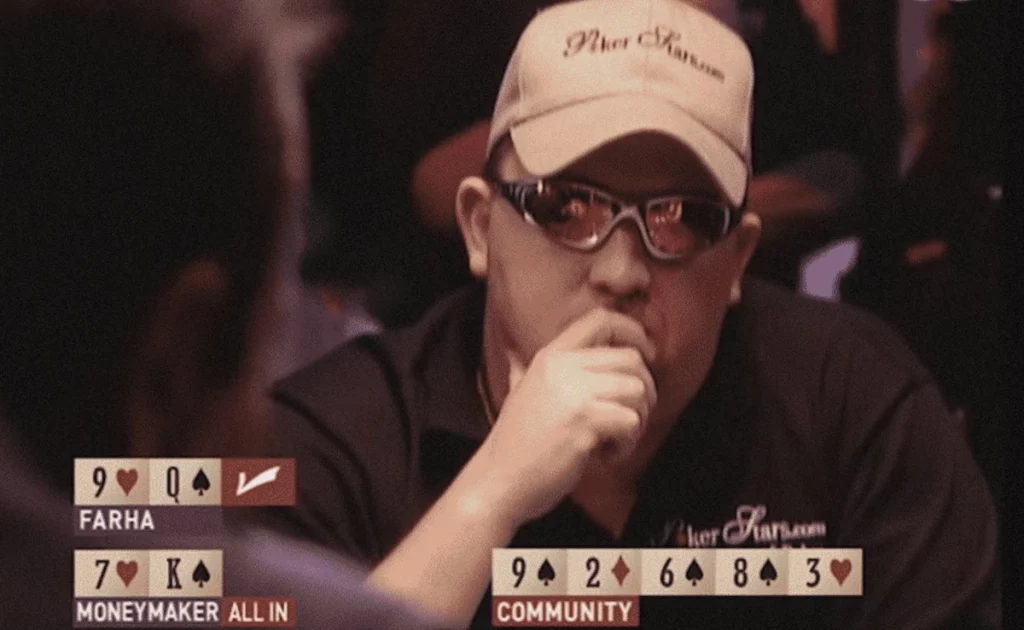
Street-by-Street:

  • Preflop: Moneymaker raised with K♠7♥ and Farha called in the big blind with Q♠9♥.
  • Flop (9♠ 2♦ 6♠): Farha flops top pair and checks to the aggressor, but after completely missing the board, Chris checks back.
  • Turn (8♠): The flush comes in, but Farha bets his top pair, looking to get value. Having turned an open-ended straight draw and a K-high flush draw,  Moneymaker raised to 800K over Sammy’s 300K turn lead. Farha called, and the pair went to the river.
  • River (3♥): Farha checked over to Moneymaker, who completely whiffed his draws. After a brief deliberation, Moneymaker moved all-in, putting Sammy to the test. After a couple of minutes, Farha eventually folds the best hand.

Why It Worked:

Just like the first hand on this list, the success of Moneymaker’s play revolves around Farha’s perception of his bluffing frequency. Across from him is an amateur who’s heads up for the Main Event bracelet, the biggest prize in poker – how often is he going to be bluffing in a big spot like this? While the line of checking back the flop and raising the turn doesn’t make a lot of sense, it doesn’t have to, as Farha is unlikely to think that he’s bluffing in that spot.

What the Greatest WSOP Bluffs Teach Us About Bluff Construction

While they shouldn’t be your only form of study, looking back at these hands can teach you important lessons about bluffing. Below, we’ve highlighted the three patterns we see when analysing these Main Event bluffs:

  1. Recognise Scare Cards – It’s important to know which cards are good to continue bluffing on, and which ones you should give up on. For example, in the Rigby hand, the board of A44 was perfect for bluffing, as Jensen likely had a big pocket pair and would be scared of the ace. That bluff wouldn’t have worked nearly as well if the board was 963.
  2. Leverage The Situation – Using the tournament situation to your advantage is one of the best ways to get folds from your opponent. The Main Event is full of these high-leverage situations, whether it’s Qui Nguyen’s triple barrel bluff heads-up for the title, or Rebei’s 5bet/cbet combo late on Day 7 that forced Kim off his overpair. In the situations where the stakes are high, your opponents are far more likely to talk themselves into a fold than they are a call, so use that leverage to pull off your bluffs.
  1. Use Your Table Image – In many situations, a player’s decision to call will come down to the frequency at which they think you’re bluffing. If you have a table image of a conservative player, you can use this to your advantage to get your opponent to fold. We saw this in the Wu vs. Chidwick hands and the Moneymaker vs. Farha hands – both pros thought that their amateur opponents would be underbluffing given the situation, which allowed their bluffs to work

Frequently Asked Questions

Q: What is considered the greatest bluff in WSOP Main Event history?

The title of the “greatest ever Main Event bluff” is a subjective one, but given the context of the hand, we believe that Moneymaker’s river shove against Farha is the best of the bunch. Being able to hold his nerve in such a huge spot against a renowned professional like Farha takes a lot of guts and knowledge of the game ESPN announcer Norman Chad described it as "the Bluff of the Century," and it was later awarded "Most Memorable TV Hand" at the WSOP First Fifty Honors in 2019.

Q: What is "The Dirty Diaper" in poker?

"The Dirty Diaper" is the nickname for 3-2 offsuit, a name that originated in Nick Rigby's Pittsburgh home game. The hand gained mainstream recognition after Rigby used it to bluff Ronald Jensen off pocket kings at the 2021 WSOP Main Event — calling a large preflop raise and then shoving the A-4-4 flop to take down the pot.

Q: Has a woman ever made the WSOP Main Event final table?

Yes, Barbara Enright, a Poker Hall of Famer, reached the WSOP Main Event final table in 1995 and finished fifth. Leo Margets made the final table of the 2025 Main Event, becoming the first woman to final table a “modern” Main Event, finishing 7th.

Q: What makes a bluff work at the WSOP Main Event specifically?

Several factors consistently appear in the most successful Main Event bluffs:

  • Board Texture: The player bluffing either has a range advantage or can use scare cards to their advantage, like the ace in the Rigby vs. Jensen hand.
  • Tournament Leverage – Many of the best bluffs put their opponent to the test for all their chips, leveraging their tournament life when the pay jumps are at their biggest.
  •  
  • Table Image – Players who have established a tight image can leverage that reputation to make their bluffs more believable at critical moments.

Q: Can you bluff with the best hand at the WSOP?

Technically, if you hold the best hand and make a bet, you’re value betting. However, as you have no way of knowing that you have the winner, you can make a bet with the best hand thinking that you’re bluffing. There’s a great example of this in the 2012 Main Event, when Greg Merson and Jake Balsinger got into a queen-high battle. Merson technically had the best hand with QJ, but shoved over Balsinger’s bet on the river, thinking that he had to bluff to win. Balsinger actually had QT, so Merson was “bluffing” with the best hand.

Jordan Conroy

Jordan Conroy

Author
View All Posts By Jordan Conroy

Jordan started writing about poker in late 2020 after discovering he could combine his passion for explaining things with his favorite game. He continues to stay on top of the newest poker theory and the latest goings on in the poker world to deliver top-quality content. While poker is his biggest passion, he also closely follows soccer, snooker, and F1.

William Kassouf sticking tongue put playing poker
David Lappin David Lappin

How do you Solve a Problem like Kassouf? Three of the Best Tournament Directors Weigh In

Kassouf 86ed Speaking exclusively on the latest episode of ‘The Chip Race’, poker professional and tournament director Kenny Hallaert gave

Joshua Boulton Winning WSOP Event
Paul Seaton Paul Seaton

Joshua Bolton Wins Poker Hall of Fame Bounty Event in Las Vegas

The British player Joshua Bolton won Event #92 on the 2025 WSOP roster this week as he beat American rob

michael mizrachi with stack of cash at WSOP Main Event
Sandra Gaweda Sandra Gaweda

Michael Mizrachi Wins 2025 WSOP Main Event for $10 Million

Michael “The Grinder” Mizrachi finally grabbed the one title that had always eluded him: the WSOP Main Event. Already one

Comments

Leave a CommentCancel Reply
Placeholder Image Sign Up
WSOP man

WSOP Main Event Biggest Bluffs: The 10 Most Memorable Hands Ever Pulled Off

Will Kassouf

Best WSOP Hands of All Time (Street-by-Street Analysis)

2025 WSOP

WSOP Bracelet Timeline: Every Design From 1970 to 2026

See All
Online Poker Player

Is Online Poker Rigged? Myths vs. Real Statistics

Shamrock Shuffle Up

Play the Shamrock Shuffle Up in our St. Patrick’s Day Freeroll!

LUSPS Freerollers Open

February Freerollers Finale Sees Fatai Finish Above All Others for $75

See All
Legal US poker sites logo
Browse Our Site
  • Poker Reviews
    • Ignition Review
    • Bovada Review
    • BetOnline Review
    • Americas Cardroom Review
  • State Laws
    • Texas
    • Florida
    • California
    • Virginia
    • Washington
    • Ohio
  • Georgia
  • Illinois
  • Colorado
  • New York
  • Arizona
  • Massachusetts
  • Wisconsin
  • Contact Us
  • Responsible Gambling
  • About Us
  • Sitemap
  • Privacy Policy
  • Authors
  • Blogs
  • News
You Are In Safe Hands
Our Recommended Poker Sites Have Been Verified by
18+ BeGambleAware MGA
Follow us:

© 2026 Hyperdrive Promotions UAB | All Rights Reserved. Trust in Your Bets, Gamble Responsibly.
For Visitors 18 Years and Older.

Hyperdrive Promotions UAB
Level 27, Wing On Centre, 111 Connaught Road Central
Sheung Wan, Hong Kong
Tel:+1 (419) 601-6487