


America’s Biggest Gamblers by State: Who Spends the Most on Gambling?
America’s Biggest Gambling States: Where Is the Most Money Being Spent? Ask where America gambles the most, and Nevada is


Poker Burnout and Mental Health
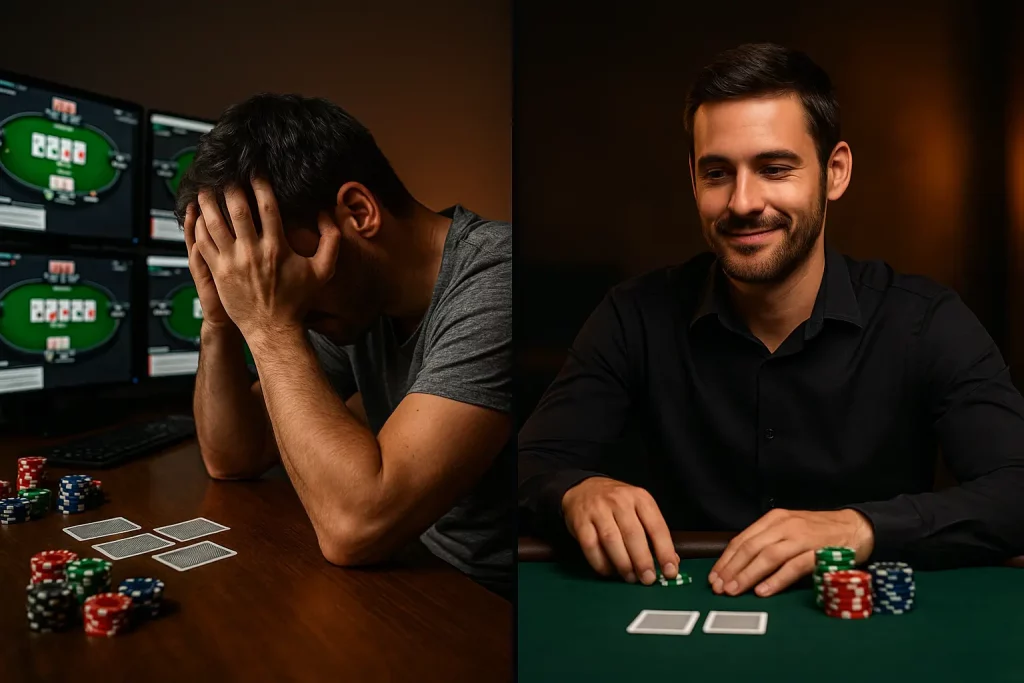
Last month, “Alex Martinez,” a successful online poker professional who routinely played 12 tables simultaneously, hit a wall. He was experiencing poker burnout. After grinding 50-hour workweeks for three straight months, he made basic mathematical errors and felt physically ill at the sight of a poker table.
His story isn’t unique. Studies have shown elevated rates of psychological distress and fatigue among high-volume online poker players. Yet few players understand how to recognize burnout early or recover properly. This article aims to help you identify warning signs and follow a structured recovery process if you ever feel like poker-induced burnout is creeping up.
Name changed at the player’s request.
Multi-tabling significantly intensifies poker’s cognitive load. While single-table players might make roughly 60-90 decisions per hour, a 12-table grinder can face 700-1,000 decisions in the same period.
This constant decision pressure accelerates mental fatigue, a primary driver of burnout. Burnout doesn’t just affect your mental health, it directly impacts your performance at the tables, making it essential to address as part of your comprehensive poker strategy guide approach to the game.
| Single-Table Players | Multi-Table Players |
|---|---|
| General fatigue | Severe decision paralysis |
| Occasional tilt | Frequent micro-tilts |
| Basic focus issues | Pronounced attention fragmentation |
| Regular stress | Compounded mental strain |
Professional player Jennifer Liu notes:
“In 2013, I was named one of the World Poker Tour’s “Ones to Watch,” and I started working with brands like 888 Poker and Natural8 to promote their sites. But, by 2017, I was feeling burnt out. I had just gotten out of a difficult relationship, and that combined with the stress of poker was completely draining. I needed to isolate myself for a while.”
Even before cognitive symptoms become apparent, your body often signals distress through these common physical indicators:
Beyond physical symptoms, these cognitive warning signs often appear first and can severely impact decision-making quality across different poker games:
Red Flag Alert: Seek immediate professional help if you experience chest pain, severe anxiety, or thoughts of self-harm. For crisis help in the U.S., dial 988.
Once you’ve recognized burnout symptoms, what comes next? Understanding the recovery process helps players avoid rushing back too soon. The following timeline combines experiential reports from 54 professional multi-tablers interviewed for this article and best practices drawn from occupational burnout research.
The first two days are critical for stopping the burnout cycle and beginning physical recovery:
After the initial 48-hour reset, this phase focuses on establishing healthy routines while maintaining complete distance from poker:
| Category | Task | Daily Goal | Notes |
|---|---|---|---|
| Sleep | Log bedtime & wake-up | Aim for 7–9 hours nightly | Consistency more important than duration early on |
| Physical Activity | Moderate exercise | 30 minutes | Walking, stretching, or light cardio—no need for intensity yet |
| Mindfulness | Meditation / breathing practice | 10 minutes | Helps detach from poker stress loops |
| Nutrition | Balanced meals & hydration | 3 meals + ~2L water | Prioritize whole foods and steady energy |
| Social | Non-poker interaction | At least 1 activity / check-in | Reconnect with friends, family, or hobbies |
Only after completing the first week of recovery should you gradually reintroduce poker-related activities, and only if baseline energy and mood have stabilized:
As you resume playing online poker, remember that structure and patience are important for preventing relapse. A measured return doesn’t just avoid re-triggering burnout. It can actually improve your long-term results by establishing sustainable habits.
Once you’re ready to return to multi-tabling, follow this conservative progression to rebuild your capacity safely:
| Timeframe | Max Tables Allowed | Focus / Notes |
|---|---|---|
| Days 1–3 | 1 table only | Rebuild focus; track mental state and decision quality |
| Days 4–7 | 2 tables | Gradually add load; stop if fatigue or tilt emerges |
| Week 2 | 4 tables | Resume small grind volume; monitor bankroll discipline and energy levels |
| Week 3 | +2 tables (max 6)if stable | Only increase if performance, mindset, and results remain consistent |
| Week 4+ | Controlled scaling | Expand cautiously; never add more than 2 tables at a time, reassess weekly |
Throughout your return, monitor these key indicators to ensure you’re not pushing too hard too fast:
Chronic tilt episodes create a vicious cycle of emotional exhaustion that significantly contributes to burnout, making managing tilt effectively one of your most important defenses against long-term mental fatigue.
Remember, poker burnout is not a sign of weakness. When you push yourself to the limit, your body reacts instinctually. Respect these signals rather than fighting through them. If you recognize these symptoms, take immediate action. Your long-term poker career depends on protecting your mental health and maintaining peak performance capacity. Have you recovered enough? If so, consider leaning back into the poker grind gradually at one of the best online poker sites for real money.
America’s Biggest Gambling States: Where Is the Most Money Being Spent? Ask where America gambles the most, and Nevada is

Manuel Ferrari’s Million-Euro Moment The dust has finally settled on another Pokerstars EPT Barcelona, the centrepiece of the European poker

Your face, my thane, is as a book where menMay read strange matters. To beguile the time,Look like the time;




Comments