




Shot-Clocks Are Necessary But Poker Players Need To Be Allowed To Sharpen Their Axes
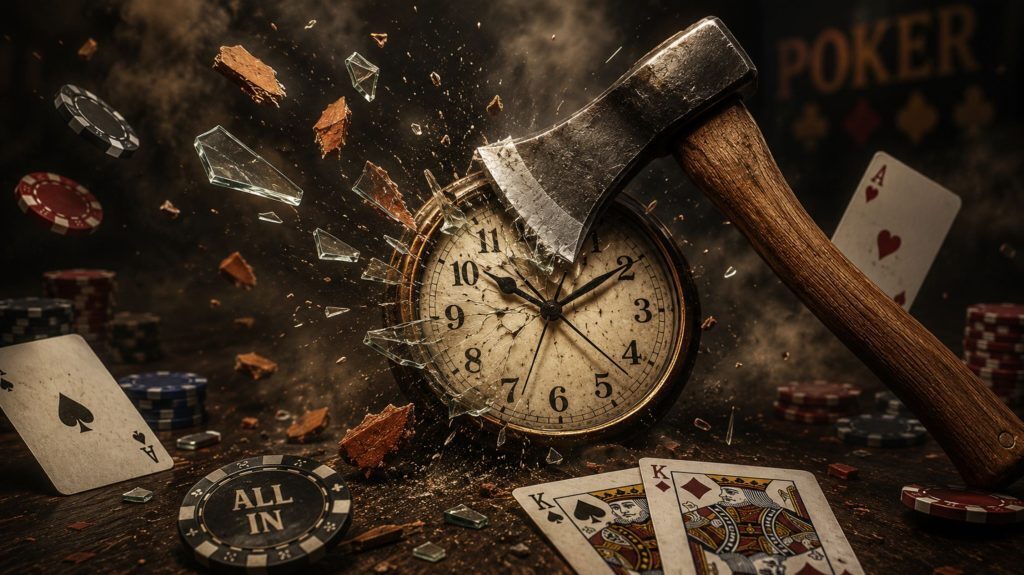
Give me six hours to chop down a tree and I will spend the first four sharpening the axe.“ ~ Abraham Lincoln
Brain Trust
During one of the short breaks at the recent PokerStars Open Malaga event, myself and Dara O’Kearney had a great chat with tournament director Nick O’Hara. There are a lot of superb TDs in the game, among whom there are a few truly elite ones. Nick is one of those, evidenced by his knowledge, thoughtfulness, manner and composure under pressure. He is open-minded and he gives a lot of consideration to possible rule changes with fairness and the player experience in mind.
Pokerstars are incredibly lucky to have Nick in the team, as they are to have Toby Stone, Kenny Hallaert and Glenn Doyle in their brain trust, always thinking of ways to innovate and optimize the structures and procedures. Since joining Pokerstars as an ambassador in April, I have gotten a glimpse into how everyone communicates. There is polite disagreement, compromise and ultimately harmony as they display a united front on various topics.
Consistency is vital in poker so that consensus is very necessary but it shouldn’t be confused for a rigidness or dogmatism. Player feedback is constantly being gathered. The perfect solution in theory might be imperfect in practice. Arguments are continually being reframed and reexamined. One such argument is on the hot topic of stalling, something everyone agrees needs to be curbed but at what cost? That is what Nick, Dara and I found ourselves discussing a fortnight ago and I continue to ponder it today.
Shot-Clock
Time and tide wait for no man but, a few stops ago, Pokerstars started implementing a shot clock and time card system in a lot of their tournaments, usually being introduced a dozen or so levels into the tournament. It was pretty simple: Players have 15 seconds to act pre-flop on their first action with any subsequent actions in the hand given 30 seconds of think-time. Two time cards are given to each player which can be used at their discretion for an extra 30 seconds with one additional time card handed out after each break.
This system takes the onus off of players to police one another with requests of ‘clock’. It removes the need for a member of floor staff to come to the table, ask the dealer if the player had enough time, likely be told they did, explain that there would be a countdown and then do the countdown. Essentially, the new system automates and equalizes the use of time, much like online poker. Overall, it worked pretty well and, in Malaga, every tournament deployed this system.
Surveys asked if players should be allowed to use their 15 seconds or their 30 second extensions for purposes other than think-time – to stall for a ladder jump or a table-break. I’m not privy to the results of that survey but my strong opinion is that one’s time is their own to do as they see fit. If a player sacrifices a minute in a spot to ensure a ladder jump, they deprive themself of a minute that they might want if they have a difficult decision later.
15 or 20?
Nick asked Dara and I if we felt like the 15 seconds was enough for a first decision. I don’t want to speak for him but my hunch is that he thought it might be a tad mean. Dara and I certainly felt like it was miserly and that 20 seconds would be better. There is also a risk that an action clock could ultimately slow the game down by encouraging players to use all their available thinking time. Now, of course, that means an extra 5 seconds of potential stalling time for every player who wishes to take advantage but I think that’s a reasonable trade-off so that players, especially recreational players, aren’t flustered in close spots.
I respect how the PokerStars Team are really trying to fix the stalling problem but I’m worried that we might over-do and end up penalising players who very genuinely need a little more time. I’m all for sportifying poker in this way but I think we have to be careful about turning off less experienced players who might walk away from a tournament feeling like they were unfairly rushed into mistakes. It’s a question of finding the balance and I personally think 20 seconds on a player’s first decision and a third time-bank card would be better.
Nick seemed very receptive to our takes and I’m sure his plan was to relay them back to the brain trust. Turning to leave, little did he know I was only getting started. “While we’re talking shot clocks”, I said, “I do have a little bugbear with how the 15 seconds is still being policed”. It was at that moment that a realization washed across Nick’s face. He was about to be subjected to a vintage moan from one of poker’s squeakiest wheels.
Bubble Adjacent
So, the previous day, I was bubble-adjacent in the mystery bounty event (6 off the money) and a short-stack at my table started to use the majority of his 15 seconds each hand. The other players were all using between 1 and 10 seconds. After five hands, the dealer called the floor over to inform him that a player was maxing out his time-bank before folding pre-flop. The floor explained to the table that the players needed to keep the game moving and that using the full 15 seconds each hand was not okay. For the next five hands, the player in question used between 8 and 13 seconds each hand while another player at the table, not particularly short in chips, started using between 10 and 15 seconds.
We were three from the money and again, the floor was summoned. This time, after a discreet confab with dealer, we were informed that any player continuing to use the full 15 seconds would be put on a 5 second shot-clock. The player who had been using between 8 and 13 seconds protested, firstly explaining factually that nobody was using the full 15 seconds every hand and secondly, so what if they were? Was it not their time to use? Noteworthy too is that it had taken less than 25 minutes to play the previous ten hands, a pretty brisk pace of play near the bubble and not much slower than normal action.
Nick listened patiently. He also quickly surmised that I was the protesting protagonist in the story. I told him that the problem as I see it here is there is an assumption being made that short stacks around the bubble are all stalling. That might (and I do mean ‘might’) be true but what is certainly true is that short stacks around the bubble are in a difficult ICM predicament. There is a lot to consider when playing with a high risk premium and, in this particular tournament, counter to that was the fact that it was a mystery bounty with bounties coming in shortly.
Trust The System
At this point, Nick was probably regretting all the life choices that had brought him to this moment but undeterred, I continued my unsolicited rant. I broke down how the short-stacks have more fold equity versus some players at the table, less versus others and they might have cultivated a tight image which could help them ‘get a light one through’. I explained how the shape of the range of playable hands twists and contorts when the bubble looms. I argued that there are bubble factor math problems, range interactivity calculations and a lot of dynamics to be factored, all of which take a little time.
I suppose my argument ultimately boiled down to the fact that PokerStars have created a system which I believe mostly solves the problem of stalling. No longer is policing time in the domain of the big stacks and the over-worked tournament directors. The system is the police now. I understand that sharp operators will stress test any system but the answer is not hassling players to act beyond the new strict rules that have been set. Furthermore, if the tournament director tells me that I can’t have a 10-15 second decision every hand, and I answer ‘I do’, is that TD going to call me a liar?
Are my hands going to pulled out of the muck to verify that the spot was a close one? Are floor staff qualified to judge whether a spot warrants 15 seconds of consideration time rather than 5? I personally think it is hugely problematic if staff start to make assertions about strategy and I also think reducing someone’s clock to 5 seconds on a bubble is insane and barely gives the player time to peel their cards. Time and tide might wait for no man but poker players still need for 20-30 seconds to sharpen their axes.




Comments