


Best Poker Games You Can Play With a $100 Bankroll
Starting with just $100 is a smart and practical way to explore poker games for every bankroll. With the right


Poker Games for Every Skill Level
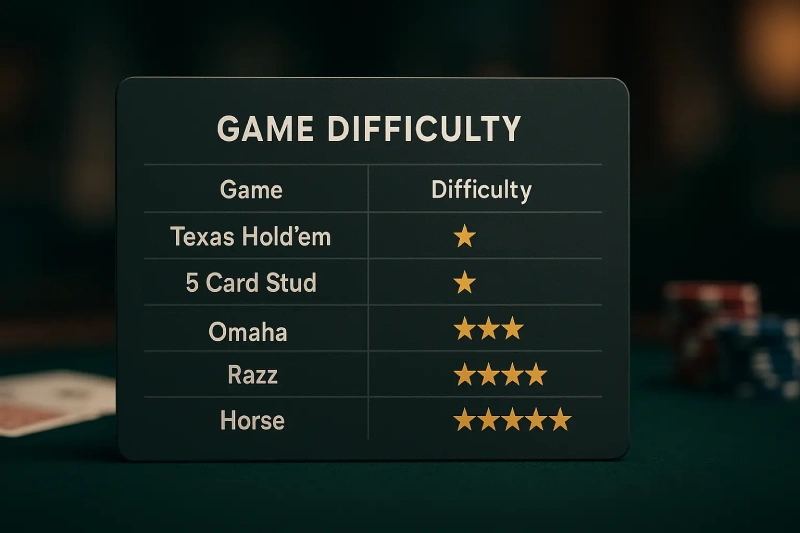
Finding the right poker game for your skill level can mean the difference between building confidence and losing your bankroll. When you pick games that match your abilities, you create a foundation for steady improvement and long-term profit. Honest self-assessment is your foundation; without it, you'll either waste time in games that are too easy or lose money in games beyond your current abilities. Learn a framework for matching poker formats with your skills, bankroll, and goals. Discover how to transition from beginner-friendly options to more complex games.
Poker skills naturally progress through distinct stages: beginners focus on learning the rules and hand rankings, intermediate players develop strategic concepts such as pot odds and positional awareness. The competencies that truly define your level are hand reading, bet sizing, emotional control, and mathematical fundamentals. The following games will help you develop gradually, while still providing fun and exciting gameplay.
Learning how to play No-Limit Texas Hold'em cash games at micro-stakes offers the ideal starting point for beginners, as they combine simple rules with abundant learning resources and flexible session structures. With stakes ranging from $0.01/$0.02 to $0.05/$0.10, you can practice fundamental concepts like position play and pot odds without significant financial pressure.
Maintaining a bankroll of at least 20 buy-ins ensures you can weather natural variance. Unlike tournaments, cash games offer lower variance and a more direct connection between skill development and profit, making them perfect for building the disciplined bankroll management habits that distinguish intermediate and advanced players.
If traditional No-Limit Hold'em cash games feel overwhelming at first, you have several gentler entry points into poker. Learning Five Card Stud or Texas Hold'em simplifies the decision-making process. The former through simple betting rounds, the latter by capping bet sizes to reduce variance.
Low-stakes Sit & Go tournaments offer another accessible path with their fixed buy-ins and condensed time frames, while play money games let you learn basic mechanics risk-free (just remember that players tend to behave unrealistically when nothing's at stake).
For intermediate players ready to expand beyond Texas Hold'em, selecting the right poker variant will be important for skill development and bankroll growth. The games below challenge you to think beyond made-hand strength while building the strategic depth needed for advanced play.
Learning how to play Pot-Limit Omaha gives intermediate players the ability to think in terms of equity distribution and drawing potential rather than relying on made-hand strength alone. The four-card format creates closer pre-flop equities (even premium hands win only 60% versus strong opponents) and forces you to evaluate multiple draws simultaneously, building the combinatorial thinking that separates good players from great ones.
The pot-limit structure prevents simple all-in shortcuts and rewards calculating pot odds across multiple streets, while the game's widespread availability at every major site means you'll always find action at your skill level. Most importantly, PLO's higher variance teaches proper bankroll management and emotional discipline under pressure, skills that transfer directly to every other poker format you'll play.
Multi-Table Tournaments present a different challenge entirely, requiring you to navigate changing blind levels, understand stack-to-blind dynamics, and master bubble play. Start with smaller buy-ins to keep variance manageable.
For cash game players looking to sharpen their skills, 6-Max tables demand more aggressive play and wider ranges, while Zoom and Fast-Fold formats accelerate your learning curve by exposing you to hundreds more hands per session against constantly rotating opponents.
The biggest mistake intermediate players make is moving up in stakes before they're truly ready. Many fall into the trap of learning flashy advanced plays while their fundamentals remain shaky, or they fail to recognize that each format and stake level demands different strategic adjustments. To avoid these pitfalls, commit to studying regularly through forums and strategy content, stay humble about short-term wins, and remember that mental game discipline is just as important as technical skill.
Some poker formats require years of experience, strong math skills, and large bankrolls. If you try them too early, you'll lose money quickly and slow down your progress. These games are tough because you face much better players and deal with big swings that can wipe out your bankroll if you're not ready. Here are the top examples:
At higher stakes, you'll face regulars who've played millions of hands and use advanced strategies to exploit weaknesses. The mix of skilled opponents and large buy-ins creates swings that can wreck your bankroll.
These formats rotate through multiple poker variants (Razz, Stud Hi-Lo, Limit Omaha Hi-Lo) with different strategies for each. You need to be good at at least five different games, which makes this expert-only territory.
Beyond the money you need, these events involve complex ICM considerations and opponents who exploit specific player types. You need a lot of tournament experience to overcome the rake and variance.
Systematic skill development separates successful players from those who plateau early. Commit to studying regularly through forums and strategy content, stay humble about short-term wins, and remember that mental game discipline matters just as much as technical skill.
A balanced study routine should dedicate most of your time to analyzing challenging hands with tracking software and consuming quality strategy content, while reserving smaller blocks for mental game development and discussions with other players. The tools of the trade are tracking software, training sites, equity calculators, and bankroll spreadsheets. Remember that consistency trumps intensity: you'll progress faster with daily 30-minute sessions than sporadic study marathons.
In the first few months, focus on mastering basic strategy for your chosen format while establishing solid bankroll habits. aim to complete your target hand volume and achieve consistent win rates. As you progress over the next 6-12 months, you'll be ready to move up in stakes, potentially explore a second poker variant, and develop advanced skills like range construction while connecting with other serious players.
Long-term success means maintaining steady profits at your target stakes, periodically reassessing whether poker aligns with your broader financial goals, and most importantly, preserving your genuine enjoyment of the game even as variance creates inevitable plateaus in your development.
The path to poker success starts with No-Limit Texas Hold'em cash games at micro-stakes, where you can build fundamental skills without risking significant money. Your growth depends on three interconnected habits: honestly assessing your current abilities, managing your bankroll with discipline, and progressing to tougher games only after proving consistent results. Explore poker strategy concepts to accelerate your journey from beginner to winning player.
Starting with just $100 is a smart and practical way to explore poker games for every bankroll. With the right


I started playing poker over a decade and a half ago when my brother taught me the basics in an
Chat in poker tournaments creates a strategic dynamic that directly impacts player performance and tournament outcomes. Most online poker platforms





Comments