


Using HUDs In Online Poker
HUD is a software overlay that displays real-time statistics about your opponents directly on your poker table window. Their use


ICM vs Chip EV: Understanding the Key Differences in Tournament Poker
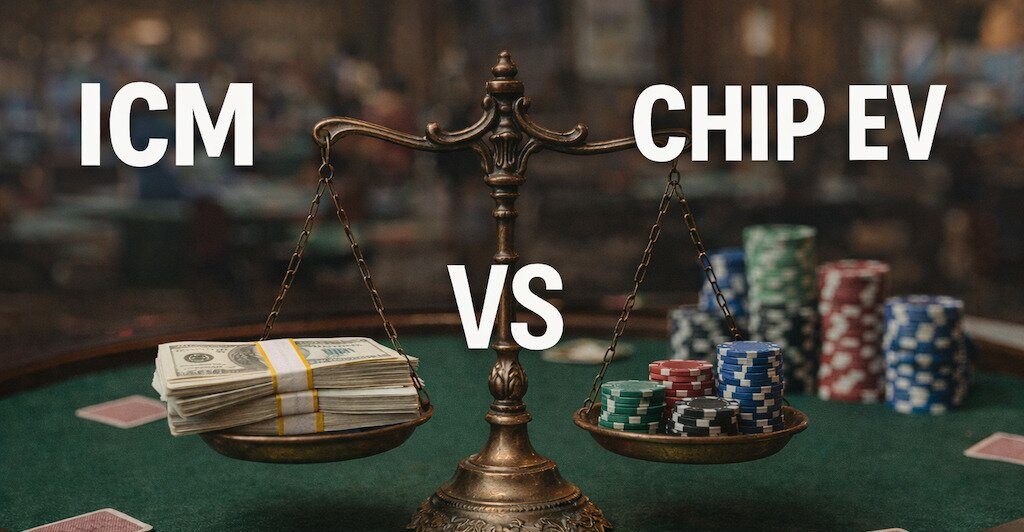
Tournament poker strategy becomes much more complex when you understand the differences between ICM (Independent Chip Model) and Chip EV (Expected Value). While most players are familiar with these concepts on a basic level, the detailed applications during bubble play and final table situations reveal important strategic differences that distinguish top tournament players from the rest of the field. Discover the math behind both approaches, learn how to exploit opponents who misapply them, and find the hybrid strategies that define modern tournament play.
Chip EV and ICM represent two fundamentally different methods for evaluating tournament decisions. Each model serves specific purposes depending on your tournament stage and the payout structure you're facing. The distinctions between Chip EV and ICM affect every major tournament decision you'll face. This comparison shows how each model approaches different aspects of tournament play:
| Aspect | Chip EV | ICM |
|---|---|---|
| Focus | Accumulating chips | Maximizing real money value |
| Application | Early stages, cash games | Late stages, bubble situations, final tables |
| Risk Assessment | Ignores payout structures | Incorporates payout structures and stack sizes |
| Decision Impact | Purely chip-based decisions | Real money considerations, especially near pay jumps |
| Flexibility | Less flexible, consistent chip value | Highly flexible, varies with payout structure and player stacks |
This model uses probability-based calculations to determine your chances of finishing in each paying position based on current chip distributions and stack sizes. This mathematical approach incorporates the diminishing returns principle, where each additional chip becomes progressively less valuable as your stack grows, since doubling your stack doesn't double your tournament equity.
Risk premium adjustments automatically account for increased elimination risk, making survival more valuable than pure chip accumulation as payouts approach. Learn how your ICM value changes based not just on your chips, but on how those chips compare to every other player's stack at the table.
Knowing when to apply Chip EV versus ICM thinking can dramatically affect your tournament results. The transition between these approaches often determines whether you maximize your long-term profitability or leave money on the table.
During early tournament play, Chip EV dominates your decision-making process. The primary goal involves accumulating chips without immediate pressure from payout structures, since you're still far from the money, and elimination doesn't carry the same financial consequences.
This environment allows for loose aggression to build a stack without worrying about ICM implications or survival concerns. Mastering effective bluffing techniques becomes more effective as players are less concerned about busting early in the tournament, while speculative hands like suited connectors can be profitable due to the potential for large pots and stack building.
As tournaments progress toward the money and final table, ICM becomes the dominant factor in your strategy. The focus shifts dramatically toward preserving your stack and making decisions that maximize monetary value rather than chip accumulation.
Learning proven bubble play strategies requires avoiding risky plays that could lead to elimination just before reaching the money, while final table dynamics demand adjusting strategies to account for significant pay jumps and relative stack sizes among remaining players. Short stack strategy involves making calculated moves to survive while exploiting larger stacks' increased caution due to ICM pressure.
Recognizing when to switch between Chip EV and ICM thinking separates good players from great ones. These transition points typically occur near the bubble, approaching final tables, or when significant pay jumps create meaningful differences in tournament equity.
Tournament dynamics create unique situations where understanding ICM pressure allows skilled players to exploit opponents who either ignore these concepts or apply them incorrectly. The psychological and strategic implications extend far beyond simple math calculations, creating profitable opportunities for those who recognize when opponents play too conservatively or aggressively for their stack size.
Big stack bullying allows large stacks to apply maximum pressure on medium stacks who play too tight due to ICM considerations, stealing blinds and antes with wider ranges. Short-stack desperation creates situations where players with critically short stacks often push too wide or too narrow, creating calling opportunities for those who understand proper ICM calling ranges. Medium stack paralysis frequently causes mid-sized stacks to become overly passive near pay jumps, allowing aggressive players to accumulate chips through well-timed steals and re-steals. Learn effective fish-spotting techniques to recognize when opponents play either too tight or too loose for bubble conditions so you can adjust your strategy for maximum profit.
Making strategic adjustments based on Chip EV and ICM considerations requires understanding how different tournament situations affect optimal play. Your approach must adapt constantly as stack sizes change and payout implications shift throughout the tournament.
Understanding how to modify your hand ranges according to ICM and Chip EV is important for tournament success. In ICM-heavy situations, you'll typically tighten your range to avoid unnecessary risks that could jeopardize your tournament life.
Different stack sizes require completely different strategies based on ICM implications and your relative position in the tournament. Your approach must account for both your absolute chip count and how it compares to other players at your table. Short stacks must focus on survival and picking optimal spots to double up while avoiding marginal situations that could end your tournament.
Medium stacks need to balance aggression with caution, leveraging ICM considerations to exploit both shorter and larger stacks when opportunities arise. Big stacks should apply pressure on shorter stacks while exploiting their ICM concerns, but avoid unnecessary confrontations with other large stacks.
Modern tournament strategy increasingly recognizes that pure ICM and pure Chip EV approaches both have limitations. This has led to hybrid models that account for skill edges and future game considerations, helping bridge the gap between theoretical ICM calculations and real-world tournament dynamics where player skill, position, and future betting rounds all influence optimal decisions.
Future game simulation involves advanced players considering not just current ICM values but how their decisions affect future betting opportunities and stack playability in subsequent hands. Skill edge adjustments recognize that when you have a significant skill advantage over opponents, taking slightly negative ICM spots can be profitable long-term if they preserve your ability to outplay weaker players.
Risk-reward calibration helps successful players learn to balance ICM considerations with the potential upside of building a commanding chip lead that allows for future exploitation. Adopt proven variance management strategies that move beyond viewing ICM as static, with expert players adjusting their ICM calculations based on opponent tendencies, table dynamics, and changing tournament conditions.
Tournament players frequently make costly errors by misapplying ICM and Chip EV concepts or failing to recognize when each model should guide their decisions. Understanding these common pitfalls helps you avoid expensive mistakes that can significantly impact your long-term tournament profitability.
Using the right tools and resources can significantly enhance your understanding and application of ICM and Chip EV concepts. These resources help you practice scenarios, analyze hands, and develop better tournament instincts through repetition and study.
Several popular ICM calculators can help you analyze tournament situations and improve your understanding of these concepts. ICMIZER offers detailed analysis and scenario simulations with comprehensive training features, while HoldemResources Calculator provides thorough ICM calculations and specialized training tools for tournament situations. PokerStove serves as a versatile tool for calculating hand equity and basic ICM scenarios across different tournament stages.
Enhance your tournament skills with recommended learning resources that focus specifically on ICM and advanced tournament strategy. Explore comprehensive tournament strategies offer comprehensive courses on ICM and tournament strategy, while books such as "The Mathematics of Poker" provide in-depth insights into ICM calculations and Chip EV applications. Online forums like Two Plus Two allow you to engage with communities for ongoing discussions and strategic advice from experienced players.
Understanding the differences between ICM and Chip EV can transform your tournament results. By applying these concepts strategically, you can make more informed decisions that improve your chances of success. Regular practice with the tools and resources available will help you continuously refine your approach and develop better tournament instincts. Start implementing these strategies in your next tournament, and you'll begin to see improvements in your decision-making and overall results.
HUD is a software overlay that displays real-time statistics about your opponents directly on your poker table window. Their use
Your bankroll management for Tournament poker is significantly different from that for cash games. The ups and downs are bigger,
Starting with just $100 is a smart and practical way to explore poker games for every bankroll. With the right








Comments