

As the 2026 Oscars approach, early frontrunners are already building momentum. But history shows that not every awards-season favorite will win over audiences with the same certainty.
That’s the idea behind an Oscar Bluff: when a film’s prestige starts running ahead of how people actually feel about it — like a poker bluff that looks convincing until the cards are on the table.
To track that disconnect, we created a Prestige Gap Index, which compares how strongly a film performs with the Academy versus its wider reception. Looking back at the awards-season heavyweights from 2014 to 2025, we break down the biggest prestige gaps and pull out the warning signs that a 2026 frontrunner might be heading for a fall-flat moment of its own.
Key Findings
- Early 2026 “divide” watch: Hamnet (8 noms, 82), Frankenstein (9 noms, 81), and F1 (4 noms, 77) sit in the 80s or lower audience reception range where divides historically form.
- Emilia Perez - the #1 ranked “bluff” scored a perfect 100 on the Prestige Gap Index - the largest awards vs reception gap of the decade.
- 4 of the Top 10 most divisive films won Best Picture, showing that major Academy success doesn’t always translate to audience approval.
- The average reception score among the Top 10 was 66.5/100
- Historical dramas made up 40% of the biggest “bluffs”, suggesting prestige period pieces are most likely to divide voters and general audiences.
The 2026 Oscar Nominations Showing Early Signs of a Divide
Three 2026 Oscar contenders already sit in the historical range where prestige gaps tend to form — high nomination totals paired with reception scores in the low 80s or below. As awards season ramps up, more eyes usually means more ratings. Once nominations and wins push these films to wider audiences, review volume tends to climb, and that’s when an Oscar Bluff becomes easier to spot. This year, the early signs are showing up around Hamnet, Frankenstein, and F1.
Hamnet: 8 nominations | Reception Score: 82 (126 minutes)
With double-digit nominations and strong critic scores, Hamnet is firmly in the Academy’s lane. However, its audience reception sits in the low 80s, below the 90+ territory typical of true crowd favorites. Historically, that combination is where prestige gaps start to form.
Even among viewers who respect the craft, a recurring audience critique is that the film asks for patience before it pays off. One Letterboxd viewer wrote the “first 5/6th of this movie was… unbelievably boring,” adding that “it was a little too slow for me.”
Frankenstein — 9 nominations | Reception Score: 81 (150 minutes)
With nine nominations, Frankenstein has clear institutional momentum, but its audience ratings sit just above 80. a range that typically produces voter–audience splits.
The audience pushback is also quite direct. Letterboxd reviewers repeatedly flag runtime, pacing, and emotional flatness, calling it “boring and artificial” and saying it “feels like it was directed by a machine.” Others reduce it to the basics — “TOO LONG. TOO BORING.” As more people watch and reviews stack up, Frankenstein looks like a prime Oscar Bluff candidate.
F1 — 4 nominations | Reception Score: 77 (155 minutes)
While earning fewer nominations, F1 posts the lowest Reception Score among major 2026 contenders at 77. Even some negative reviews nod to the craft. As one IMDb reviewer put it: “Great cinematography…” before adding that it’s a “frivolous story.” Audience criticism then hits what happens between the set pieces. Another IMDb reviewer wrote: “If you are a fan of actual Formula One, the story is beyond ridiculous. Not one part of it makes any sense, it’s all style and not much substance.” Other viewers hit similar notes, calling it “too long,” “kind of boring,” and “generic and unoriginal.”
That mix of technical praise alongside story and runtime complaints is exactly the kind of profile that can widen into a bigger prestige gap if guild wins or late momentum push F1 further into the awards conversation.
The Biggest Oscar Bluffs of the Last Decade
These rankings use our Prestige Gap Index. We score each film’s awards momentum (Oscars plus major precursor wins) and compare it with its overall reception across Rotten Tomatoes, Metacritic, IMDb, and Letterboxd. The larger the gap, the higher the film ranks.
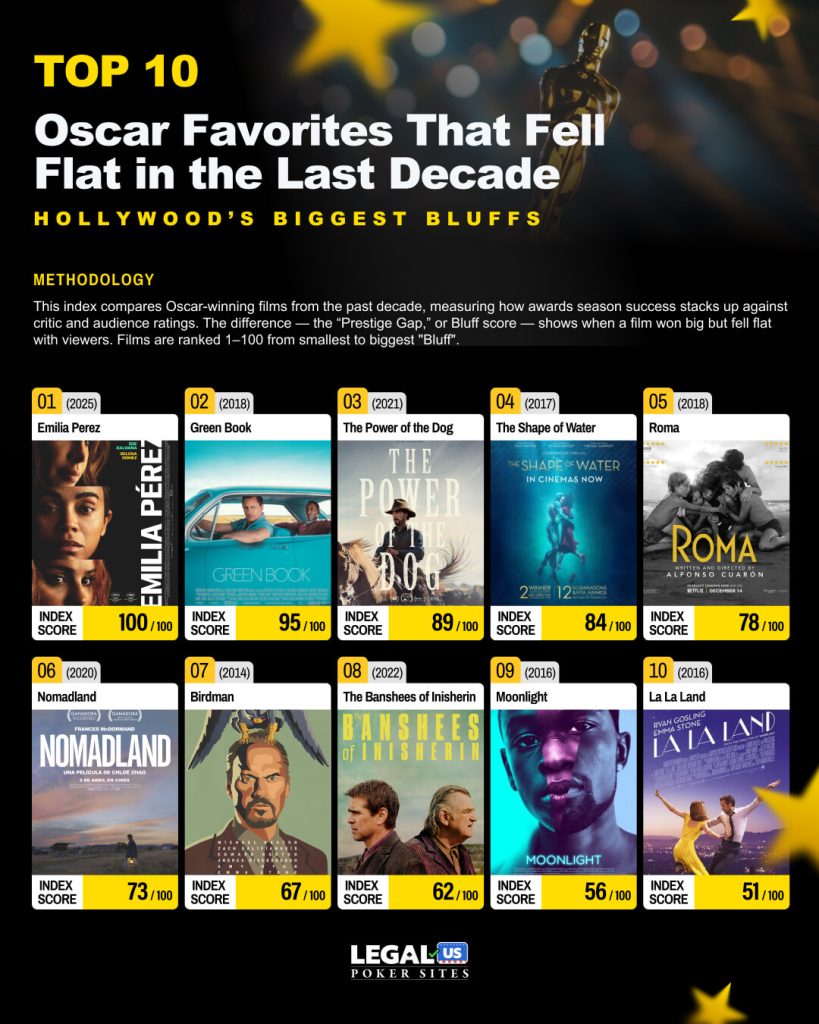
#1 Emilia Perez - Prestige Gap Index 32.Score: 100/100 🎬
Emilia Pérez (2024) entered awards season as a major contender, earning 13 Academy Award nominations and winning 2 Oscars, including Best Actress and Best Original Score. It also performed strongly across the broader awards circuit, building significant institutional momentum. On the industry circuit, it looked like a confident all-in move.
Audience reaction, however, was far more muted. The film holds a 70% audience score on Rotten Tomatoes and just 5.3/10 on IMDb — translating to an overall audience reception score of 49 in our analysis. That stark contrast between awards success and viewer sentiment produced the largest prestige–reception gap of the decade, earning it a perfect 100/100 on our Prestige Gap Index.
While critics and Academy voters praised its bold structure and technical ambition, many audience reviews were far more divided — questioning the film’s emotional authenticity and handling of its central themes. Online, the reaction went further. Clips and musical moments circulated widely, sparking memes, parody videos, and ironic commentary during awards season. What began as a prestige frontrunner increasingly became a cultural talking point.
#2 Green Book - Prestige Gap Index Score: 95/100 🎬
Green Book (2018) also showed strong traction throughout awards seasons. So much so that it landed Best Picture, which was avidly supported by other major wins across the scene. Its traditional storytelling and historical backdrop aligned closely with Academy voting patterns.
Critically, however, enthusiasm was more measured. The film posted a 77% Rotten Tomatoes critic score and a 69 on Metacritic — the latter marking its lowest major review-platform score. While audience ratings were stronger (91% on Rotten Tomatoes and 8.2/10 on IMDb), its combined reception score still fell well short of its awards-weighted dominance in our model. This imbalance created one of the decade’s clearest prestige gaps, earning Green Book a Bluff Index score of 95.
Marketed as a powerful drama with plenty of interest behind it, Green Book was fired up to be a sure favorite. But the film’s narrative didn't quite meet the mark for the majority of the audience.
#3 The Power of the Dog - Prestige Gap Index Score: 89/100 🎬
Jan Campion’s 2021 western drama was a critical heavyweight, collecting 12 Oscar nominations and 8 other prestigious accolades. It delivered on an austere tone and deliberate pacing aligned closely with director-driven prestige signals, placing it firmly in the Academy’s lane.
Critics responded strongly, with a 94% Rotten Tomatoes score and an 89 on Metacritic, contributing to a high aggregated critic score of 92 in our model. Audience reaction, however, was notably cooler: 65% on Rotten Tomatoes and 6.8/10 on IMDb, producing an aggregated audience score of just 68.
#4 The Shape of Water – Prestige Gap Index Score 84/100 🎬
Guillermo del Toro’s 2017 fantasy romance made a serious impression in awards circles. Celebrated for its meticulous production design, it also won three Oscars for: Best Director, Best Original Score, and Best Picture.
Critics were enthusiastic, with a 92% Rotten Tomatoes score and an 87 on Metacritic, but audience reaction was more tempered — landing at 72% on Rotten Tomatoes and 7.3/10 on IMDb. That softer viewer response created a notable spread between prestige and public sentiment, placing it at 84 on our Prestige Gap Index.
The film’s unconventional romance and quieter emotional register drew admiration from the critics, which spurred it towards Academy recognition, yet proved more divisive among general viewers. The relationship between an Amphibious creature and mute woman may not have been as believable as intended by producers.
#5 Roma - Prestige Gap Index Score 78/100 🎬
Alfonso Cuarón’s Roma (2018) was one of the most critically acclaimed films of its year, earning three Oscars from 10 nominations. Shot in black and white and praised for its meticulous direction and visual precision, it posted near-unanimous critical approval — 96% on Rotten Tomatoes and 96 on Metacritic.
Audience response, while still positive, was noticeably more reserved. The film holds 72% on Rotten Tomatoes and 7.7/10 on IMDb, contributing to an aggregated audience score of 76 in our model. That difference between near-perfect critical acclaim and more moderate viewer ratings pushed it to 78 on the Prestige Gap Index.
Part of that divide may lie in how the film was experienced. Critics and Academy voters championed its scale, technical detail, and theatrical craftsmanship, but many viewers encountered it via streaming following Netflix’s limited cinema release. For some, the quiet pacing and observational style felt meditative; for others, it felt distant — creating a measurable, if not dramatic, prestige-to-audience gap.
Why Do Oscar Voters and Audiences Disagree?
Looking across the Top 5 films on the Prestige Gap Index, a few common threads emerge. While each film is distinct, several shared traits stand out:
- All 5 are drama-led films centered on serious themes and character-driven storytelling.
- All 5 run over two hours, with an average runtime of roughly 2 hours and 11 minutes — reinforcing a strong tilt toward prestige-length narratives.
- 2 of the 5 won Best Picture (Green Book and The Shape of Water), showing that even the Academy’s top honor doesn’t always mirror audience intensity.
- 3 of the 5 lean heavily on slow-burn pacing or restrained storytelling (Roma, The Power of the Dog, and Emilia Perez).
- 2 of the 5 were platform-backed releases (Roma and The Power of the Dog), potentially shaping how audiences experienced them.
Taken together, the Top 5 suggest that the widest prestige gaps tend to form around long, director-driven films that prioritize craft, character study, and serious themes over spectacle — qualities that resonate strongly with awards voters, even when audience enthusiasm is more measured.
Method: How we Found Oscar Bluffs
To identify the biggest Oscar “bluffs,” we used a three-part scoring model. First, we calculated an Awards Score to capture how dominant a film was across the Oscars and major precursor wins. Next, we built a Reception Score from normalized critic and audience ratings. Finally, we measured the gap between the two to produce our Prestige Gap Index, ranking the films where awards momentum most clearly outpaced public response.
- Awards Score: Films received weighted points for Oscar nominations and wins, with additional weight given to Best Picture and major wins at the Golden Globes, BAFTAs, and Critics Choice Awards. Scores were scaled to a 100-point system for fair comparison.
- Reception Score: All critics and audience ratings were normalized to 100.
- Critics: Rotten Tomatoes + Metacritic
- Audience: Rotten Tomatoes, IMDb + Letterboxd
- Prestige Gap Index: We calculated the difference between Awards Score and Reception Score.The larger the gap, the higher the film ranks on the Index (1–100).
Calling the Oscar Bluff
The clearest pattern when identifying an Oscar Bluff is a recurring split between industry taste and audience emotional response. Technically ambitious dramas and message-driven films often rank higher with Academy voters, while deep, emotionally, and thought-provoking titles, with a clear easy-to-grasp narrative, resonate more strongly with viewers. When those priorities move in different directions, the gap naturally widens, and that’s where an Oscar Bluff tends to reveal itself most clearly.