

As the 2026 Oscars approach, early frontrunners are already building momentum. But history shows that not every awards-season favorite will win over audiences with the same certainty. An Oscar Bluff is the moment prestige outpaces perception — much like a calculated poker bluff, where confidence can temporarily overshadow the underlying hand.
Our Prestige Gap Index measures this divide, tracking the ratio between Academy scores and overall reception. Looking back at Oscar favorites that swept award season from 2014 to 2025, our index identifies the films that aligned with both industry acclaim and audience support — and those where the gap was impossible to ignore.
Key Findings
- Emilia Perez - the #1 ranked “bluff” scored a perfect 100 on the Prestige Gap Index - the largest awards vs reception gap of the decade.
- 4 of the Top 10 most divisive films won Best Picture, showing that major Academy success doesn’t always translate to audience approval.
- The average reception score among the Top 10 was 66.5/100
- Historical dramas made up 40% of the biggest “bluffs”, suggesting prestige period pieces are most likely to divide voters and general audiences.
So, Which Oscar Favorites Fell Flat?
An Oscar Bluff is when a film racks up major awards but fails to generate the same level of enthusiasm from audiences and critics. It’s the moment prestige outpaces perception. Our Prestige Gap Index measures that divide, ranking the biggest awards-to-reception mismatches from 2014 to 2025.
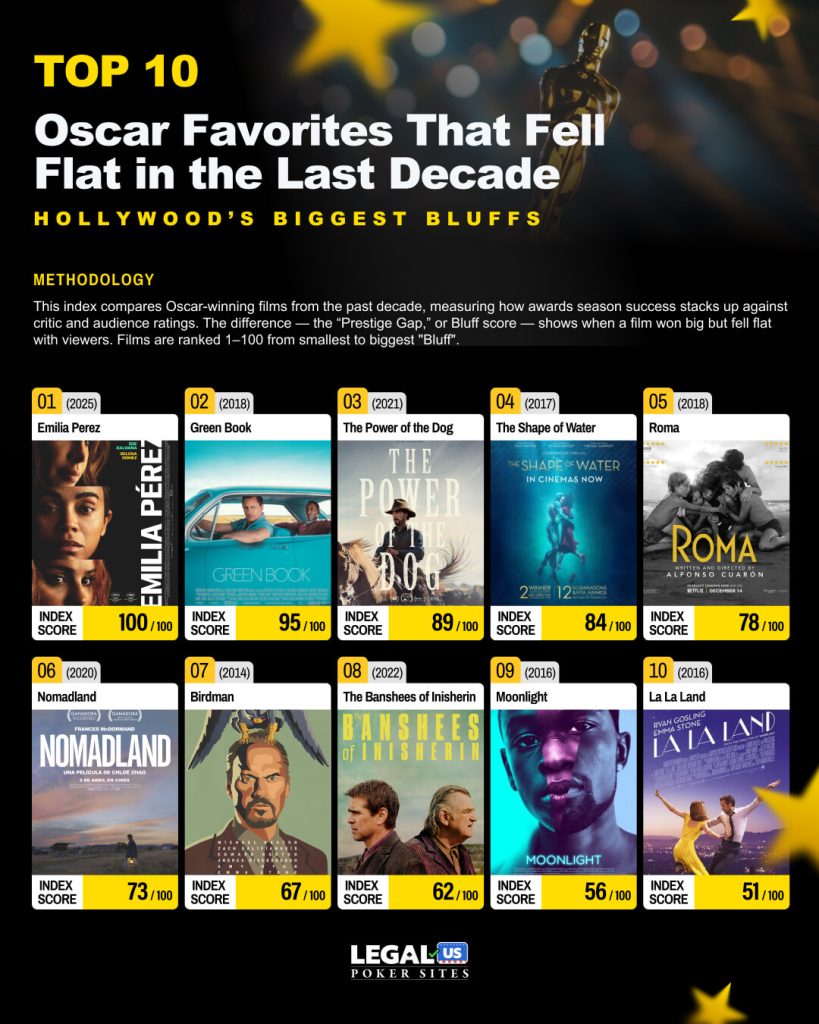
#1 Emilia Perez - Prestige Gap Index Score: 100/100 🎬
Emilia Pérez (2024) entered awards season as a major contender, earning 13 Academy Award nominations and winning 2 Oscars, including Best Actress and Best Original Score. It also performed strongly across the broader awards circuit, building significant institutional momentum. On the industry circuit, it looked like a confident all-in move.
Audience reaction, however, was far more muted. The film holds a 70% audience score on Rotten Tomatoes and just 5.3/10 on IMDb — translating to an overall audience reception score of 49 in our analysis. That stark contrast between awards success and viewer sentiment produced the largest prestige–reception gap of the decade, earning it a perfect 100/100 on our Prestige Gap Index.
While critics and Academy voters praised its bold structure and technical ambition, many audience reviews were far more divided — questioning the film’s emotional authenticity and handling of its central themes. Online, the reaction went further. Clips and musical moments circulated widely, sparking memes, parody videos, and ironic commentary during awards season. What began as a prestige frontrunner increasingly became a cultural talking point.
#2 Green Book - Prestige Gap Index Score: 95/100 🎬
Green Book (2018) also showed strong traction throughout awards seasons. So much so that it landed Best Picture, which was avidly supported by other major wins across the scene. Its traditional storytelling and historical backdrop aligned closely with Academy voting patterns.
Critically, however, enthusiasm was more measured. The film posted a 77% Rotten Tomatoes critic score and a 69 on Metacritic — the latter marking its lowest major review-platform score. While audience ratings were stronger (91% on Rotten Tomatoes and 8.2/10 on IMDb), its combined reception score still fell well short of its awards-weighted dominance in our model. This imbalance created one of the decade’s clearest prestige gaps, earning Green Book a Bluff Index score of 95.
Marketed as a powerful drama with plenty of interest behind it, Green Book was fired up to be a sure favorite. But the film’s narrative didn't quite meet the mark for the majority of the audience.
#3 The Power of the Dog - Prestige Gap Index Score: 89/100 🎬
Jan Campion’s 2021 western drama was a critical heavyweight, collecting 12 Oscar nominations and 8 other prestigious accolades. It delivered on an austere tone and deliberate pacing aligned closely with director-driven prestige signals, placing it firmly in the Academy’s lane.
Critics responded strongly, with a 94% Rotten Tomatoes score and an 89 on Metacritic, contributing to a high aggregated critic score of 92 in our model. Audience reaction, however, was notably cooler: 65% on Rotten Tomatoes and 6.8/10 on IMDb, producing an aggregated audience score of just 68.
#4 The Shape of Water – Prestige Gap Index Score 84/100 🎬
Guillermo del Toro’s 2017 fantasy romance made a serious impression in awards circles. Celebrated for its meticulous production design, it also won three Oscars for: Best Director, Best Original Score, and Best Picture.
Critics were enthusiastic, with a 92% Rotten Tomatoes score and an 87 on Metacritic, but audience reaction was more tempered — landing at 72% on Rotten Tomatoes and 7.3/10 on IMDb. That softer viewer response created a notable spread between prestige and public sentiment, placing it at 84 on our Prestige Gap Index.
The film’s unconventional romance and quieter emotional register drew admiration from the critics, which spurred it towards Academy recognition, yet proved more divisive among general viewers. The relationship between an Amphibious creature and mute woman may not have been as believable as intended by producers.
#5 Roma - Prestige Gap Index Score 78/100 🎬
Alfonso Cuarón’s Roma (2018) was one of the most critically acclaimed films of its year, earning three Oscars from 10 nominations. Shot in black and white and praised for its meticulous direction and visual precision, it posted near-unanimous critical approval — 96% on Rotten Tomatoes and 96 on Metacritic.
Audience response, while still positive, was noticeably more reserved. The film holds 72% on Rotten Tomatoes and 7.7/10 on IMDb, contributing to an aggregated audience score of 76 in our model. That difference between near-perfect critical acclaim and more moderate viewer ratings pushed it to 78 on the Prestige Gap Index.
Part of that divide may lie in how the film was experienced. Critics and Academy voters championed its scale, technical detail, and theatrical craftsmanship, but many viewers encountered it via streaming following Netflix’s limited cinema release. For some, the quiet pacing and observational style felt meditative; for others, it felt distant — creating a measurable, if not dramatic, prestige-to-audience gap.
#6 Nomadland | Prestige Gap Index Score: 73/100 🎬
With 93% on Rotten Tomatoes and a 93 on Metacritic, Nomadland dominated with critics, while its 7.3/10 IMDb rating reflects a more measured audience response.
#7 Birdman | Prestige Gap Index Score: 67/100 🎬
Holding 91% on Rotten Tomatoes and 87 on Metacritic, Birdman thrived with critics, though its 7.7/10 IMDb score shows slightly softer audience enthusiasm.
#8 The Banshees of Inisherin | Prestige Gap Index Score: 62/100 🎬
At 96% on Rotten Tomatoes, critics embraced the film’s sharp writing, while its 7.7/10 IMDb rating suggests audiences were positive but less fervent.
#9 Moonlight | Prestige Gap Index Score: 56/100 🎬
With 98% on Rotten Tomatoes, Moonlight was a critical landmark, though its 7.4/10 IMDb score reflects admiration that was quieter among general audiences.
#10 La La Land | Prestige Gap Index Score: 51/100 🎬
Scoring 91% on Rotten Tomatoes and 8.0/10 on IMDb, La La Land connected broadly, even if its awards momentum slightly outpaced audience intensity.
#11 Poor Things | Prestige Gap Index Score: 45/100 🎬
At 92% on Rotten Tomatoes and 8.0/10 on IMDb, Poor Things impressed both critics and viewers, though its bold style sparked more divided reactions outside review circles.
#12 Boyhood | Prestige Gap Index Score: 40/100 🎬
With 97% on Rotten Tomatoes and 7.9/10 on IMDb, Boyhood earned deep critical praise alongside solid, if less historic, audience approval.
#13 Wicked: Part One | Prestige Gap Index Score: 34/100 🎬
Strong audience ratings and fan enthusiasm kept Wicked more closely aligned between industry buzz and public excitement.
#14 Three Billboards Outside Ebbing, Missouri | Prestige Gap Index Score: 29/100 🎬
A 90% Rotten Tomatoes score and 8.1/10 on IMDb reflect a film that resonated with both critics and audiences, narrowing its prestige gap.
#15 Everything Everywhere All At Once | Prestige Gap Index Score: 23/100 🎬
With 94% on Rotten Tomatoes and 7.8/10 on IMDb, the film matched awards dominance with genuine audience momentum.
#16 Mad Max: Fury Road | Prestige Gap Index Score: 18/100 🎬
At 97% on Rotten Tomatoes and 8.1/10 on IMDb, Fury Road balanced technical acclaim with strong public approval.
#17 Anora | Prestige Gap Index Score: 12/100 🎬
High critic scores and steady audience ratings point to minimal disconnect between festival acclaim and general reception.
#18 Oppenheimer | Prestige Gap Index Score: 7/100 🎬
Earning 93% on Rotten Tomatoes and 8.4/10 on IMDb, Oppenheimer paired awards recognition with massive audience engagement.
#19 Parasite | Prestige Gap Index Score: 1/100 🎬
With 99% on Rotten Tomatoes and 8.5/10 on IMDb, Parasite achieved near-universal alignment between critics and audiences.
Why Do Oscar Voters and Audiences Disagree?
Looking across the Top 5 films on the Prestige Gap Index, a few common threads emerge. While each film is distinct, several shared traits stand out:
- All 5 are drama-led films centered on serious themes and character-driven storytelling.
- All 5 run over two hours, with an average runtime of roughly 2 hours and 11 minutes — reinforcing a strong tilt toward prestige-length narratives.
- 2 of the 5 won Best Picture (Green Book and The Shape of Water), showing that even the Academy’s top honor doesn’t always mirror audience intensity.
- 3 of the 5 lean heavily on slow-burn pacing or restrained storytelling (Roma, The Power of the Dog, and Emilia Perez).
- 2 of the 5 were platform-backed releases (Roma and The Power of the Dog), potentially shaping how audiences experienced them.
Taken together, the Top 5 suggest that the widest prestige gaps tend to form around long, director-driven films that prioritize craft, character study, and serious themes over spectacle — qualities that resonate strongly with awards voters, even when audience enthusiasm is more measured.
Could 2026 Deliver the Next Oscar Bluff?
Early data suggests the strongest bluff potential may not sit with the biggest frontrunners — but with the films where nomination totals are rising faster than audience reception.
In the 2026 field:
- Hamnet has secured 11 nominations, yet currently holds a Reception Score of 82. A strong score, but notably below the 90+ territory typically associated with runaway audience enthusiasm.
- Frankenstein follows a similar pattern, with 8 nominations and a Reception Score of 81, suggesting solid critical traction but more measured public response.
- F1, despite a more modest 4 nominations, posts a Reception Score of 77, the lowest among major contenders — a level that historically correlates with wider prestige gaps if awards momentum accelerates.
By comparison, the current nomination leaders — Sinners (16 nominations, RS 92) and One Battle After Another (13 nominations, RS 90) — show much tighter alignment between institutional support and reception.
Historically, the largest Prestige Gap scores emerge when nomination counts climb while reception scores remain in the low 80s or below. If awards momentum for films like Hamnet or Frankenstein continues to build without a parallel rise in audience reception, 2026 could produce the next measurable Oscar bluff.
Method: How we Found Oscar Bluffs
To identify the biggest Oscar “bluffs,” we measured the gap between awards success and overall reception.
Awards Score
Films received weighted points for Oscar nominations and wins, with additional weight given to Best Picture and major wins at the Golden Globes, BAFTAs, and Critics Choice Awards. Scores were scaled to a 100-point system for fair comparison.
Reception Score
All critics and audience ratings were normalized to 100.
- Critics: Rotten Tomatoes + Metacritic
- Audience: Rotten Tomatoes, IMDb + Letterboxd
Prestige Gap Index
We calculated the difference between Awards Score and Reception Score.
The larger the gap, the higher the film ranks on the Index (1–100).
In short: the Index highlights where awards momentum outpaced audience reaction.
Calling the Oscar Bluff
The clearest pattern when identifying an Oscar Bluff is a recurring split between industry taste and audience emotional response. Technically ambitious dramas and message-driven films often rank higher with Academy voters, while deep, emotionally, and thought-provoking titles, with a clear easy-to-grasp narrative, resonate more strongly with viewers. When those priorities move in different directions, the gap naturally widens, and that’s where an Oscar Bluff tends to reveal itself most clearly.
